
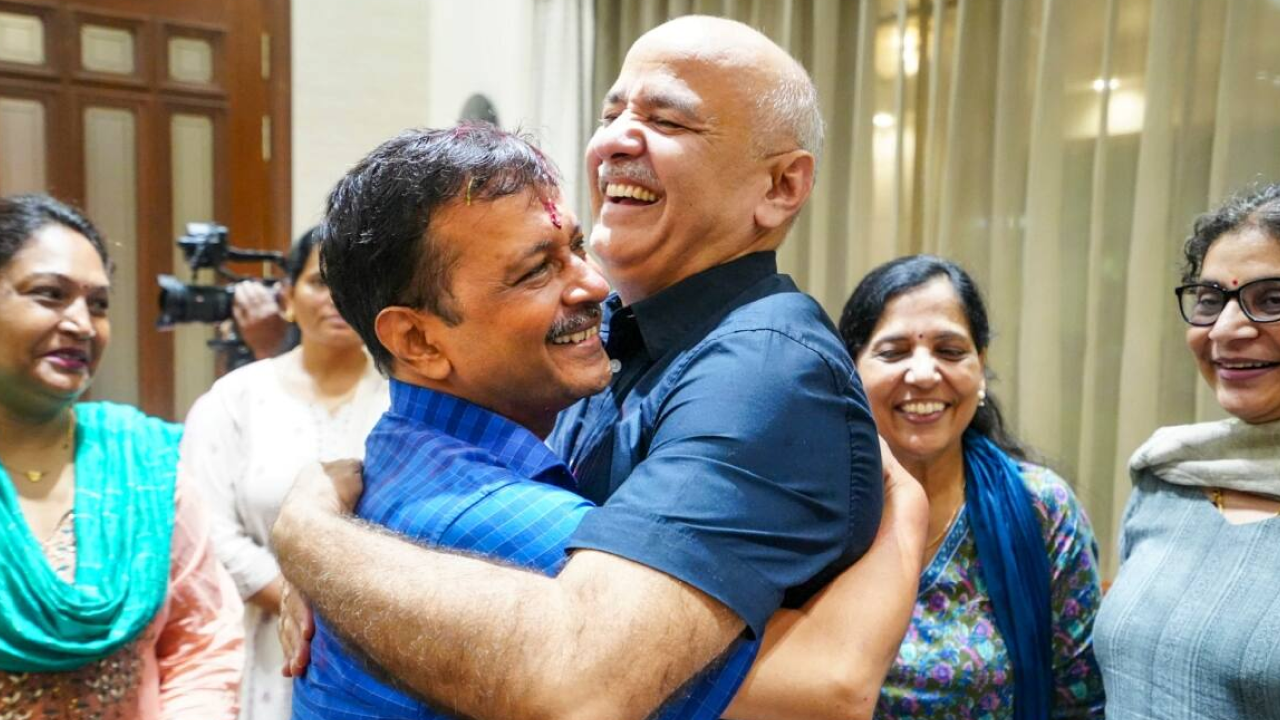
In a sweeping setback to the prosecution, a Delhi court on Friday discharged all 23 accused in the high-profile Delhi Excise Policy case, including former Chief Minister Arvind Kejriwal and former Deputy Chief Minister Manish Sisodia, ruling that the Central Bureau of Investigation (CBI) failed to establish even a prima facie case of criminal conspiracy or corruption.
The order was delivered by Special Judge Jitendra Singh at the Rouse Avenue Court, which refused to take cognisance of the CBI’s chargesheet. The court concluded that the prosecution’s narrative of a larger conspiracy behind the now-scrapped 2021–22 Delhi Excise Policy did not withstand judicial scrutiny, observing that there was no material evidence demonstrating criminal intent.
The ruling effectively brings the CBI’s case registered in 2022 following allegations of policy manipulation and kickbacks to a close at the trial court level, marking a major development in one of the most politically charged investigations in recent years.
Court Finds No Evidence of Conspiracy
In its detailed order, the court rejected the CBI’s contention that a criminal conspiracy had been hatched during the formulation and implementation of the excise policy. The prosecution had alleged that loopholes were deliberately inserted to benefit select liquor licensees and that ₹100 crore in kickbacks had been paid by a so-called “south lobby” to influence policy decisions.
However, the judge held that there was no overarching conspiracy or demonstrable criminal intent. The court noted that the theory of a central conspiratorial role attributed to senior constitutional authorities could not be substantiated on the available record.
The court was also critical of the manner in which the investigation was conducted. It observed that the agency had attempted to construct its case largely on the basis of statements from approvers, warning that such an approach if used to fill gaps in the prosecution’s narrative could amount to a serious violation of constitutional principles.
In a particularly sharp remark, the judge indicated that a departmental inquiry would be recommended against CBI officials for procedural lapses, including the decision to make a public servant the primary accused in the case.
Background of the Case
The case originated in July 2022 after Delhi Lieutenant Governor V K Saxena recommended a CBI probe into alleged irregularities in the 2021–22 excise policy introduced by the Aam Aadmi Party (AAP) government.
The CBI subsequently registered a First Information Report alleging that the policy was manipulated to enable cartelisation and monopolisation in the liquor trade. The agency claimed that policy changes favoured specific entities and that kickbacks were routed to political leaders.
In addition to the CBI probe, the Enforcement Directorate initiated a parallel investigation under the Prevention of Money Laundering Act (PMLA), leading to multiple arrests.
Over time, 23 individuals were chargesheeted, including political leaders, bureaucrats, and businesspersons. Among them were Kejriwal, Sisodia, Telangana Jagruthi president K Kavitha, and several alleged intermediaries and liquor traders.
Kejriwal’s name appeared in a fourth supplementary chargesheet filed by the CBI, after not being included in the original chargesheet or the first three supplementary filings. His counsel argued that the later inclusion merely reiterated earlier allegations without introducing substantive new evidence.
Both Kejriwal and Sisodia spent months in custody after lower courts denied them bail. Relief eventually came from the Supreme Court, allowing them to walk free pending proceedings.
Earlier this year, a separate Delhi court had also acquitted Kejriwal in two cases filed by the Enforcement Directorate related to non-compliance with summons in the same matter.
What Happens Next
While the discharge order marks a significant legal victory for the accused, the CBI retains the option of challenging the ruling before a higher court. Appeals in such high-profile matters are common, especially where broader questions of public policy and alleged corruption are involved.
Legal experts note that the court’s refusal to take cognisance of the chargesheet sets a high bar for any further proceedings. If the prosecution decides to appeal, it will need to demonstrate substantial legal or evidentiary errors in the trial court’s assessment.
For now, the discharge order halts the possibility of a full-fledged criminal trial in the case at the trial court level.
Political and Institutional Impact
The case has had deep political ramifications since its inception. Opposition parties repeatedly described the arrests as politically motivated, while central agencies maintained that their actions were evidence-driven.
Friday’s ruling is likely to intensify political debate over the use of investigative agencies in cases involving elected officials. The court’s observations regarding the reliance on approver statements and its proposed departmental inquiry into investigative conduct could fuel broader scrutiny of how complex conspiracy cases are built.
For the Aam Aadmi Party, the judgment offers significant political vindication ahead of future electoral contests. Shortly after the verdict, Sunita Kejriwal, wife of the former chief minister, publicly welcomed the ruling, stating that truth ultimately prevails.
Timeline of Events
- July 2022: CBI registers FIR following recommendation by the Delhi Lieutenant Governor.
- 2022–2023: Multiple arrests made, original and supplementary chargesheets filed.
- Subsequent Months: Bail denied by trial court and Delhi High Court, later relief granted by Supreme Court.
- January 2025 (earlier this year): Kejriwal acquitted in two ED-linked summons cases.
- Friday 27 Feb 2025 (latest development): Rouse Avenue Court discharges all 23 accused and rejects CBI chargesheet.
Why This Matters
The discharge of all accused in the Delhi Excise Policy case represents more than a procedural development. It directly addresses questions about prosecutorial standards in corruption investigations involving senior public officials.
By ruling that the allegations failed judicial scrutiny at the threshold stage, the court has underscored the requirement for concrete, legally admissible evidence before a criminal trial can proceed particularly in cases alleging large-scale conspiracies within government.
The broader implications may extend to ongoing and future investigations involving public policy decisions, reinforcing judicial oversight at the pre-trial stage.
For now, one of India’s most closely watched corruption probes stands effectively closed at the trial court level pending any appeal.