
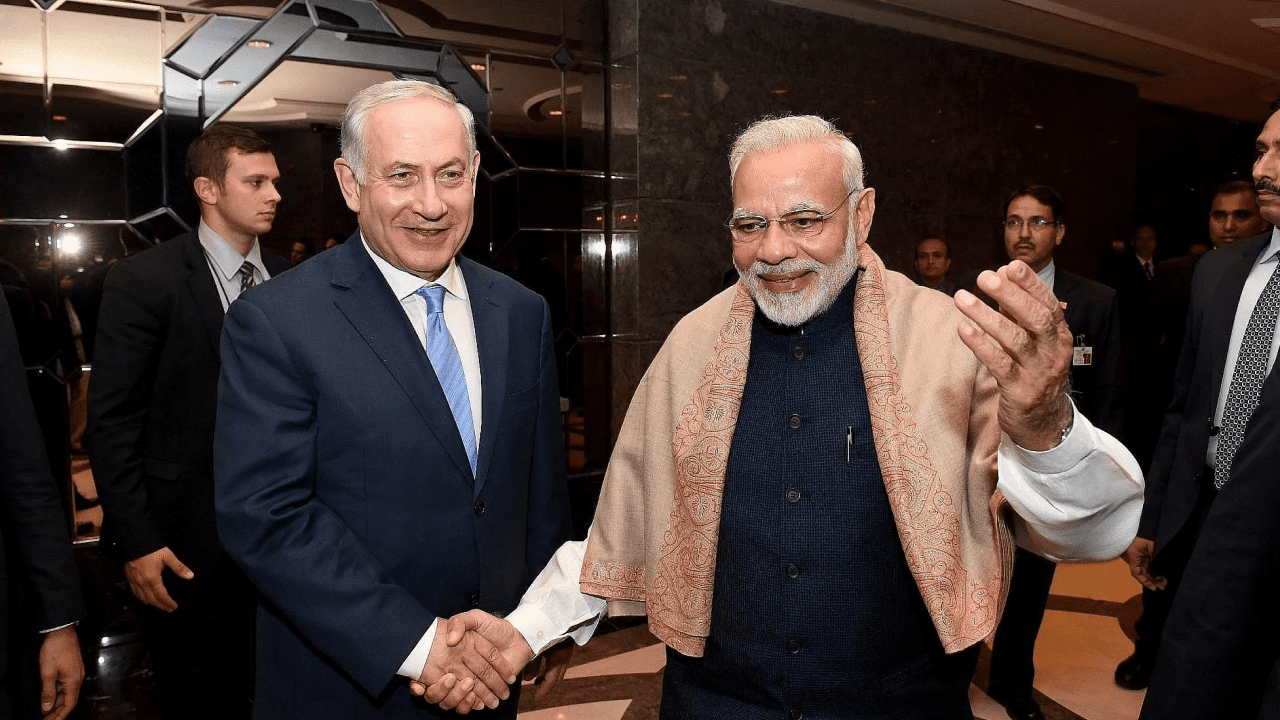
Modi Israel visit underscores India’s deepening strategic partnership with Israel at a time of heightened tensions between the United States and Iran. As Prime Minister Narendra Modi arrived at Ben Gurion International Airport in Tel Aviv, New Delhi and Jerusalem prepared to elevate bilateral ties through a new security memorandum of understanding (MoU) focused on defence co-development and technology collaboration.
The visit carries geopolitical weight beyond bilateral engagement. With West Asia navigating fresh instability linked to US-Iran friction, India’s outreach to Israel signals continuity in its strategic partnerships while reinforcing its commitment to counterterrorism and regional economic cooperation.
Also read: India-US Interim Trade Deal Set for March Signing, Operational by April: Goyal
Defence Cooperation Anchored in History
India-Israel defence ties have evolved steadily over the past three decades, marked by operational cooperation and technology transfers that have strengthened India’s military capabilities.
During the 1999 Kargil War, the Indian Air Force deployed Israeli Litening targeting pods mounted on Mirage-2000 aircraft to strike Pakistani positions in the Drass and Batalik sectors. The precision strikes using laser-guided bombs significantly altered the battlefield dynamics and are widely regarded as a turning point in the conflict.
Since then, Israeli-origin systems have featured prominently in India’s military operations. From precision-guided munitions to advanced surveillance platforms, cooperation has expanded across air, land and intelligence domains. Israeli drones including the Searcher and Heron series have enhanced India’s reconnaissance capabilities along sensitive borders.
New Security MoU to Boost Co-Development
During this visit, India and Israel are set to sign a security MoU aimed at fostering joint development and production of advanced weapon systems in India. The agreement is expected to deepen collaboration between Indian and Israeli defence industries, with a strong emphasis on technology sharing under strict confidentiality frameworks.
The move aligns with India’s broader push for indigenous defence manufacturing while leveraging Israel’s expertise in high-end military technology. Officials view the agreement as a step toward elevating the bilateral partnership to a new strategic level.
Strategic Convergence in West Asia
A defining feature of India-Israel relations has been the personal rapport between Prime Minister Modi and Israeli Prime Minister Benjamin Netanyahu. Their diplomatic engagement has translated into stronger institutional cooperation across defence, agriculture, technology and trade.
India’s growing ties with Israel also intersect with its expanding relationship with the United Arab Emirates. All three countries share concerns over terrorism and radicalization, and have found common ground in promoting stability and economic integration in the region.
Together, India, Israel and the UAE are key stakeholders in the proposed India-Middle East Economic Corridor, envisioned as a modern connectivity and trade corridor linking South Asia with Europe through West Asia.
A Geopolitical Signal
Modi’s second visit to Israel comes at a delicate geopolitical moment. With tensions between Washington and Tehran once again on the rise, India’s engagement with Israel is being closely watched as a statement of strategic intent.
While New Delhi continues to balance its relationships across the region, the visit reinforces a consistent message: India stands by its strategic partners and seeks deeper cooperation rooted in trust, technology and shared security concerns.