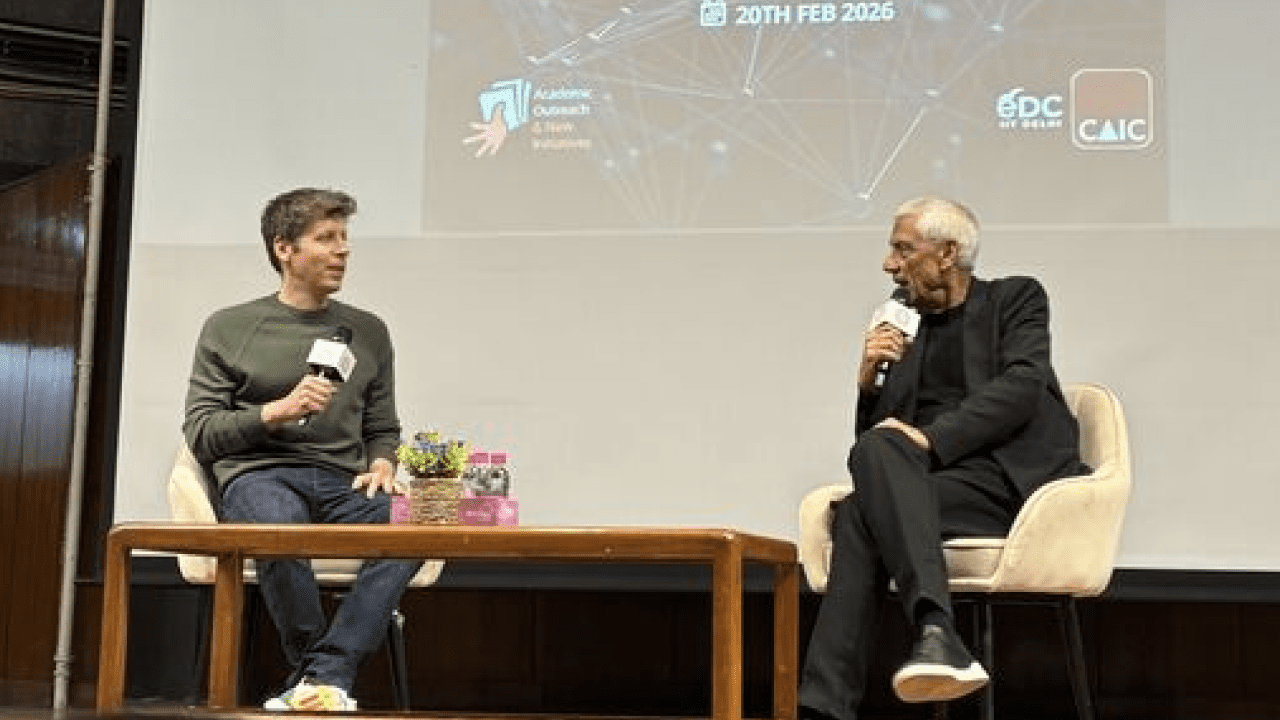
Sam Altman has warned that artificial intelligence is set to automate not just scientific discovery but the entire global economy, fundamentally reshaping education, healthcare and the nature of work. Speaking at the Indian Institute of Technology (IIT) Delhi during a conversation with venture capitalist Vinod Khosla, the OpenAI CEO outlined a future where “superintelligence” is universally accessible and urged students to adapt quickly to stay relevant.
Addressing questions about what India might look like in 2047, when the country marks 100 years of independence, Altman said the next generation will grow up in a world transformed by advanced AI systems.
He remarked that his one-year-old child would never “know a world where he was smarter than a computer ever,” underscoring the rapid acceleration of AI capabilities.
Also read: Vinod Khosla Predicts AI Will Eliminate IT and BPO Jobs Within Five Years
AI to Reshape Education, Healthcare and Work
Altman predicted sweeping disruption across major sectors.
“Education is clearly going to totally change. Healthcare is clearly totally going to change. What it means to do work is going to totally change,” he said.
He also suggested that future companies may consist of just a handful of people supported by massive data centers, capable of generating unprecedented value through AI-powered innovation.
According to Altman, scientific discovery is the primary engine driving long-term economic growth and improvements in quality of life. The economic systems that translate discoveries into real-world applications are equally critical. He argued that both processes are now on the verge of automation.
“We’re going to automate scientific progress. We’re going to automate the whole economy,” he said.
‘Superintelligence’ at Everyone’s Fingertips
Altman said the defining feature of the coming decades will be universal access to powerful AI systems, which he described as “superintelligence at your fingertips.”
This shift, he suggested, will permanently alter the balance between human and machine intelligence, redefining how knowledge is acquired and applied.
Advice for Students in an AI-Driven Era
Turning to students, Altman offered a clear message, technical dominance over AI systems will not be the differentiator in the future.
By the time current first-year students graduate, he said, they are unlikely to know any technical field better than AI itself.
Instead, he advised focusing on distinctly human capabilities.
“You may understand better what people want. You may understand much better how to interact with people, motivate them, how to come up with creative ideas, adapt quickly, and create value,” Altman said.
He emphasized the importance of continuously experimenting with emerging AI tools.
“I can’t emphasise enough how important I think it is to stay on the forefront of the tools. I expect that to be a compounding accelerant,” he said, encouraging students to build projects consistently and explore what becomes possible as AI capabilities rapidly expand.
‘Make Something People Want’
Altman also referenced the long-standing motto of Y Combinator “make something people want” describing it as one of the most enduring principles in investing and entrepreneurship.
He said he wished his own college education had included a course dedicated to understanding and developing that skill.
Altman argued that identifying real human needs and building solutions around them is a learnable and crucial ability one that will remain valuable even as AI systems grow increasingly powerful.