
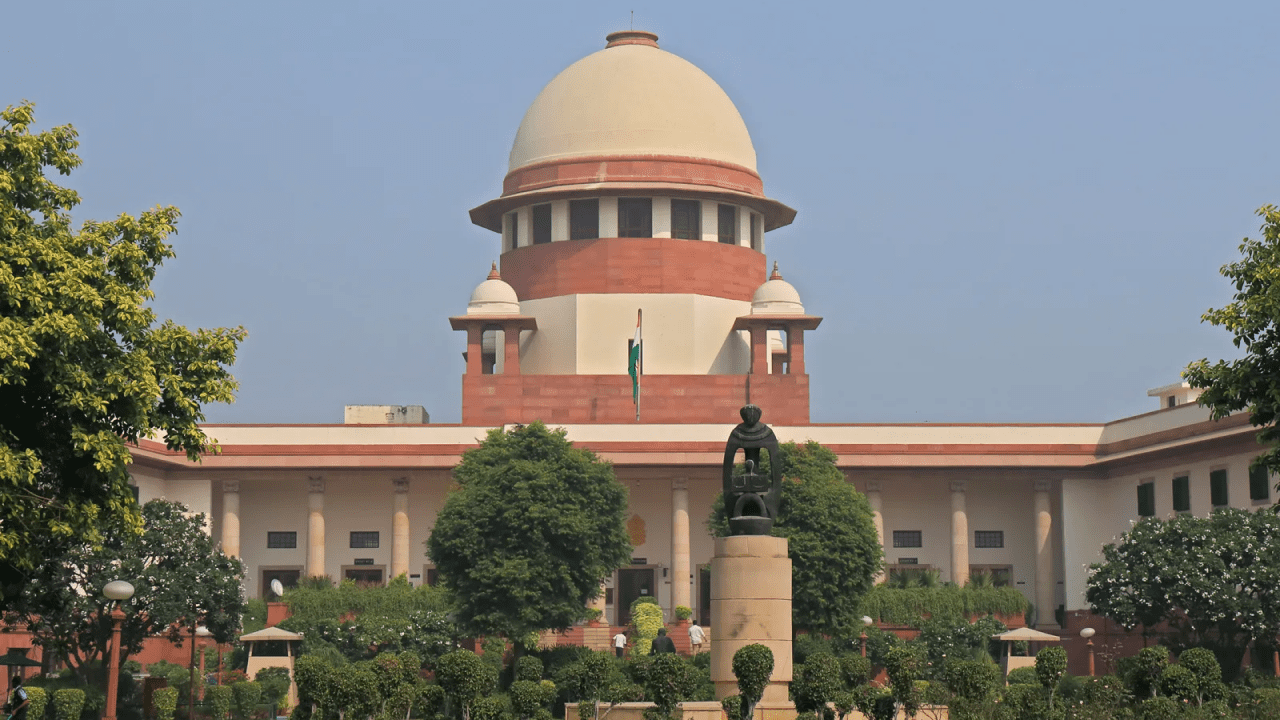
The Supreme Court missing children data came under sharp scrutiny on Tuesday as the top court directed the Centre to conduct a deeper analysis of nationwide statistics to determine whether an organised pattern is emerging behind thousands of cases. The court said identifying regional or national trends is critical to improving coordination, restoring children to their families, and dismantling trafficking and kidnapping networks.
A bench of Justices B.V. Nagarathna and Ujjal Bhuyan asked whether the data collected so far reveals any identifiable pattern state-wise, region-wise, or across India that could point to organized criminal activity. The direction came during the hearing of a public interest litigation (PIL) filed by Guria Swayam Sevi Sansthan, a non-profit organization working on child protection issues.
Also read: Mumbai Police Clarification Ends Panic Over Viral Child Trafficking Claims
Court Seeks Trend Analysis, Not Just Data Collection
The bench had earlier, in December 2025, directed the Centre to compile data on missing children from January 1, 2020, to December 31, 2025, along with updated information on the status of prosecutions.
On Tuesday, the court emphasised that mere collection of data is insufficient.
“It is necessary to analyse data to identify if an emerging pattern appears either state-wise, region-wise or across the country,” the bench observed.
The court instructed states and Union Territories to provide the required information to the nodal officer appointed under the Mission Vatsalya portal, operated by the Ministry of Home Affairs (MHA).
Additional Solicitor General Aishwarya Bhati, appearing for the Centre, informed the court that 12 states and UTs have not submitted data on missing children, while 14 have failed to provide prosecution status updates.
The matter has been posted for hearing on March 10. The court warned that if the required data is not submitted by the next hearing, it may be compelled to take “serious measures” against non-compliant states and UTs.
Disturbing Trends in Five-Year Data
An affidavit filed by the MHA included data from 24 states and UTs, revealing troubling patterns in reported missing children cases, recoveries, and those who remain untraced.
Among the non-responsive states and UTs are Delhi, Maharashtra, Assam, West Bengal, Jammu & Kashmir (UT), Punjab, Gujarat, Tamil Nadu, and Odisha.
Bihar reported the highest number of missing children among responding states. The state recorded:
- 4,868 cases in 2020
- 3,870 cases in 2021
- 7,472 cases in 2022
- 8,933 cases in 2023
- 12,443 cases in 2024
- 16,390 cases in 2025
Although many children were restored to their families or child care institutions, 8,857 children remained untraced in Bihar as of December 2025.
After Bihar, the highest numbers of untraced children were reported in:
- Madhya Pradesh: 2,825
- Chhattisgarh: 1,712
- Haryana: 1,434
- Rajasthan: 754
Notably, Bihar and Chhattisgarh have not provided prosecution data, leaving unclear how many cases resulted in convictions or acquittals.
Court Questions Steps Taken to Break Networks
The bench asked the Centre what concrete steps have been taken to dismantle trafficking networks.
“When you trace the missing children, what is the information that you get from them? You need to interview these children. It will assist in your investigation,” the court told the Centre.
Senior advocate Aparna Bhatt, representing the petitioner organisation, stressed the need for age-based data segregation. She pointed out that organised gangs often target different age groups for different purposes newborns and toddlers for illegal adoption, and minor girls for immoral trafficking.
The PIL, pending since 2024, seeks to use consolidated data to curb the widespread menace of child trafficking, which remains a persistent social reality.
Existing Mechanisms Under Review
In earlier hearings, suggestions were made to involve a specialised agency such as the Central Bureau of Investigation (CBI), particularly due to the inter-state and international dimensions of trafficking. However, the court favoured strengthening existing mechanisms by appointing nodal officers at state and district levels.
The Centre had launched the Khoya Paya Portal in 2015 as a centralised database for missing children, but it failed to ensure effective inter-state coordination.
In 2020, the MHA introduced the Crime Multi Agency Centre (Cri-MAC), a national-level communications platform to enable real-time information sharing among police forces, including in human trafficking cases.
Earlier, in June 2013, the MHA had issued advisories directing states and UTs to establish Anti-Human Trafficking Units (AHTUs) in every district. The advisory also mandated that if a child remains missing for four months, the case should be transferred to the AHTU.
According to the Crime in India 2022 Report, the all-India figure for unrecovered child victims of kidnapping and abduction from previous years stands at 51,100.
The Supreme Court’s latest intervention signals heightened judicial scrutiny as authorities attempt to determine whether India’s missing children crisis is driven by isolated incidents or a coordinated national network.