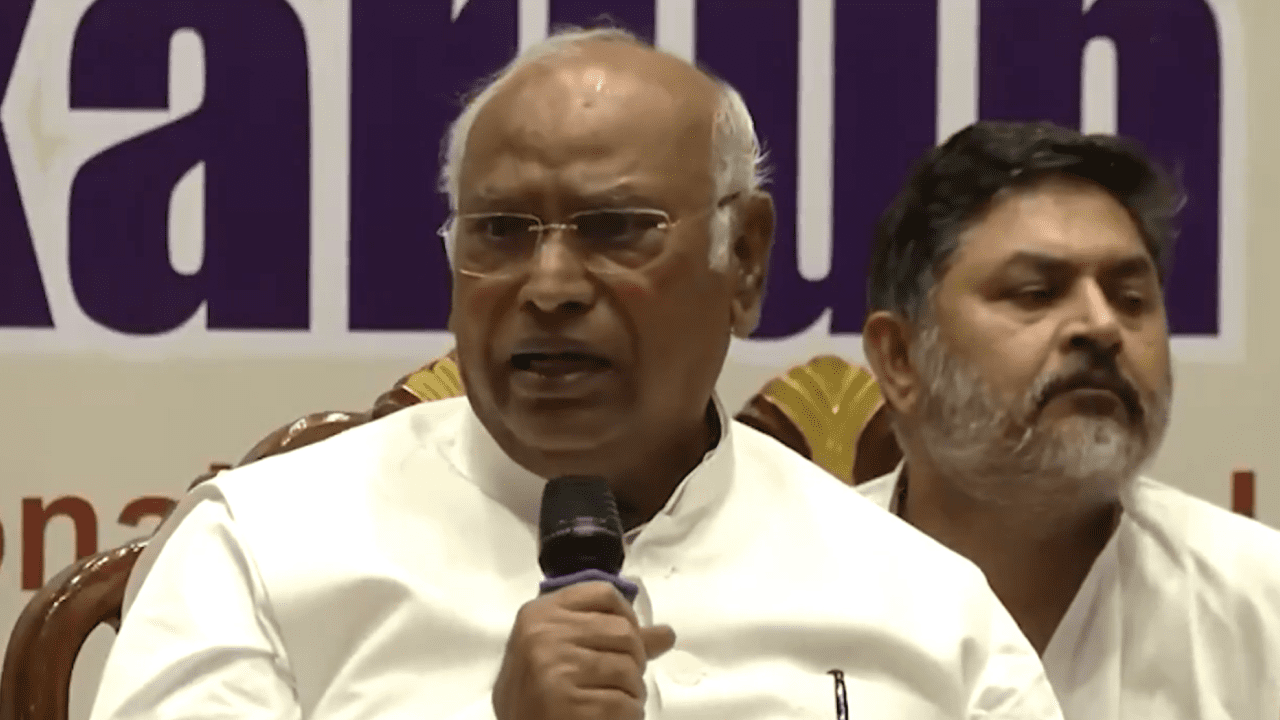
A sharp political controversy erupted after Congress president Mallikarjun Kharge referred to Prime Minister Narendra Modi as a “terrorist” during a campaign address in Chennai, drawing swift backlash from the BJP and intensifying tensions ahead of the Tamil Nadu assembly elections. The remark later clarified by Kharge has injected fresh acrimony into an already heated electoral contest, with alliances and ideological battles at the forefront.
Speaking to reporters on the final day of campaigning, Kharge targeted the AIADMK for aligning with the BJP, questioning how a party rooted in the legacy of Dravidian leaders could partner with the ruling party at the Centre. In the course of his criticism, Kharge used the controversial term for the Prime Minister, alleging that the BJP’s politics undermines equality and justice.
The Congress leader later issued a clarification, stating that he did not intend to label Modi a terrorist but meant that the Prime Minister “terrorises” political opponents and institutions. Kharge alleged that central agencies such as the Enforcement Directorate (ED), Income Tax (I-T) department, and the Central Bureau of Investigation (CBI) were being used to pressure opposition parties. He also raised concerns over issues like delimitation and institutional independence.
Also read: Women’s Quota Amendment Bill Fails in Lok Sabha, Dealing Rare Setback to Modi Government
Political Flashpoint in Tamil Nadu
The controversy comes at a critical moment in Tamil Nadu’s political landscape, where alliances are under scrutiny. Kharge’s remarks were part of a broader attack on the AIADMK, which rejoined hands with the BJP in April 2025 after a split ahead of the 2024 Lok Sabha elections. That election saw the DMK-led alliance dominate the state, leaving both the BJP and AIADMK without representation.
Kharge accused the AIADMK of abandoning its ideological roots and becoming subservient to the BJP. He contrasted this with the leadership of DMK chief M.K. Stalin, portraying him as a figure willing to challenge the Centre and defend state interests. The Congress is contesting the elections as part of the DMK-led alliance, which is seeking to retain power in the state.
Voting for all 234 assembly constituencies is scheduled imminently, with counting set for May 4. The high-stakes contest has sharpened rhetoric on both sides, with national and regional dynamics intersecting in a crucial electoral battleground.
BJP Hits Back Strongly
The BJP responded swiftly and forcefully to Kharge’s comments, accusing the Congress of lowering the level of political discourse. Party spokesperson Shehzad Poonawalla criticised the Congress on social media, alleging a pattern of repeated insults directed at the Prime Minister. He claimed that such rhetoric reflects a broader strategy of attacking Modi rather than engaging in substantive debate.
BJP IT cell head Amit Malviya also condemned the remarks, describing them as indicative of frustration within the Congress. He argued that personal attacks signal a lack of credible political alternatives and weaken democratic discourse.
The BJP further used the controversy to reinforce its narrative that opposition parties resort to personal criticism instead of policy-based engagement, particularly during election campaigns.
Allegations Over Model Code and Institutions
Beyond the controversial remark, Kharge also accused the Prime Minister of violating the Model Code of Conduct by addressing the nation during the election period after a key constitutional amendment bill failed in Parliament. He alleged that the Election Commission was not acting independently and suggested it was functioning in alignment with the ruling party.
Kharge additionally questioned the Centre’s handling of the Women’s Reservation Bill, stating that the Congress had supported its passage in 2023 and had called for immediate implementation. He accused the Prime Minister of presenting a misleading narrative about the opposition’s stance on the issue.
These allegations add another layer to the political confrontation, bringing institutional integrity and governance practices into the electoral debate.
Why This Matters
The controversy underscores the increasingly combative nature of political campaigning in India, particularly during high-stakes state elections. Personal remarks and counterattacks often overshadow substantive policy discussions, shaping public perception and media narratives.
In Tamil Nadu, where regional identity and federal dynamics play a significant role, the alignment between national and state-level parties is a critical issue. Kharge’s comments reflect a broader attempt by the Congress-DMK alliance to frame the BJP and its allies as centralising forces that could undermine state autonomy.
At the same time, the BJP’s response highlights its strategy of portraying the opposition as negative and disrespectful, aiming to consolidate support by emphasising leadership and governance credentials.
What Happens Next
With voting imminent, the immediate political impact of the controversy will likely play out in campaign messaging and voter sentiment. Both sides are expected to leverage the episode to mobilize their respective bases Congress and its allies by reinforcing their critique of the BJP, and the BJP by highlighting what it calls the opposition’s divisive rhetoric.
The Election Commission may also face increased scrutiny over allegations of bias and enforcement of the Model Code of Conduct, though no formal action has been indicated so far.
Ultimately, the electoral outcome in Tamil Nadu will determine whether such controversies influence voter behavior or remain part of the broader background noise of electioneering. Regardless, the episode has once again spotlighted the tone and tenor of political discourse in India’s democratic process.