
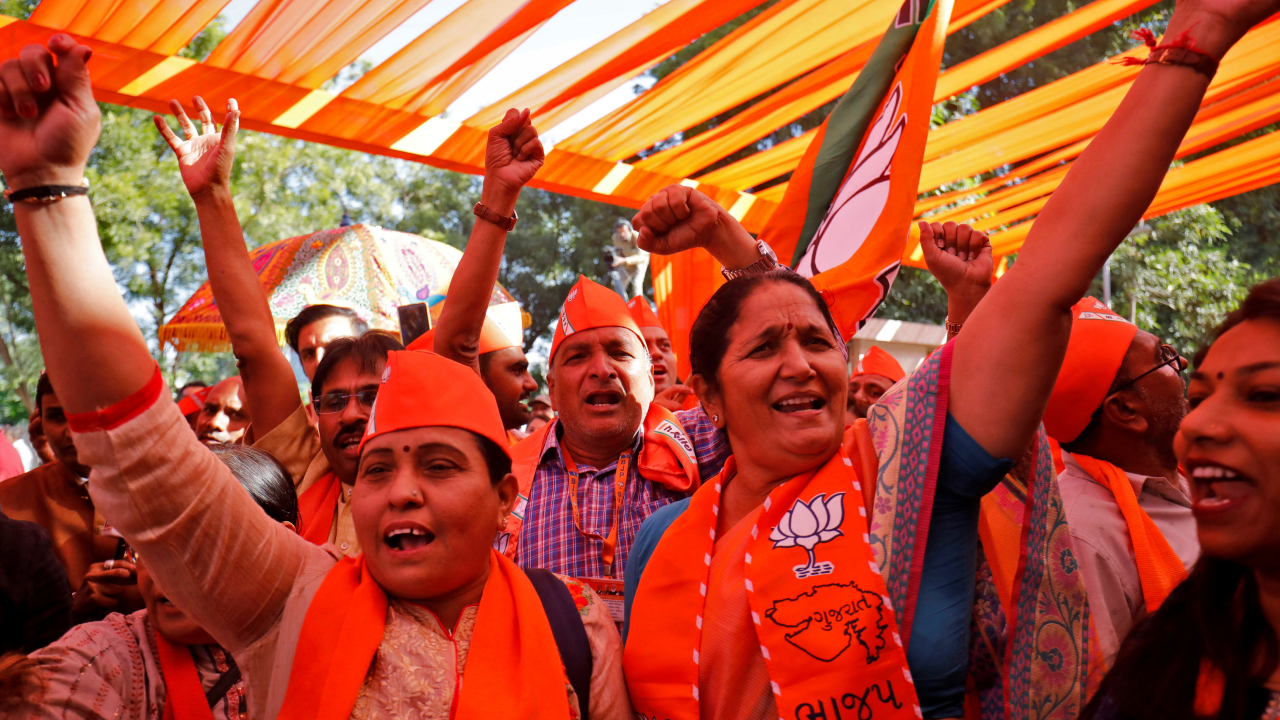
Gujarat’s ruling Bharatiya Janata Party (BJP) delivered a landmark performance in the 2026 local body elections, securing an unprecedented victory across urban and rural regions of the state. On Tuesday, the party won all 15 municipal corporations, including nine newly formed bodies, and maintained overwhelming dominance in municipalities, district panchayats, and taluka panchayats, solidifying its political stronghold ahead of next year’s Assembly elections.
The elections, covering over 41.8 million eligible voters across 15 municipal corporations, 84 municipalities, 34 district panchayats, and 260 taluka panchayats, reflected a decisive mandate for the BJP. In municipal corporations, the party captured 937 of 1,044 declared seats, while Congress managed 95 and smaller parties, including the Aam Aadmi Party (AAP), won a handful. The BJP also claimed 78 of 84 municipalities, 33 of 34 district panchayats, and 220 of 260 taluka panchayats.
Prime Minister Narendra Modi hailed the results as a testament to the “unbreakable bond” between Gujarat and the BJP, emphasizing that voters endorsed a politics of development. “The people have voted for good governance and have blessed the hard work of the BJP over the years,” Modi wrote on X. Chief Minister Bhupendra Patel highlighted that the outcome reflects public faith in the state government’s governance model and its development agenda.
Also read: AAP Faces Major Political Crisis as Raghav Chadha Leads Mass Rajya Sabha Defection to BJP
Expert Analysis / What This Means
The BJP’s sweeping success in Gujarat has far-reaching implications for both local governance and the upcoming Assembly elections. The consolidation of urban strongholds in major cities like Ahmedabad, Surat, Vadodara, and Rajkot signals the party’s entrenched influence in high-density voter centers, while rural victories in taluka and district panchayats demonstrate its sustained grassroots reach. For the opposition, the results expose the widening gap between Congress and AAP, raising questions about strategic recalibration ahead of 2027.
The high number of uncontested seats 736 compared to 220 in 2021 suggests a shrinking competitive landscape, potentially impacting voter engagement and political pluralism. For citizens, this dominance may translate into accelerated policy implementation at the local level, but it also places scrutiny on accountability mechanisms. Comparisons with past elections underscore that BJP’s vote share and organizational outreach have reached new peaks, reinforcing a trend of centralized influence in Gujarat politics.
Key Election Outcomes
- Municipal Corporations: BJP won all 15, with 937 of 1,044 seats. Newly formed corporations like Morbi and Porbandar saw a clean sweep. In Ahmedabad, BJP secured 160 of 192 seats, while Surat reversed AAP gains from 2021, winning 115 seats against AAP’s four.
- Municipalities: BJP dominated 78 of 84 municipalities, Congress won six, and AAP 18.
- District Panchayats: BJP captured 33 of 34 seats; AAP claimed Narmada, Congress won one seat in Khadia, Ahmedabad.
- Taluka Panchayats: BJP took 220 of 260 seats, securing a majority in rural regions.
Notably, smaller parties also made their mark. The All India Majlis-e-Ittehadul Muslimeen (AIMIM) won three seats in Bhuj Nagarpalika, and the Samajwadi Party (SP) claimed Ward No. 4 in Kathlal Nagarpalika, marking their entry into Gujarat’s civic politics. Independent candidates also emerged victorious in select wards, underscoring local dynamics that occasionally transcend party lines.
Background Context
These elections were the first in Gujarat following a Special Intensive Revision (SIR) of electoral rolls, which resulted in over 6.8 million deletions the highest among states in the second phase of the exercise. Additionally, this cycle marked the implementation of an increased OBC quota, rising from 10% to 27%, potentially influencing candidate selection and voter demographics. Nine of the 15 municipal corporations held elections for the first time after being constituted in January 2025, expanding the urban electoral map significantly.
Industry / Market Impact
The election outcome also has implications beyond politics. A stable BJP-led governance model could accelerate urban development initiatives, infrastructure projects, and industrial investments, particularly in cities like Surat, Ahmedabad, and Vadodara, which are economic hubs. Investors and corporates often view such electoral clarity as a signal for policy continuity, potentially boosting regional economic confidence.
What Happens Next
With Assembly elections slated for late 2027, these local body results are widely interpreted as a bellwether for state-level political sentiment. The BJP is expected to leverage its robust grassroots network to consolidate its voter base further, while opposition parties face pressure to rebuild organizational strength and voter engagement strategies. Observers anticipate a detailed post-election analysis to guide campaign strategies, candidate selection, and policy messaging ahead of the next major political contest.