
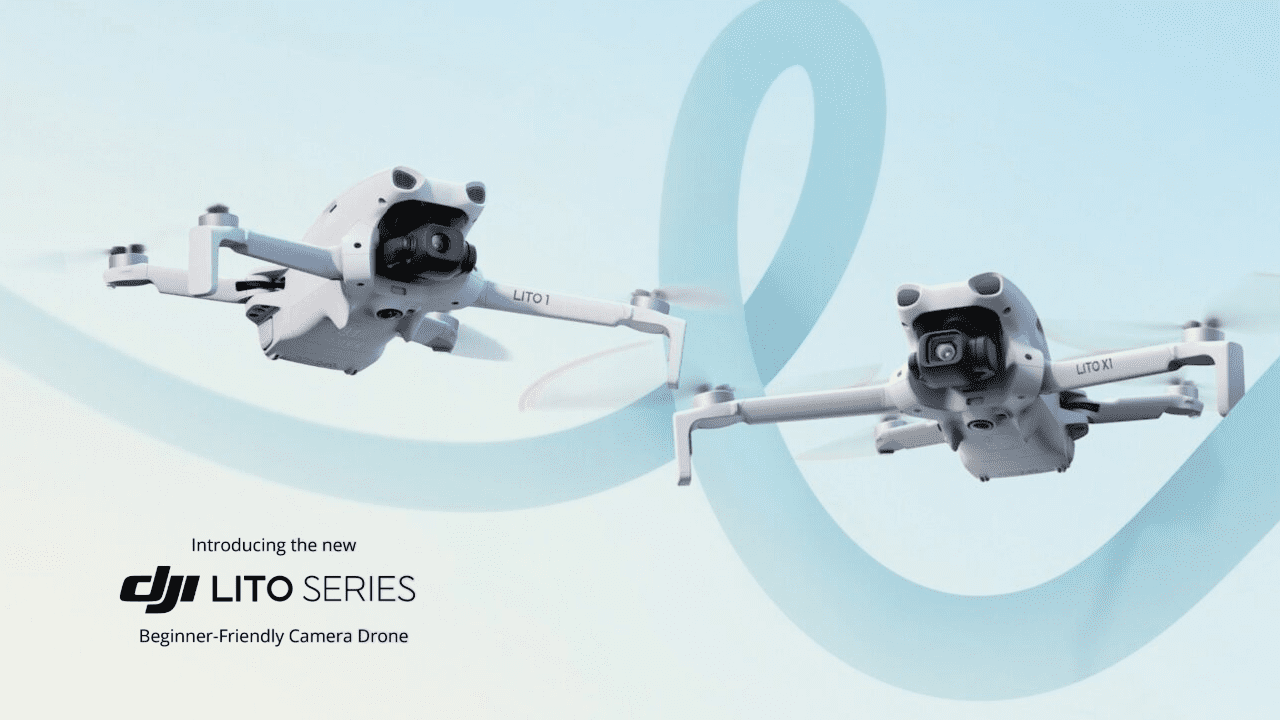
DJI has unveiled its new Lito series, a line of lightweight, sub-249g drones designed for first-time aerial creators, marking a notable expansion of its consumer drone portfolio. The series introduces two models, the Lito 1, priced from €309, and the more advanced Lito X1 starting at €379, both featuring folding frames, 36-minute flight times, and omnidirectional obstacle sensing. While the European and select international markets will see immediate availability, the U.S. launch remains delayed due to pending regulatory approval.
The Lito series positions itself below the DJI Mini 5 Pro, targeting beginners and casual users rather than professionals. Both drones share DJI’s Fly app interface and automated creative modes such as QuickShots, Panorama, and ActiveTrack, which simplify filming for users without prior aerial photography experience.
Advanced Imaging and Sensor Technology
The Lito 1 features a 48MP 1/2-inch CMOS sensor with an f/1.8 lens, capable of recording 4K video at up to 60fps and slow-motion in 4K/100fps or FHD/100fps. Color options remain standard without log capture or HDR support, emphasizing ease of use for newcomers.
The Lito X1 upgrades the experience with a 48MP 1/1.3-inch sensor paired with an f/1.7 lens and an 82° field of view, supporting 10-bit D-Log M and HDR capture up to 14 stops of dynamic range. Photographers and videographers will also benefit from 200fps slow-motion capabilities and 42GB of internal storage, reducing reliance on external memory cards.
A standout feature on the X1 is forward-facing LiDAR, allowing obstacle detection up to 36 meters with a vertical range of 80° and horizontal coverage of 60°. This complements the omnidirectional vision system shared with the Lito 1, enabling safer autonomous flight in low-light or low-texture environments, where traditional vision sensors may struggle.
Flight Performance and Connectivity
Both drones achieve a maximum horizontal speed of 18 m/s (approx. 40 mph), with wind resistance rated at 10.7 m/s. Flight duration reaches 36 minutes with standard batteries, extendable to 52 minutes using the optional Intelligent Flight Battery Plus, though regional restrictions apply. The X1 is rated for temperatures as low as -10°C, while the Lito 1 operates from 0°C upward.
Connectivity is anchored by DJI’s O4 transmission system, offering ranges up to 15 km in ideal conditions, with 1080p/60fps live view. Wi-Fi 6 QuickTransfer supports direct file offloading to smartphones at speeds up to 50 MB/s, and Bluetooth 5.4 enables accessory pairing.
Expert Analysis / What This Means
The introduction of the Lito series demonstrates DJI’s strategic push to capture the beginner and hobbyist segment with feature-rich yet accessible drones. For users, this means entry into aerial photography without navigating complex setups or professional-grade equipment. Industry-wise, the inclusion of LiDAR at sub-€400 prices could pressure competitors to integrate higher-end sensing into budget drones.
The X1’s HDR and D-Log M capabilities signal a blurring of lines between consumer and prosumer devices, offering advanced imaging in a compact, lightweight form. Future models in the Lito series may further refine this balance, potentially reshaping DJI’s consumer tier structure. Comparatively, the Lito series resembles the Mini 4 Pro in sensor capabilities but adapts features for a more approachable price point and easier flight experience.
Market Availability and U.S. Delay
While European markets can pre-order the drones now, DJI confirmed that the Lito series will not immediately launch in the United States due to regulatory approval delays. This is unusual for DJI, which typically coordinates near-simultaneous global releases. American customers will need to wait, and DJI appears to be incentivizing domestic buyers with discounts on existing models like the Mini 3, Mini 4K, and Neo.
Industry / Market Impact
The Lito series’ pricing strategy under €400 makes high-performance drone features accessible to students, amateur filmmakers, and social media creators, potentially expanding DJI’s user base. The integration of LiDAR into a sub-249g drone disrupts expectations for entry-level models, likely prompting competitors to innovate in obstacle-sensing technology for lightweight drones.
Background Context
The Lito series’ launch aligns with DJI’s broader trend of democratizing aerial filmmaking tools. While the Mini series targeted more experienced hobbyists, the Lito drones provide a stepping stone for beginners while still offering sufficient capabilities to be useful for secondary or backup cameras in professional workflows. The regulatory-compliant sub-249g weight also eases adoption in regions with strict drone registration rules.