
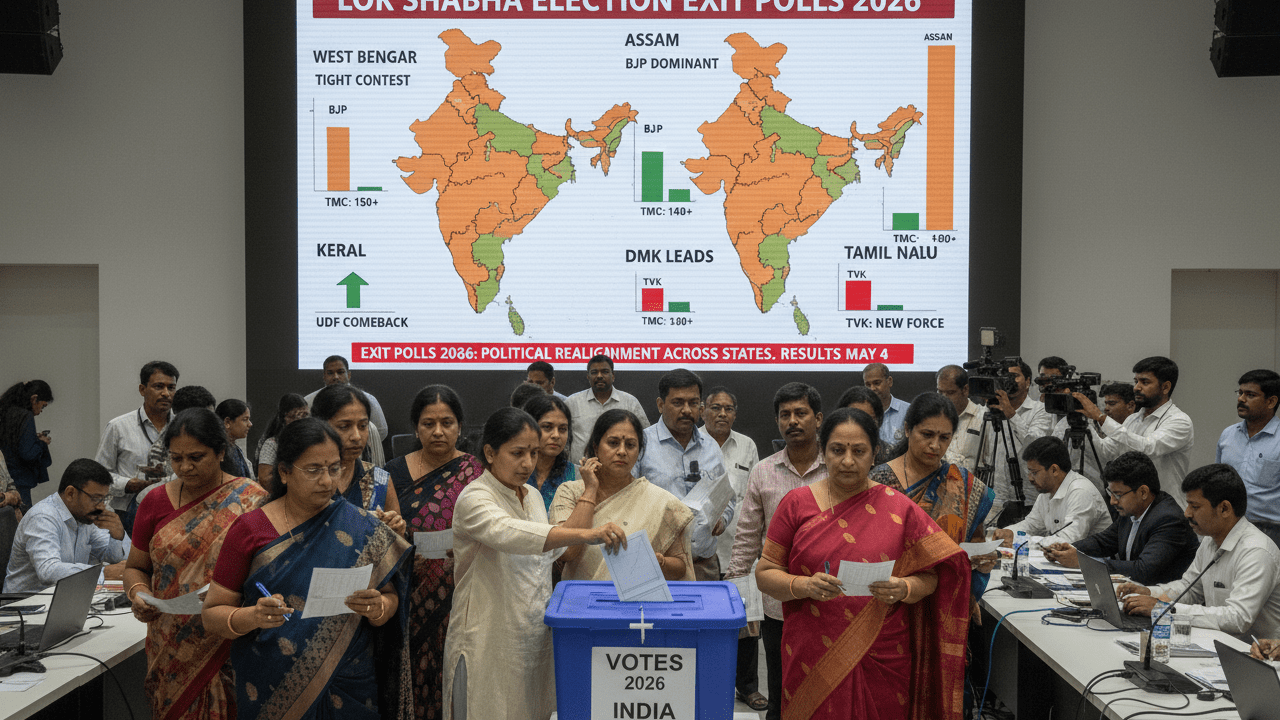
India’s 2026 Assembly exit polls have set the stage for a potentially transformative political moment, with projections pointing to a tight and historic contest in West Bengal, a dominant showing for the BJP in Assam, a likely comeback for the Congress-led alliance in Kerala, and a possible second consecutive term for the DMK in Tamil Nadu. The results, due on May 4, could reshape regional power structures and influence national political momentum ahead of upcoming electoral cycles.
Across five key regions West Bengal, Tamil Nadu, Kerala, Assam, and Puducherry exit polls suggest both continuity and disruption. While incumbents appear resilient in some states, others may witness significant shifts, particularly in territories historically resistant to the BJP’s expansion.
Also read: BJP Sweeps Gujarat Local Body Elections, Wins All 15 Municipal Corporations in Historic Mandate
A Fragmented Yet Defining Electoral Map
West Bengal remains the focal point of the 2026 elections. Most exit polls indicate a narrow edge for the BJP in the 294-seat assembly, projecting figures close to or just above the majority mark of 148 seats. If confirmed, this would mark the party’s first-ever government in the state, ending over three decades of Left Front rule followed by 15 years of Trinamool Congress dominance.
However, projections remain divided. Some pollsters suggest a strong BJP surge, while others foresee the TMC retaining power with a comfortable margin. TMC leaders have rejected the projections, arguing that high voter turnout reflects public support for the ruling party rather than anti-incumbency.
In Assam, the projections are far more consistent. Nearly all exit polls forecast a decisive victory for the BJP-led alliance, with seat estimates nearing a two-thirds majority in the 126-member assembly. This would secure a third consecutive term for Chief Minister Himanta Biswa Sarma, reinforcing the party’s hold in the northeast.
Kerala appears poised for a political shift. Exit polls unanimously predict a return of the Congress-led United Democratic Front (UDF), potentially ending a decade-long stint in opposition. The ruling Left Democratic Front (LDF), which made history with back-to-back wins in 2016 and 2021, is not expected to retain power this time, reflecting a reversion to the state’s traditional pattern of alternating governments.
Tamil Nadu presents a more nuanced picture. Most projections suggest that the DMK-led alliance will overcome anti-incumbency and secure a second consecutive term something the party has historically struggled to achieve. However, the emergence of actor Vijay’s Tamilaga Vettri Kazhagam (TVK) has introduced a new dynamic. While most exit polls see the party as a minor player, at least one projection suggests a dramatic upset, potentially positioning it as a major contender.
In Puducherry, the NDA is widely expected to retain power, continuing its foothold in the Union Territory.
High Turnout, High Stakes
Voter turnout reached notable highs across states, with Puducherry crossing 91%, Tamil Nadu recording over 85%, and Assam nearing 86%. Kerala and West Bengal also saw strong participation. Analysts suggest that turnout patterns may play a decisive role, though parties interpret these trends differently to support their narratives.
The elections were conducted amid heightened scrutiny of the electoral process. The Special Intensive Revision (SIR) of voter rolls, which led to the removal of millions of names under a “logical discrepancy” category, sparked controversy and legal questions. In West Bengal alone, approximately 2.7 million voters were reportedly affected.
Despite these tensions, polling especially in West Bengal was largely peaceful, supported by an unprecedented deployment of central forces and administrative reshuffles by the Election Commission.
Also read: Raghav Chadha Leads Mass Exit of AAP MPs to BJP in Major Rajya Sabha Shift
Expert Analysis / What This Means
The 2026 exit polls point to a possible reconfiguration of India’s political geography. A BJP victory in West Bengal would represent a symbolic and strategic breakthrough in eastern India, a region that has long resisted the party’s expansion. It would also strengthen the ruling alliance’s national narrative ahead of future elections.
In contrast, a UDF comeback in Kerala signals that regional political cycles and local governance factors continue to outweigh national trends in certain states. This reinforces the limits of centralized electoral strategies.
Tamil Nadu’s scenario highlights the growing unpredictability of voter behavior, especially with new entrants disrupting traditional two-party systems. Even if the DMK retains power, the emergence of a third force could permanently alter electoral equations.
Assam’s projected outcome underscores the BJP’s consolidation in the northeast, suggesting that identity politics, development narratives, and leadership continuity remain influential factors.
Overall, these elections demonstrate that while national parties seek expansion, regional dynamics, leadership credibility, and local issues continue to play decisive roles in shaping outcomes.
Industry / Market Impact
Political stability in key states such as Tamil Nadu and Assam could have positive implications for regional investment climates, particularly in manufacturing, infrastructure, and energy sectors. Tamil Nadu, a major industrial hub, is closely watched by investors for policy continuity.
A regime change in Kerala could also influence sectors like tourism, remittances, and welfare-driven consumption, depending on the incoming government’s fiscal priorities.
Meanwhile, a BJP win in West Bengal may trigger renewed focus on industrialization and federal investment in the state, potentially altering its economic trajectory.
What Happens Next
All eyes now turn to May 4, when official counting will determine whether these projections hold. Exit polls in India have a mixed track record, with notable inaccuracies in previous elections, including West Bengal in 2021 and the 2024 general elections.
Political parties across states have expressed confidence in their respective performances, dismissing unfavorable projections. Campaign narratives are already shifting toward claims of mandate legitimacy and governance continuity.
If the exit polls prove accurate, India could witness both consolidation and disruption strengthening incumbents in some regions while ushering in significant political change in others. The outcomes will likely shape not only state-level governance but also the broader national political discourse in the months ahead.