
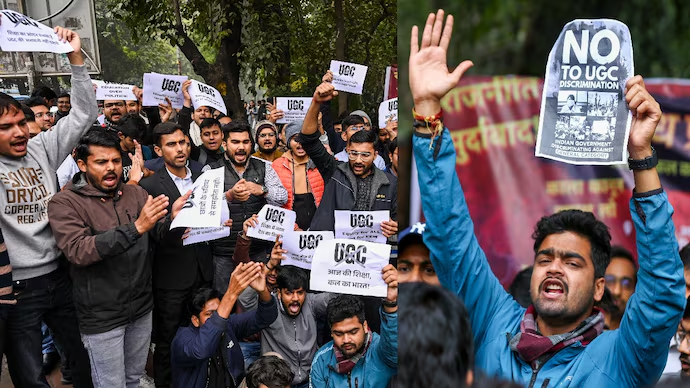
UGC caste discrimination rules stayed by the Supreme Court on Thursday after the top court put a hold on the University Grants Commission’s newly notified equity regulations aimed at addressing caste-based discrimination in higher education institutions. The court flagged concerns that the rules could be misused and may have “dangerous impacts” on society if not carefully defined.
A bench comprising Chief Justice Surya Kant and Justice Joymalya Bagchi stayed the implementation of the Promotion of Equity in Higher Education Institutions Regulations, 2026, and issued notices to the Centre and the UGC. The court said it would examine the definition of caste-based discrimination used in the new framework.
The bench observed that while the intent behind the regulations may be to curb discrimination, their current form had the potential to divide society. With the stay in place, the Supreme Court directed the UGC to continue implementing the 2012 anti-discrimination regulations so that students can still access grievance redressal mechanisms and complaint portals.
The court’s intervention comes amid widespread protests by students from the general category, who raised concerns over exclusion and the possibility of misuse of the new rules.
What do the new UGC rules propose?
The Promotion of Equity in Higher Education Institutions Regulations, 2026, lays out a comprehensive anti-discrimination framework for universities, colleges, and other higher education institutions across India.
Under the new rules, institutions would be required to establish Equity Committees, Equity Squads, and dedicated helplines to address complaints of discrimination. The regulations place special emphasis on protecting students belonging to Scheduled Castes (SC), Scheduled Tribes (ST), and Other Backward Classes (OBC).
The regulations were framed following a Supreme Court directive seeking effective implementation of the 2012 guidelines. The plea that led to this direction was filed by the mothers of Rohith Vemula and Payal Tadvi, two students whose deaths by suicide were linked to alleged caste-based discrimination on campus.
Why did the rules trigger protests?
The new framework sparked strong opposition from sections of upper-caste and general category students, who argued that the regulations were exclusionary. Two petitions were subsequently filed before the Supreme Court seeking either a rollback or modification of the rules to ensure protection against discrimination regardless of caste, religion, or gender.
One of the petitions argued that by limiting the scope of caste-based discrimination to SC, ST, and OBC categories, the UGC had denied grievance redressal and institutional protection to students from non-reserved or general categories who may also face harassment or bias.
Students staged protests outside the UGC headquarters in Delhi, demanding the withdrawal of the regulations. Delhi University PhD scholar Alokit Tripathi said the rules could create “complete chaos” on campuses by shifting the burden of proof entirely onto the accused, without adequate safeguards.
Despite assurances from Union Education Minister Dharmendra Pradhan, protests continued in several parts of the country. “I want to humbly assure everyone that no one is going to face any harassment. There will be no discrimination and no one will have the right to misuse the regulation.
The protests also spread to Bareilly in Uttar Pradesh, where suspended city magistrate Alankar Agnihotri said the regulations had triggered anger among Brahmin organisations.
Political reactions to the Supreme Court order
Several political leaders welcomed the Supreme Court’s decision to stay the regulations. Samajwadi Party president Akhilesh Yadav said on X that true justice lies in ensuring that no individual is subjected to oppression or unfair treatment.
Students at Lucknow University described the order as a “victory for students,” while Congress MP Pramod Tiwari thanked the court for stepping in, he said the government should focus on maintaining peace instead of fueling divisions in the name of caste or religion.