
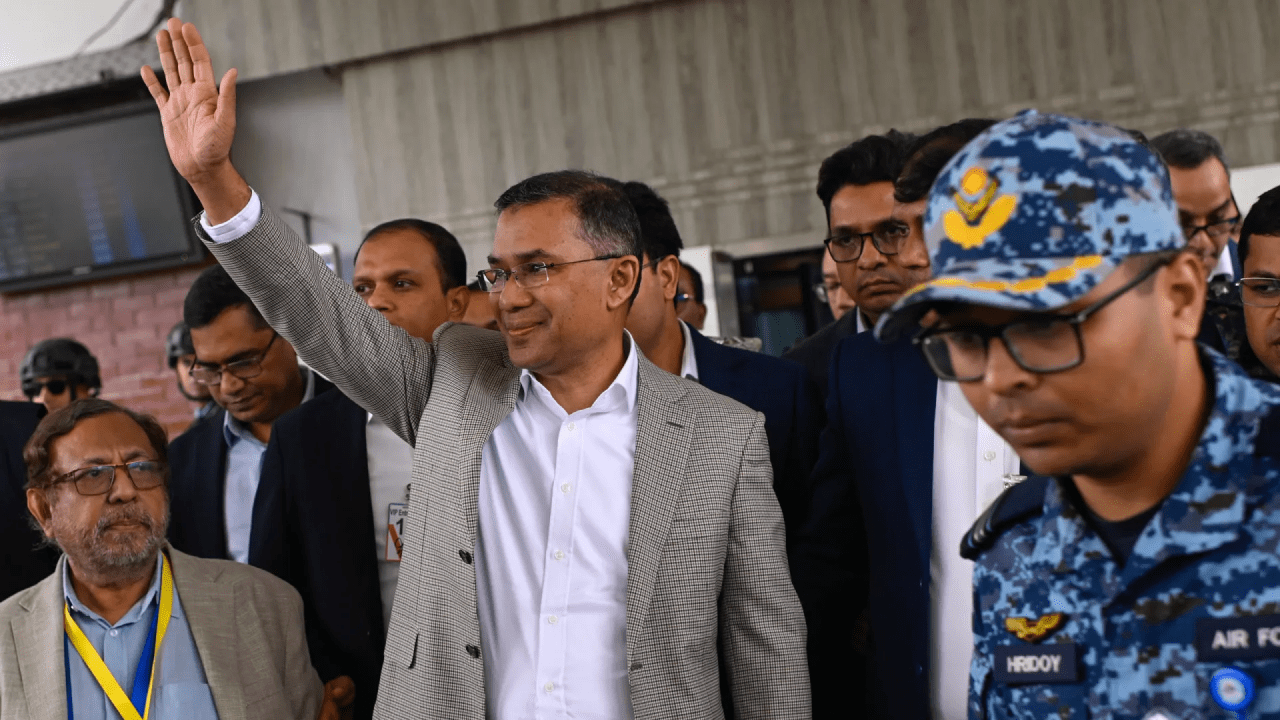
Tarique Rahman is poised to become Bangladesh’s next prime minister after securing a sweeping victory in the country’s first parliamentary election since the ouster of long-time leader Sheikh Hasina. His ascent follows the 2024 student-led uprising that ended Hasina’s 15-year rule and reshaped the political landscape of the South Asian nation of 170 million people.
Rahman’s return from nearly two decades in exile and his rapid consolidation of power signal a turning point in Bangladeshi politics. Once branded by U.S. diplomats as a “symbol of kleptocratic government,” the 60-year-old chairman of the Bangladesh Nationalist Party (BNP) now stands at the threshold of leading a country eager for democratic renewal yet wary of dynastic politics.
His rise raises a defining question for Bangladesh, does Rahman represent genuine reform, or merely a reshaped version of the old political order?
Also read: US Government Shutdown Begins as Congress Misses 2026 Budget Deadline
A Cinematic Return After 17 Years in Exile
Rahman returned to Dhaka on December 25, 2025, ending 17 years in self-imposed exile in London. In a moment that captured public imagination, he arrived accompanied by his ginger cat, Zebu affectionately called “Jebu” in Bangla whose images quickly went viral on social media.

The emotional homecoming was overshadowed by personal tragedy. Just a week after his return, his mother, three-time former prime minister Khaleda Zia, died at the age of 80.
Speaking from his office beneath portraits of his late parents, Rahman described the moment as bittersweet. He expressed regret at not being able to embrace his mother after years abroad, calling it a deeply painful loss.
On January 9, 2026, Rahman formally assumed the chairmanship of the BNP and launched an election campaign centered on reconciliation and moving beyond the bitterness of the Hasina era.
A Political Life Shaped by Blood and Rivalry
Born in 1965, Rahman’s life has been intertwined with Bangladesh’s turbulent political history. His father, President Ziaur Rahman, a Liberation War hero and founder of the BNP, was assassinated in a 1981 coup attempt.
During the 1971 Liberation War that led to Bangladesh’s independence, Rahman was briefly detained as a child. His father rose to power in the aftermath of the 1975 assassination of Sheikh Mujibur Rahman, a pivotal event that reshaped the nation’s political trajectory.
The decades that followed were marked by intense rivalry between Khaleda Zia and Sheikh Hasina a bitter contest that defined Bangladeshi politics for a generation. Rahman entered active politics in 1988 as a BNP member in Bogra and rose to prominence during his mother’s 2001-2006 tenure as prime minister.
Controversy and the “Khamba Tarique” Era
Rahman’s earlier political career was dogged by allegations of corruption. Critics dubbed him the “Dark Prince” and “Khamba Tarique,” a reference to accusations of inflated procurement deals involving electricity poles.
Diplomatic cables from the U.S. Embassy between 2006 and 2009, later published by WikiLeaks, described him as “phenomenally corrupt” and a polarizing figure in Bangladeshi politics.
In 2007, amid an anti-corruption drive by a military-backed caretaker government, Rahman was arrested and later claimed he was tortured in custody. He faced multiple charges, including money laundering and a life sentence related to a 2004 grenade attack on an Awami League rally.
In 2008, he left for London, pledging not to engage in politics. From abroad, however, he continued to influence the BNP as senior vice-chairman and later as acting chairman after Khaleda Zia’s imprisonment in 2018. He consistently dismissed the charges against him as politically motivated.
Legal Rehabilitation and Political Rebranding
The political upheaval of July-August 2024, which forced Sheikh Hasina into self-exile in India, opened the door to Rahman’s legal and political rehabilitation.
Between late 2024 and early 2025, Bangladeshi courts overturned several of his convictions, citing procedural irregularities and insufficient evidence. He was acquitted in the 2004 grenade attack case and cleared of money laundering charges.
Adopting a more conciliatory tone, Rahman campaigned on a reformist platform under the slogan “Bangladesh Before All.” He pledged clean governance, justice over revenge, and economic productivity over corruption.
In a rare acknowledgment of past controversies, he offered a broad apology for “unwanted mistakes,” while distancing himself from his parents’ legacies, stating he would seek to “do better.”
A Delicate Geopolitical Balancing Act
Rahman inherits a complex foreign policy landscape. India, which maintained close ties with Sheikh Hasina for 15 years, has begun recalibrating its approach. India’s External Affairs Minister met Rahman in Dhaka and delivered a personal letter from Prime Minister Narendra Modi expressing hope for a new chapter in bilateral relations.
At the same time, the BNP leadership has signaled that it will not grant any neighbor privileged status, instead emphasizing equality and mutual interest. Analysts suggest Rahman may seek to diversify partnerships, balancing relations with India, deepening infrastructure ties with China, and cautiously engaging Pakistan.
A Young Electorate and Institutional Reform
Rahman assumes office at a moment of demographic and institutional transition. Nearly 44% of voters are under 37, reflecting a generational shift in political expectations following the 2024 uprising.
The 2026 election also included a referendum introducing a 10-year cap on prime ministerial tenure a safeguard aimed at preventing prolonged rule of the kind seen during the Hasina years.
Whether Tarique Rahman’s premiership will mark a decisive democratic renewal or a continuation of Bangladesh’s entrenched political rivalries remains uncertain. For now, his leadership represents both change and continuity in a nation still redefining its future.