
India and the European Union (EU) have signed a landmark free trade agreement (FTA), a move expected to significantly boost bilateral trade by removing barriers on more than 90 per cent of Indian goods.
The pact has been described as the “mother of all” trade agreements, drawing global attention as it is set to create a market of nearly two billion people and account for around one-fourth of the world’s gross domestic product (GDP).
Commerce Secretary Rajesh Agrawal confirmed on Monday that negotiators from India and the EU have successfully concluded what he described as an “ambitious, balanced, forward-looking and mutually beneficial” India-EU Free Trade Agreement.
The signing of the trade deal was formally announced by Prime Minister Narendra Modi on Tuesday.
Watch the full story in Hindi in the video below:
Why the India-EU Trade Deal Matters
The agreement marks the conclusion of negotiations that were relaunched in June 2022 after a gap of almost nine years. Once implemented, the FTA is expected to integrate a consumer market of over 1.9 billion people and represent 25 per cent of global GDP.
The European Union is currently India’s largest trading partner, with bilateral trade in goods valued at $135 billion in 2023–24. The new agreement is expected to further strengthen trade ties at a time when countries are seeking to derisk supply chains amid global trade disruptions.
According to an earlier report, the trade pact may allow duty-free access to more than 90 per cent of Indian goods in the EU’s vast market, which includes 27 member states such as Germany, France, Italy, Spain and Belgium.
Big Relief for Indian Exporters
The trade agreement aims to remove both tariff and non-tariff barriers on a wide range of products. Labour-intensive sectors such as textiles, leather, chemicals, electronics and jewellery are expected to benefit the most, as these sectors do not directly compete with European manufacturers.
At present, Indian exporters face stiff competition from duty-free and quota-free imports from least developed countries like Bangladesh. Once the proposed FTA comes into force, this duty disadvantage for Indian exporters is expected to end.
Signed During EU Leaders’ India Visit
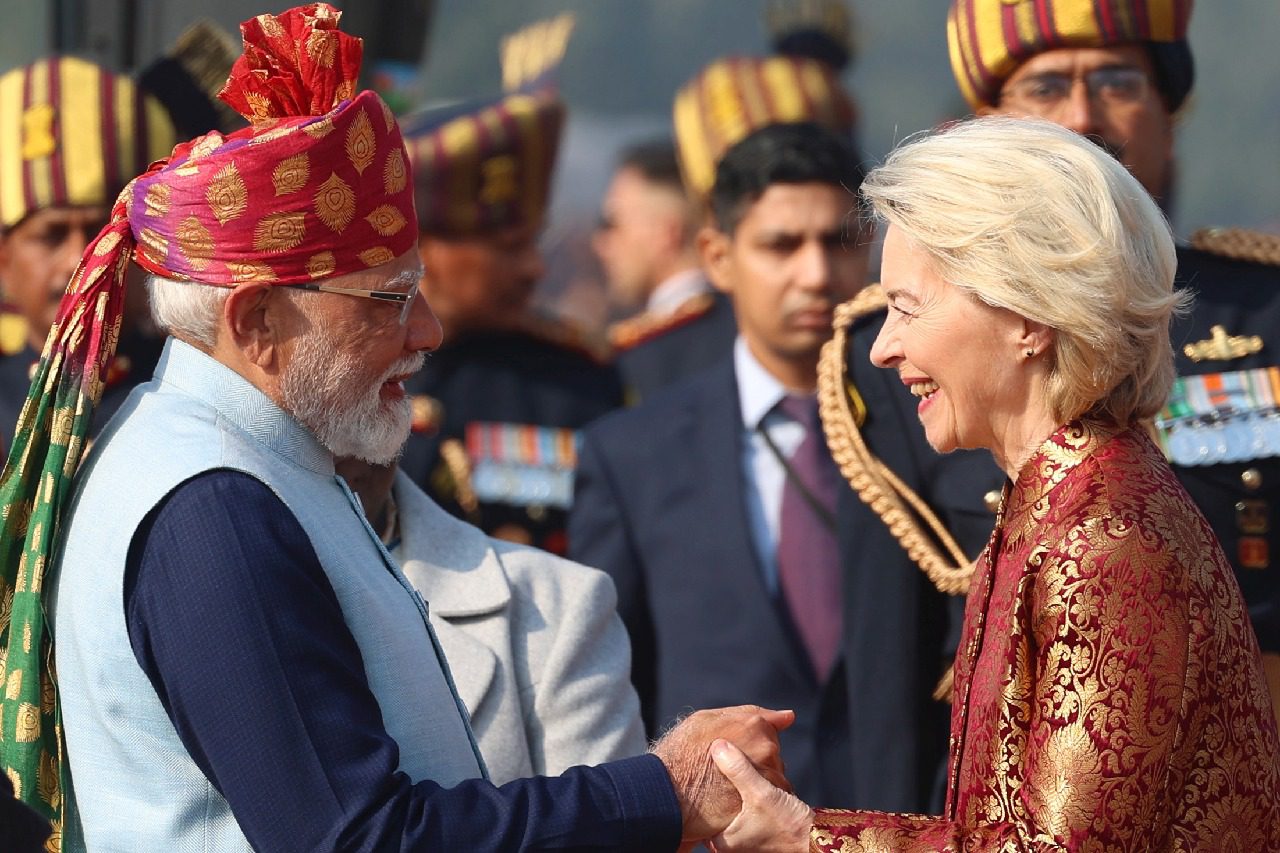
The announcement came during a two-day India visit by European Council President Antonio Costa and European Commission President Ursula von der Leyen. Both leaders attended the Republic Day celebrations as chief guests and later held a summit with Prime Minister Modi.
A Counterweight to Trump-Era Tariffs
The India-EU trade deal has also drawn attention in the United States. Shortly before the signing, US Treasury Secretary Scott Bessent reiterated allegations that India’s oil trade with Russia was financing the war in EU-backed Ukraine.
The agreement is widely seen as a strategic counterweight to former US President Donald Trump’s tariff-heavy trade policies, which affected both India and the EU.
In August last year, Trump announced 25 per cent tariffs on Indian imports and an additional 25 per cent penalty linked to India’s Russian oil purchases, taking total duties to 50 per cent. The EU also faced 25 per cent tariffs on steel and aluminium imports.
PM Modi Welcomes the Agreement
Announcing the deal, Prime Minister Modi said the agreement would bring major opportunities for people in both India and Europe.
“This is a perfect example of a partnership between two major economies of the world. This agreement represents 25 per cent of the global GDP and nearly one-third of global trade,” he said.
He added that the FTA strengthens the shared commitment to democracy and the rule of law, and will complement India’s existing trade agreements with Britain and the EFTA bloc.