
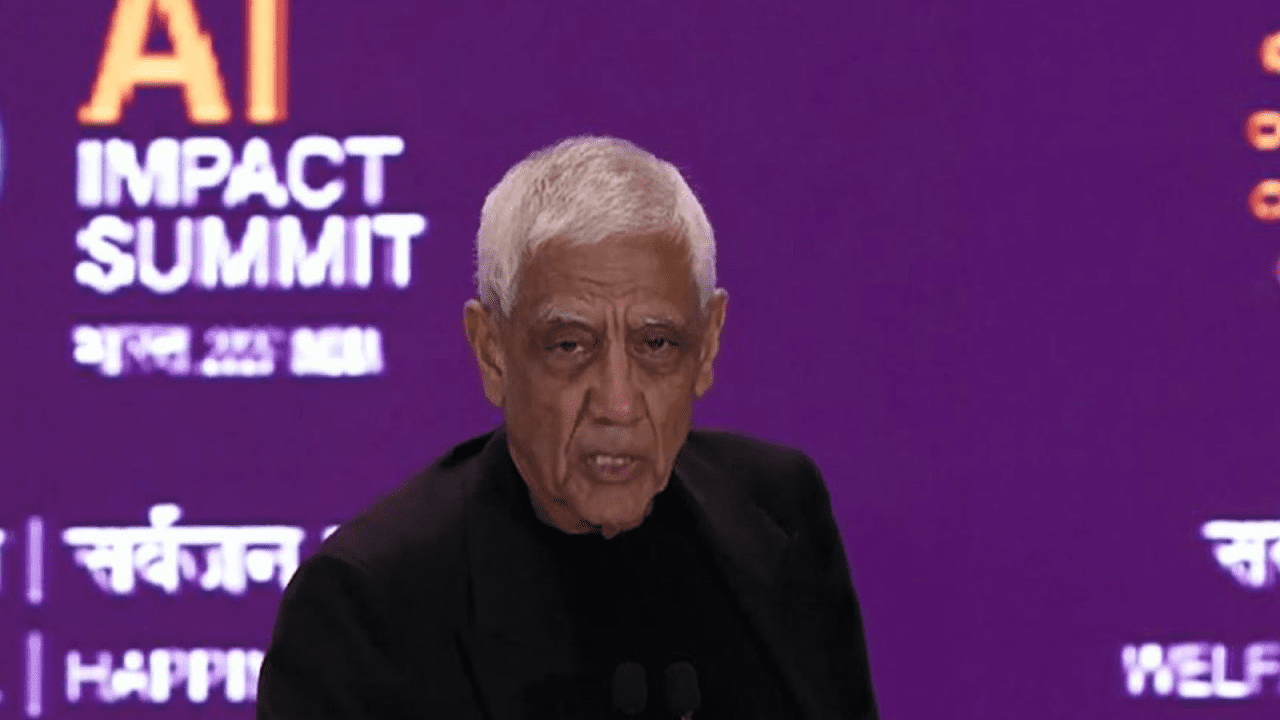
Vinod Khosla has proposed integrating AI tutors, doctors and agricultural experts into India’s Aadhaar ecosystem, outlining a plan that could deliver essential public services to more than a billion people within the next two years. Speaking at the AI Impact Summit in New Delhi, the founder of Khosla Ventures said India already has the digital infrastructure to scale such services rapidly and at low cost.
Addressing policymakers and industry leaders in the national capital, Khosla argued that India’s identity framework, powered by Aadhaar, could be leveraged in the same way it enabled the rise of Unified Payments Interface (UPI). By embedding AI-driven services into this ecosystem, he said, the country could democratize access to education, healthcare and agricultural expertise particularly for the bottom half of the population.
Also read: Vinod Khosla Predicts AI Will Eliminate IT and BPO Jobs Within Five Years
A Non-Profit Model to Build and Scale AI Services
Khosla suggested setting up a non-profit entity to build and operate these AI platforms before eventually integrating them into the Aadhaar ecosystem. He envisioned a service layer similar to UPI that would allow seamless delivery of AI-based public services nationwide.
“Aadhaar allowed us to offer UPI. There’s no reason we can’t offer, on the same identity-based system where the hard work has already been done, within a year or two to every Indian, these services,” he said.
He stressed that focusing on applications with direct social impact would ensure AI delivers transformative national benefits rather than remaining confined to elite or enterprise use cases.
AI Tutors to Personalise Learning at Scale
Khosla began with education, noting that AI-powered personal tutors are already being used by millions globally and are capable of delivering highly customised learning experiences.
According to him, these AI tutors can dynamically assess what a student does not understand and tailor lessons in real time often outperforming traditional human tutoring models. He added that such systems could significantly enhance the government’s DIKSHA platform by better organizing and personalizing its extensive content library.
By integrating AI into digital learning infrastructure, Khosla suggested India could dramatically improve educational outcomes at minimal incremental cost.
AI-Driven Primary Healthcare for All
Turning to healthcare, Khosla proposed round-the-clock AI-based primary care systems accessible to every Indian at little to no cost. These systems, he said, could provide comprehensive primary care services, including chronic disease management, mental health support, physical therapy and nutrition coaching.
“These will make available 24/7 to every Indian full primary care expertise,” he said, arguing that AI could effectively multiply India’s limited doctor resources.
With rising demand for healthcare services across the country, AI could bridge critical gaps in access, especially in underserved rural and semi-urban regions.
‘PhD-Level’ AI Agronomists for Farmers
Agriculture formed the third pillar of Khosla’s proposal. He called for equipping every farmer including those with small landholdings with access to what he described as a “PhD-level agronomist” through AI.
Available around the clock, such systems could offer guidance on crop management, soil health, pest control and productivity improvements. Khosla argued that scaling agronomy services through AI would directly benefit small and marginal farmers who often lack access to expert advice.
A “Massive Opportunity” for India
Khosla maintained that delivering AI-powered public services at scale is financially viable, requiring investments in the hundreds of millions of dollars modest compared to the potential national impact.
“These massive impact services that could be done with hundreds of millions of dollars can be done very, very cheaply scale medicine, scale teaching, scale education, scale agronomy,” he said. “If we don’t do that, it is a massive opportunity loss for us.”
He concluded that prioritizing AI applications that uplift the bottom half of the population is not only socially imperative but strategically essential for India’s long-term development.