
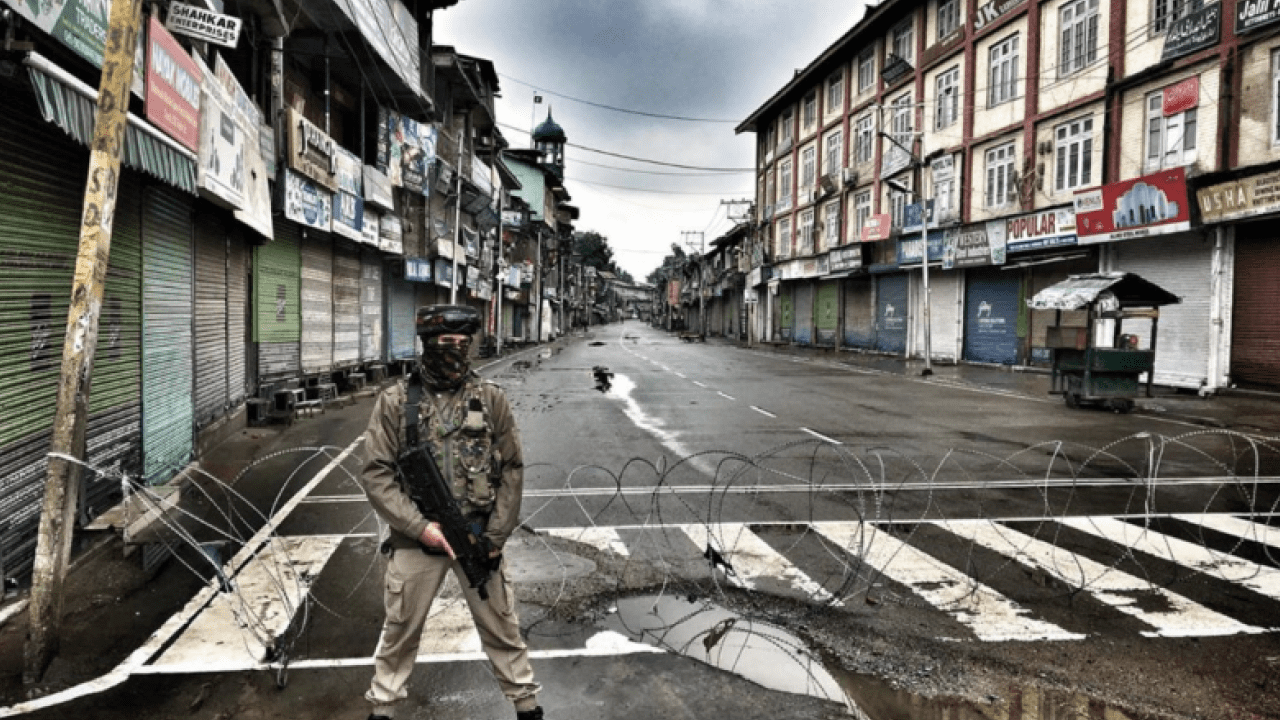
Kashmir imposed sweeping restrictions, shut schools, and curtailed internet services after Ayatollah Ali Khamenei’s killing in a reported joint U.S.–Israel strike triggered some of the largest protests seen in the Valley in years. Authorities moved swiftly to seal key areas of Srinagar, including Lal Chowk, as thousands of mourners took to the streets to express grief and anger over the death of Iran’s Supreme Leader, a figure revered by many in the region’s sizable Shia population.
Demonstrations erupted across Srinagar and extended to Budgam, Bandipora, Anantnag, Pulwama, and other districts. Protesters marched through city streets, gathered at major intersections, and staged sit-ins, raising slogans against the United States and Israel. The unrest prompted a high-level security response from the Jammu and Kashmir administration, which said the measures were preventive and aimed at maintaining public order.
While the protests were reported to be largely peaceful, officials curtailed mobile internet speeds across the Valley and ordered educational institutions to remain closed for two days. The developments come at a sensitive moment for the Union Territory, where authorities have been cautious about large-scale mobilizations in recent years.
Also read: Trump Threatens ‘Unprecedented Force’ as U.S.–Israel Offensive Kills Iran’s Supreme Leader
Streets Sealed, Internet Curtailed
The epicenter of the demonstrations was Lal Chowk, Srinagar’s commercial and symbolic heart. The iconic Ghanta Ghar (Clock Tower) square was sealed off with barricades and concertina wire, and security personnel including police and paramilitary units were deployed in large numbers. Similar restrictions were enforced in Shia-majority localities and at key junctions across the city.
Thousands converged at Lal Chowk, beating their chests in mourning and carrying photographs and flags associated with Khamenei. Women and children were among those participating in the demonstrations. Protesters also gathered outside the United Nations Military Observer Group in India and Pakistan (UNMOGIP) office in Srinagar’s Sonwar area, attempting to submit a memorandum. The office gates remained closed as security forces cordoned off the premises, and a prolonged sit-in followed.
Mobile internet services were slowed across networks, with officials stating that the move was intended to prevent the spread of rumors and curb mobilization through social media platforms. The Jammu and Kashmir Police issued a public advisory urging media organizations and social media users to verify information through official sources and avoid sensationalism. Authorities warned that action would be taken against those found spreading misinformation.
Despite the scale of the demonstrations, there were no reports of violence or major law-and-order breakdowns.
Schools Shut as Security Review Intensifies
The Jammu and Kashmir government ordered all schools and colleges including private institutions to remain closed for two days. The decision came just as educational institutions were scheduled to reopen following a three-month winter vacation. Examinations were also postponed as a precautionary measure.
Education Minister Sakina Itoo confirmed the closure, describing it as a necessary step in light of the evolving situation.
At the administrative level, Lieutenant Governor Manoj Sinha chaired a high-level security review meeting to assess the ground situation and review precautionary measures. Senior police officials, including Director General of Police Nalin Prabhat and Inspector General of Police (Kashmir Zone) VK Birdi, were seen personally monitoring deployments at protest sites.
Chief Minister Omar Abdullah appealed for calm and said the government was coordinating with the Ministry of External Affairs to ensure the safety and well-being of Jammu and Kashmir residents, including students currently in Iran.
Political and Religious Leaders Call for Peaceful Observance
The protests followed a one-day shutdown call issued by Mirwaiz Umar Farooq, chairman of the Mutahida Majlis-e-Ulama. He urged people to observe the strike with “unity, dignity, and complete peacefulness.” The shutdown call received backing from several political parties, including the People’s Democratic Party (PDP), whose president Mehbooba Mufti described the day as one of mourning and solidarity.
Large congregational prayers were offered in Srinagar during the demonstrations, and participants repeatedly described Khamenei as a central religious authority for Shia Muslims worldwide. Kashmir is estimated to have around 1.5 million Shia residents, a demographic factor that partly explains the scale and emotional intensity of the response.
Observers noted that protests of this magnitude have been rare in Srinagar in recent years, underscoring the depth of sentiment associated with Khamenei’s death.
Why This Matters
The unrest highlights the deep transnational religious and political connections that shape public sentiment in Kashmir. Although geographically distant from Iran, sections of the Valley’s population view developments in West Asia through a religious lens, particularly when it involves figures of spiritual authority.
The swift imposition of restrictions reflects the administration’s cautious approach to mass mobilizations. Authorities in Jammu and Kashmir have historically responded to large gatherings with preventive security measures to avoid escalation. The decision to slow internet services a recurring tool in the region during periods of tension signals concerns about digital platforms amplifying unrest.
The protests also carry diplomatic undertones. Demonstrators’ attempts to approach the UNMOGIP office suggest an effort to internationalize their grievance, even if symbolically. Meanwhile, the state government’s coordination with the Ministry of External Affairs indicates awareness of potential cross-border implications, particularly concerning students and residents abroad.
What Happens Next
Authorities are expected to reassess restrictions based on the security situation over the coming days. Schools are slated to reopen after the two-day closure, subject to review. Internet services may be fully restored if officials determine that the risk of unrest has subsided.
Political and religious leaders have publicly urged restraint, which could help prevent further escalation. However, the administration is likely to maintain heightened surveillance and deployment in sensitive areas, particularly in Shia-dominated neighborhoods.
For now, Kashmir remains on alert navigating the fallout of an international geopolitical shock that has resonated powerfully within the Valley.