
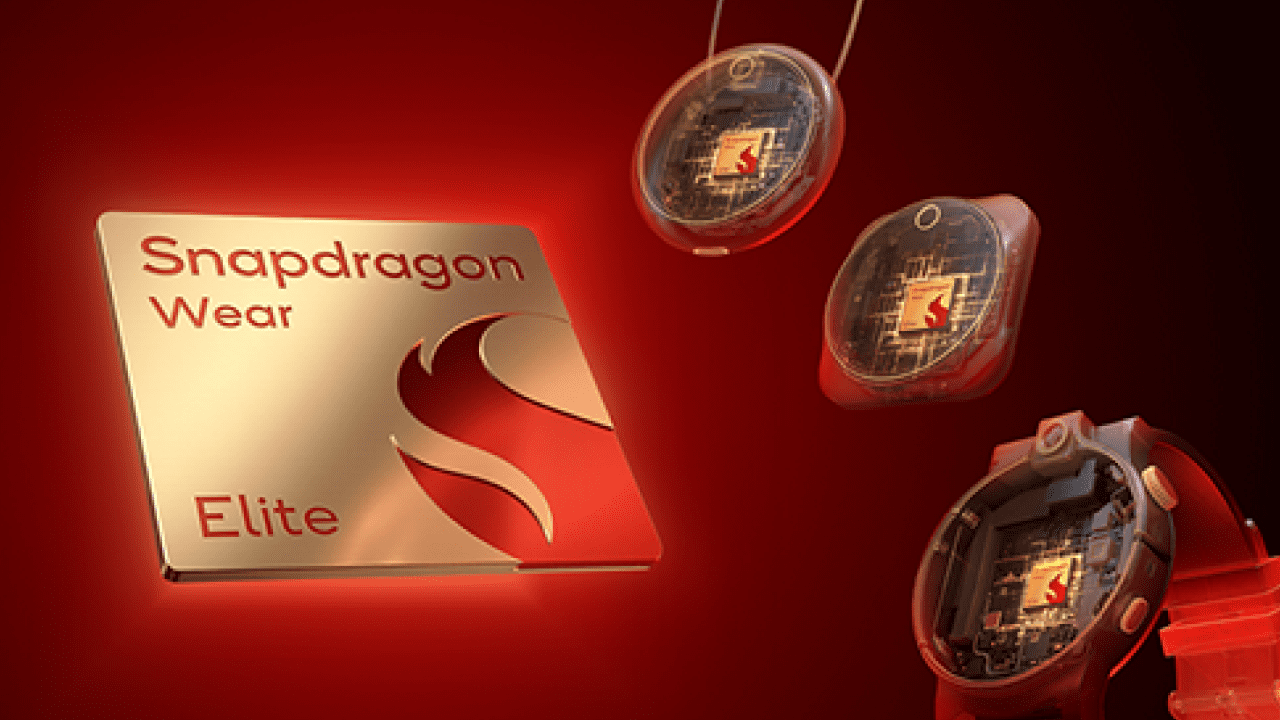
Snapdragon Wear Elite is Qualcomm’s boldest push yet into AI-powered wearables, unveiled at Mobile World Congress 2026 in Barcelona as the company seeks to redefine what smartwatches, AI glasses, and emerging “pin” devices can do independently of the cloud.
Built on an advanced 3nm process, the new chip is designed to anchor the next generation of premium Wear OS devices including the upcoming Samsung Galaxy Watch while also expanding into AI-first hardware categories such as smart glasses and pendants. Qualcomm positions the platform above its current W5+ Gen 2 tier, introducing “Elite” branding to signal a significant leap in performance, AI capability, and power efficiency.
Unlike Qualcomm’s flagship smartphone processors, the Wear Elite does not use Oryon cores. Instead, it adopts a big.LITTLE architecture for the first time in the company’s wearable lineup, combining one high-performance core clocked at up to 2.1GHz with four efficiency cores running at 1.95GHz. The result, Qualcomm says, is a fivefold improvement in single-core CPU performance compared to its predecessor, delivering faster app launches, smoother multitasking, and quicker boot times.
The Adreno A622 GPU also sees a substantial uplift, with up to seven times better graphics performance and support for 1080p at 60 frames per second an upgrade aimed at fluid animations and more immersive interfaces on small displays.
But the true centerpiece is artificial intelligence.
AI at the Core: On-Device Intelligence Without the Cloud
Snapdragon Wear Elite integrates both a Hexagon NPU and a dedicated low-power eNPU. The Hexagon NPU can handle AI models with up to two billion parameters directly on-device and process up to 10 tokens per second, enabling real-time tasks such as transcription, translation, computer vision, and AI assistant responses without relying on cloud servers.
The eNPU is optimized for always-on, low-energy tasks including keyword detection, noise suppression, and activity recognition. This architecture replaces the earlier co-processor design and introduces what Qualcomm describes as “low-power islands” specialized subsystems for audio, sensors, and display that function like independent SoCs within the main chip.
The platform is capable of managing as many as 50 concurrent sensors, supporting advanced health and wellness features such as heart rate monitoring, sleep analysis, stress tracking, and multi-activity fitness detection without significantly impacting battery life.
Qualcomm says the improvements translate into roughly 30% longer usage compared to the previous generation, with GPS tracking alone consuming 40% less power than before. Devices using typical 300–600mAh batteries can reach 50% charge in around 10 minutes via 9V quick charging.
Connectivity Breakthroughs: From Wi-Fi 6 to Satellite Links
One of the platform’s most significant upgrades is what Qualcomm calls “hexa-connectivity.” The chip integrates six major wireless technologies:
- 5G RedCap
- Wi-Fi 6 (802.11ax)
- Ultra-Wideband (UWB)
- Bluetooth 6.0
- GNSS location services
- NB-NTN satellite connectivity
For the first time in a Qualcomm wearable chip, UWB is integrated directly for secure device unlocking and proximity-based interactions. Satellite connectivity support enables devices to communicate even without traditional cellular or Wi-Fi coverage a feature increasingly relevant for outdoor fitness and safety use cases.
Micro-power Wi-Fi further reduces radio energy consumption by up to 80%, enabling always-on connectivity without dramatically draining the battery.
The chipset also supports NFC for contactless payments, LPDDR5 RAM running at 6400MHz, and up to 32GB of eMMC storage.
Expanding Beyond Smartwatches
While the next generation of the Samsung Galaxy Watch is confirmed to use Snapdragon Wear Elite, Qualcomm is positioning the chip as a broader AI wearable platform.
The company describes it as a “wrist-plus” chip designed to complement, not replace, the W5+ series. That distinction suggests Qualcomm sees diversified wearable categories emerging alongside traditional smartwatches.
In addition to Wear OS and Android support, the chip also runs Linux, making it attractive to startups building AI pins, pendants, or display-less smart glasses. Depending on camera and display configurations, Snapdragon Wear Elite can even serve as an alternative to Qualcomm’s AR-focused silicon for certain lightweight glasses applications.
Qualcomm says the first commercial devices powered by the chip are expected to launch within the next few months, with brands including Samsung and Motorola already signaling adoption plans.
Industry / Market Impact
The unveiling at Mobile World Congress 2026 underscores Qualcomm’s broader strategy to dominate the emerging AI hardware ecosystem.
As AI processing shifts from cloud servers to edge devices, wearable chips capable of running large language and vision models locally could reshape consumer expectations. By enabling up to two billion parameters on-device, Qualcomm is pushing wearables closer to smartphone-level AI independence.
This move also intensifies competition in the wearable semiconductor market. Google has publicly emphasized transforming Wear OS into a more intelligent, proactive system, while reports suggest Apple is exploring AI-centric wearable concepts. Qualcomm’s new silicon positions it as a central supplier for manufacturers racing to define that next category.
Importantly, satellite connectivity and 5G RedCap integration may also open new commercial and enterprise applications, from remote workforce safety to connected healthcare.
Why This Matters
Wearables have historically been limited by battery constraints and dependence on smartphone pairing. Snapdragon Wear Elite addresses both challenges simultaneously.
On-device AI reduces reliance on cloud connectivity, improving privacy and lowering latency. Enhanced efficiency extends battery life while enabling more sophisticated sensing and multitasking. Meanwhile, expanded connectivity including satellite makes wearables more autonomous than ever before.
If widely adopted, this chip could mark a turning point where smartwatches and AI accessories evolve from notification hubs into standalone intelligent companions.
What Happens Next
Commercial devices are expected in the coming months, beginning with premium smartwatches and potentially expanding into AI glasses and minimalist wearable devices.
The critical test will be whether manufacturers can deliver compelling use cases that justify the expanded AI horsepower. Hardware capabilities are advancing rapidly the next phase will depend on software ecosystems and consumer adoption.
Qualcomm’s bet is clear: AI wearables are no longer experimental concepts, but the next frontier of personal computing.