
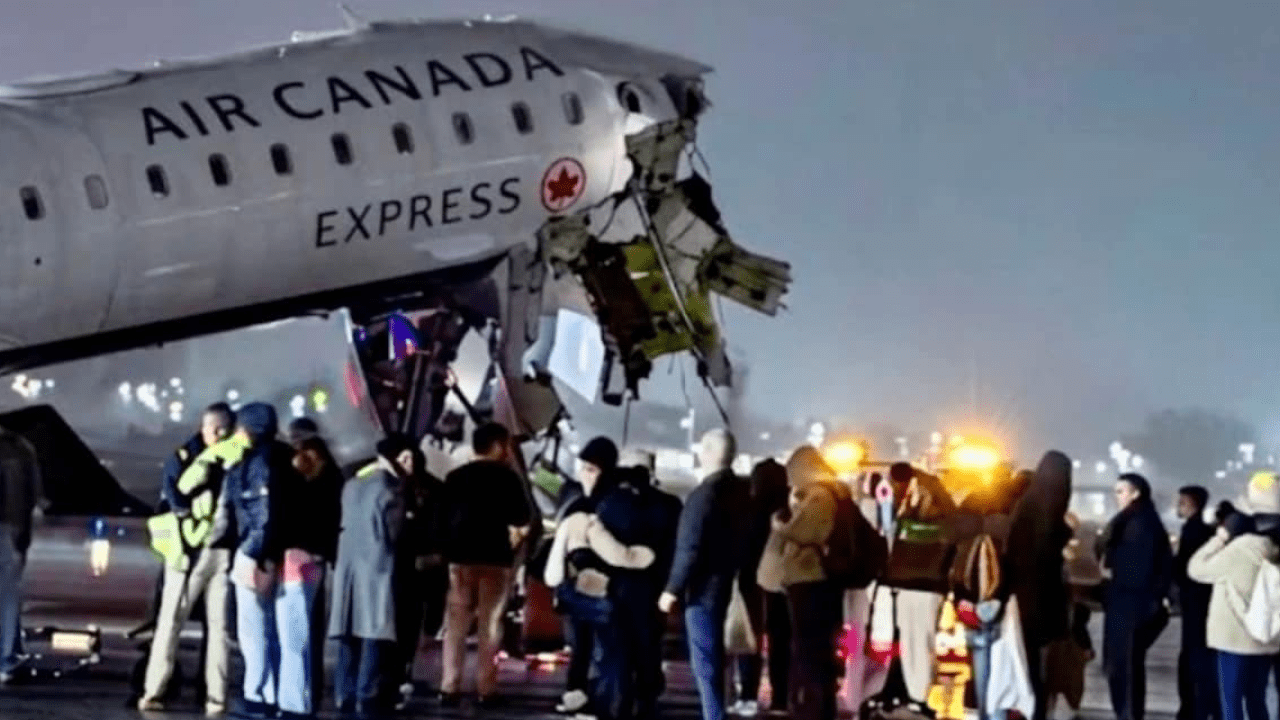
A LaGuardia airport collision involving an Air Canada Express regional jet and a fire truck brought operations at one of New York’s busiest airports to a standstill early Monday, leaving multiple casualties and raising urgent questions about runway safety protocols.
The incident occurred near runway 4-22 at LaGuardia Airport in Queens, where an Air Canada Express CRJ-900 aircraft, reportedly bound for Montreal, struck a ground emergency vehicle during active runway operations. The collision prompted the Federal Aviation Administration (FAA) to impose an immediate ground stop, halting all arrivals and departures as emergency crews rushed to the scene.
Early reports indicate that at least two people were killed and around 70 others injured, including several firefighters in critical condition. While authorities have not yet released a full official casualty breakdown, the scale of the response and initial visuals suggest a high-impact crash involving significant damage to the aircraft’s cockpit.
Passengers aboard the aircraft were evacuated onto the tarmac as emergency teams secured the site. The FAA cited an “emergency” in its notice to airmen and warned that the shutdown could extend for hours, with operations potentially suspended until at least 1800 GMT.
Also read: Indian National Removed from Canada Amid Growing Extortion Crackdown
Chaos Captured in Air Traffic Control Audio
Dramatic audio purportedly from the LaGuardia control tower has surfaced online, capturing the tense moments leading up to the collision. In the recording, controllers can be heard coordinating runway movements before abruptly issuing urgent commands.
Repeated shouts of “Stop, stop, stop!” were directed at a ground vehicle identified as “Truck 1,” suggesting a last-minute attempt to prevent the collision. Moments later, controllers instructed nearby aircraft to abort landings and execute go-arounds, indicating that the crash had already occurred or was imminent.
The audio also reveals immediate post-impact confusion, with controllers acknowledging that an aircraft had struck a vehicle and directing emergency responders onto the runway. While the authenticity of the recording has not been independently verified, it aligns with the sequence of events described in initial reports.
Extensive Damage and Emergency Response
Images from the scene show severe structural damage concentrated around the aircraft’s cockpit, reinforcing accounts that the impact occurred at the front of the plane. Emergency vehicles quickly surrounded the aircraft as responders worked to assist injured passengers and crew.
The New York City Fire Department confirmed it responded to what it described as an incident involving “a plane and a vehicle” on the runway. Multiple emergency units, including firefighting and police teams, were deployed to manage the situation and assist with evacuation efforts.
Runway 4-22 was immediately closed, followed by a full airport shutdown as authorities worked to secure the area and assess risks to other operations.
What Happens Next
A comprehensive investigation is expected to focus on how a fire truck came to be on an active runway during aircraft movement. Key areas of scrutiny will likely include:
- Air traffic control instructions and communication clarity
- Coordination between ground vehicles and runway operations
- Compliance with safety protocols for emergency vehicle access
- Timing and sequencing of aircraft movements
Investigators are expected to analyze flight tracking data, ATC recordings, and surveillance footage to reconstruct the sequence of events leading up to the collision.
The FAA, along with other aviation safety bodies, will likely issue preliminary findings in the coming days, followed by a more detailed report.
Industry / Market Impact
The LaGuardia airport collision has immediate implications for airline operations across the northeastern United States, particularly given LaGuardia’s role as a critical domestic hub.
The ground stop led to widespread delays and cancellations, affecting hundreds of flights and disrupting passenger schedules across multiple carriers. The incident also adds pressure to an aviation system already strained by weather disruptions and staffing shortages.
In the longer term, the crash could trigger renewed scrutiny of runway safety procedures at major airports, especially regarding the interaction between aircraft and ground vehicles. Airlines and regulators may face calls to implement stricter safeguards, enhanced communication systems, and improved training protocols.
Background Context
Runway incursions incidents where unauthorized vehicles, aircraft, or personnel enter an active runway have long been a concern in aviation safety. While rare, such events carry the potential for catastrophic outcomes, particularly at high-traffic airports like LaGuardia.
Airports rely on precise coordination between air traffic controllers, pilots, and ground crews to prevent such incidents. Emergency vehicles, including fire trucks, are occasionally granted runway access during urgent situations, but strict clearance procedures are designed to avoid conflicts with aircraft.
The circumstances surrounding this collision suggest a possible breakdown in that coordination, though officials have yet to confirm the exact cause.
Why This Matters
The severity of the LaGuardia airport collision underscores the critical importance of real-time communication and strict adherence to runway protocols. Even minor lapses in coordination can escalate rapidly in complex airport environments.
With casualties reported and dozens injured, the incident is likely to intensify calls for technological upgrades, such as advanced runway monitoring systems and automated alerts to prevent similar occurrences.
As investigations continue, the findings could shape future aviation safety regulations not only in the United States but globally.