
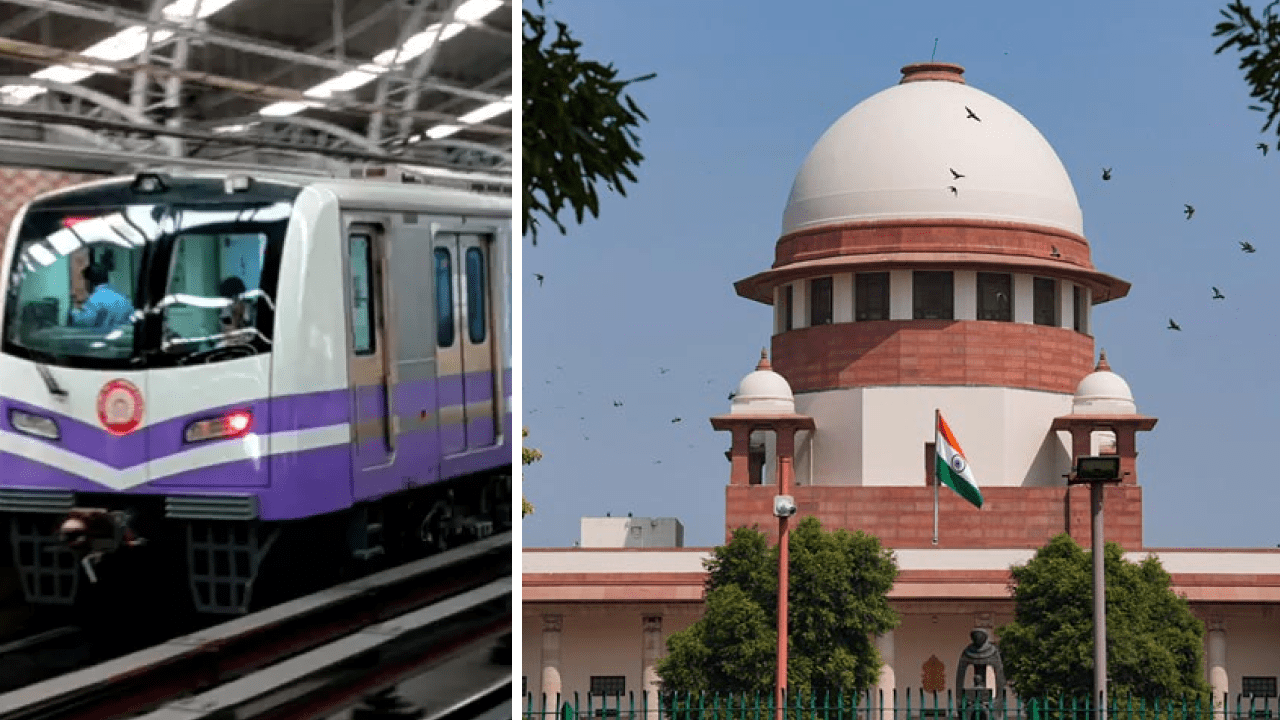
India’s Supreme Court on Monday sharply criticised the West Bengal government for delaying work on the Kolkata Metro Orange Line, refusing to grant more time and warning against politicising a key public infrastructure project.
Hearing an appeal against a prior order of the Calcutta High Court, a bench led by Chief Justice Surya Kant dismissed the state’s request to postpone construction at the busy Chingrighata crossing, calling the move “frivolous” and indicative of an “obstinate attitude.” The court said the government was effectively stalling a project designed to improve urban mobility for millions in Kolkata.
The ruling reinforces judicial pressure to complete a crucial segment of the metro corridor linking Salt Lake’s IT hub Sector V with southern parts of the city an artery long delayed due to disputes over traffic management and administrative coordination.
Court Flags ‘Dereliction of Duty’
The Supreme Court bench, which also included Justices Joymalya Bagchi and Vipul M Pancholi, expressed strong disapproval of the state’s conduct, stating that authorities had failed in their constitutional obligations.
Judges questioned why the government had not complied with the high court’s December 23 directive well before the enforcement of the election model code of conduct. The bench rejected arguments citing upcoming elections, board examinations, and local festivals as reasons for delay, asserting that such factors could not justify halting a long-running public project.
The court also indicated that the high court had shown considerable restraint so far, noting that senior officials including the chief secretary and director general of police could have faced stricter consequences for non-compliance.
Dispute Over Chingrighata Crossing
At the centre of the dispute is construction work at Chingrighata, a critical junction on the Eastern Metropolitan Bypass. The project requires temporary traffic blocks to complete overhead metro infrastructure, but state authorities had raised concerns about disruption.
Counsel for the state argued that the stretch serves as a vital emergency corridor for ambulances and organ transport vehicles, warning that road closures could hamper critical services. However, the court dismissed these concerns as insufficient to justify prolonged inaction, emphasizing that logistical arrangements should have been made.
The high court had earlier directed the state to coordinate with Metro Railway authorities and allocate specific days for traffic diversion, aiming to complete the work by February 15, 2026. The Supreme Court found no fault with that order and declined to interfere.
High Court to Continue Oversight
In its ruling, the apex court authorised the high court to take necessary steps to ensure compliance with its earlier directions, effectively strengthening judicial oversight of the project’s completion.
A related contempt petition against senior state officials remains pending before the high court, adding further legal pressure on the administration to act promptly.
The Supreme Court also refused to allow the state to withdraw its plea at a late stage, underscoring its intent to deliver a clear message on accountability.
Why This Matters
The Kolkata Metro expansion particularly the Orange Line is seen as a transformative project for one of India’s most congested metropolitan regions. The corridor is expected to significantly cut travel time between key residential, commercial, and IT zones.
Delays at bottleneck points like Chingrighata have held up the broader network’s operational readiness, affecting daily commuters and economic activity. The court’s intervention highlights the growing role of judicial oversight in infrastructure delivery, especially when administrative delays threaten public interest.
The case also underscores tensions between governance priorities balancing public convenience, emergency services, and development timelines while raising broader questions about accountability in large-scale urban projects.
Timeline of Events
- December 23, 2025: Calcutta High Court orders completion of metro work at Chingrighata by February 15, 2026.
- January 6, 2026: Deadline set for state authorities to identify dates for traffic diversion.
- Early 2026: State cites elections, exams, and festivals as reasons for delay.
- March 2026: State approaches Supreme Court seeking extension until May.
- March 2026 (Current Ruling): Supreme Court dismisses plea, criticises state, and directs compliance.
What Happens Next
With the Supreme Court declining relief, the onus is now firmly on the West Bengal government to facilitate immediate completion of the pending work.
The high court is expected to closely monitor progress, and failure to comply could lead to contempt proceedings against senior officials. Meanwhile, Metro authorities are likely to push for expedited execution, leveraging the court’s directive to overcome administrative bottlenecks.
If implemented as directed, the completion of this stretch could unlock operational readiness for a major segment of the Orange Line, offering long-awaited relief to commuters in Kolkata.