
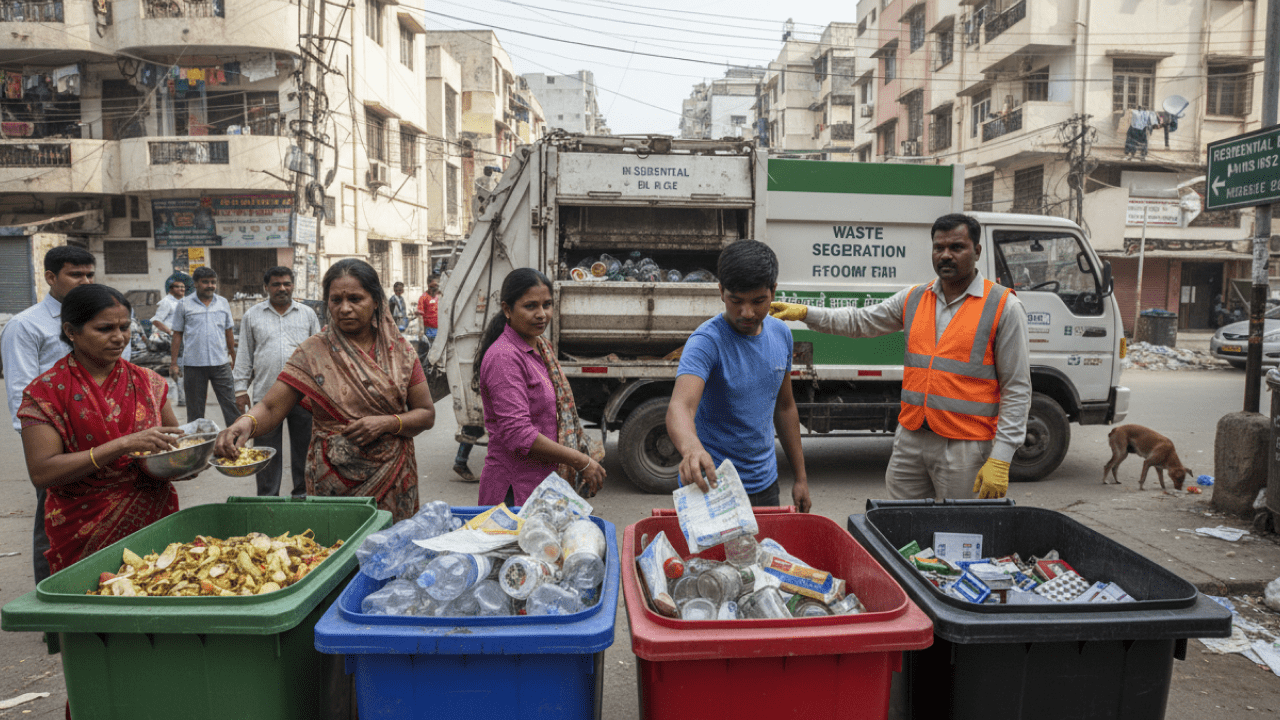
India’s new four-bin waste segregation rule has come into effect from April 1, marking a significant overhaul of the country’s solid waste management system. The updated framework mandates households, institutions, and businesses across urban and rural areas to separate waste into four distinct categories at the source an expansion from the long-standing two-bin model. Authorities say the move is aimed at improving waste processing efficiency, reducing landfill pressure, and addressing escalating environmental concerns.
The revised guidelines, introduced under the Solid Waste Management Rules, 2026 by the Ministry of Environment, Forest and Climate Change, require citizens to sort waste into colour-coded bins, green for wet waste, blue for dry waste, red for sanitary waste, and black for hazardous materials. The rules apply broadly, covering residential areas, industrial zones, airports, railway premises, religious sites, and both public and private properties nationwide.
Under the new system, sanitation workers have been empowered to refuse collection if waste is not properly segregated, signaling a stricter enforcement approach. Authorities are also rolling out upgraded collection infrastructure, including multi-compartment garbage trucks designed to prevent mixing during transportation.
Also read: Raghav Chadha Flags ‘Sugar Syrup’ Sold as Fruit Juice, Urges Crackdown on Misleading Beverage Ads
What the Four-Bin System Means
The four-bin model introduces a more granular classification of waste:
- Green bin (wet waste): Biodegradable materials such as food scraps and vegetable peels
- Blue bin (dry waste): Recyclables including plastic, paper, glass, and metal
- Red bin (sanitary waste): Items like diapers and sanitary napkins, which must be securely wrapped before disposal
- Black bin (hazardous waste): Dangerous or special waste such as medicines, bulbs, paint, and electronic waste
In addition to household waste, the rules explicitly require the separation of construction and demolition debris and prohibit mixing biomedical waste with general garbage.
Bulk waste generators including large residential complexes, hotels, and institutions face stricter obligations. Facilities generating more than 100 kilograms of waste daily or occupying large premises must process wet waste on-site, reducing reliance on municipal systems.
Why This Matters
India generates millions of tonnes of waste annually, much of which ends up in overflowing landfills due to poor segregation practices. By enforcing segregation at the source, the government aims to streamline recycling, composting, and safe disposal processes.
Improperly mixed waste has long been a bottleneck in waste management, contaminating recyclable materials and increasing health risks. The inclusion of sanitary and hazardous waste as separate categories is particularly significant, as these materials require specialized handling to prevent environmental and public health hazards.
The rules also formalize the “polluter pays” principle, allowing authorities to impose penalties on individuals and entities that fail to comply. Violations such as non-segregation, improper disposal, or false reporting can now attract environmental compensation charges.
Industry and Municipal Impact
The transition to a four-bin system is expected to reshape municipal operations and the waste management industry. Local bodies have already begun modifying collection systems, including deploying vehicles with separate compartments for each waste type.
For sanitation workers, the changes could improve working conditions by reducing exposure to mixed and hazardous waste. However, the stricter enforcement may also increase friction during the initial rollout as citizens adapt to the new requirements.
Waste processing industries, including recycling and composting sectors, are likely to benefit from cleaner, better-sorted input materials. Improved segregation could enhance the efficiency of recycling chains and reduce contamination-related losses.
Municipal authorities, meanwhile, face the challenge of scaling infrastructure and ensuring compliance across diverse regions. Digital monitoring systems introduced by the Central Pollution Control Board are expected to track implementation and identify gaps in real time.
What Happens Next
The success of the new waste segregation rule will depend heavily on public participation and enforcement consistency. Civic bodies have begun awareness campaigns urging citizens to adopt responsible disposal habits, including segregating waste at home, avoiding open dumping, and adhering to designated collection schedules.
Authorities are also encouraging community-level monitoring and reporting of violations to strengthen compliance. Over time, stricter penalties and improved infrastructure are expected to drive behavioral change.
If effectively implemented, the four-bin system could significantly reduce landfill dependency, boost recycling rates, and improve environmental outcomes. However, experts caution that sustained public engagement and robust municipal support will be critical to achieving these goals.