
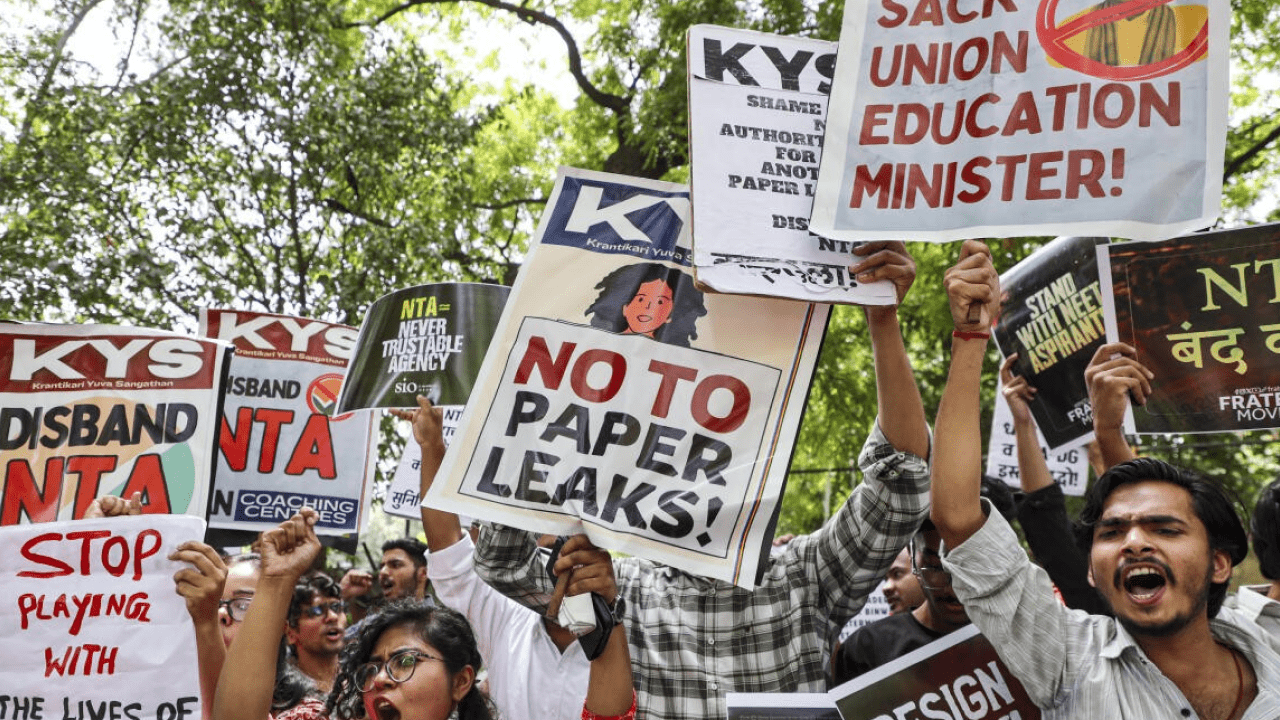
The NEET UG 2026 paper leak controversy has triggered one of the biggest credibility crises in India’s entrance examination system, forcing the Union government to cancel the medical entrance test and announce a nationwide re-examination. Accepting accountability for the security lapse, Union Education Minister Dharmendra Pradhan on Friday acknowledged a “breach in the chain of command” despite reforms introduced after the 2024 NEET scandal.
The National Eligibility cum Entrance Test (NEET-UG), conducted on May 3 for lakhs of aspiring medical students, was scrapped after authorities confirmed that portions of the actual question paper had circulated under the guise of “guess papers.” The fresh examination is now scheduled for June 21, while the Central Bureau of Investigation (CBI) has been tasked with tracing the source of the leak and identifying those involved, including possible insiders within the National Testing Agency (NTA).
The controversy has once again placed India’s examination infrastructure under scrutiny, particularly after the government had implemented recommendations from the high-level Radhakrishnan Committee formed in response to the 2024 NEET paper leak crisis.
Speaking at a press conference, Pradhan said the government regretted the need for a re-examination but insisted the decision was necessary to protect meritorious students from being disadvantaged by organised cheating networks and the so-called “education mafia.”
How the NEET UG 2026 Leak Was Detected
According to the Education Ministry, the examination initially proceeded without disruption on May 3. However, by May 7, the NTA began receiving complaints that several questions circulating in unofficial “guess papers” closely matched the actual exam.
Following these complaints, the Higher Education Department initiated an internal enquiry and coordinated with central agencies and state authorities. By May 12, investigators concluded that the original paper had indeed been compromised, prompting the government to cancel the exam nationwide.
The issue escalated further after the CBI informed a Delhi court that the leak may have originated from within the NTA itself. Investigators are now examining the involvement of agency officials and other government-linked personnel connected to the examination process.
Pradhan said the government would allow the probe to continue independently and assured students that strict action would be taken against everyone involved.
Major Changes Announced for the NEET Re-Exam
The Ministry of Education and NTA have introduced several procedural changes for the June 21 re-examination in an attempt to restore confidence among students and parents.
Key changes include:
- Candidates will be allowed to choose their preferred examination city.
- Additional time of 15 minutes will be provided for OMR sheet formalities and verification procedures.
- The revised examination schedule will run from 2 pm to 5:15 pm.
- Fresh admit cards will be released by June 14 through the official NTA portal.
- Students will not be required to register again for the re-exam.
- Previously paid examination fees will either remain valid or be refunded where applicable.
The Education Minister also announced a significant long-term shift in the examination format. Beginning next year, NEET will move entirely to computer-based testing (CBT), a reform the Radhakrishnan Committee had strongly advocated to reduce paper leak risks and improve transparency.
Expert Analysis / What This Means
The NEET UG 2026 controversy represents more than a single examination failure it highlights deep structural vulnerabilities in India’s high-stakes testing ecosystem. Despite reforms introduced after the 2024 leak, another breach has exposed weaknesses in operational oversight and exam security implementation.
For students, the immediate impact is severe. Lakhs of aspirants who spent months preparing now face additional psychological pressure, uncertainty in admission timelines, and the burden of revising for a second attempt. Many families may also incur added travel and accommodation expenses despite the government’s effort to allow city selection flexibility.
From an institutional standpoint, the crisis damages the credibility of the NTA, which was already under scrutiny after previous examination irregularities. Repeated breaches could further erode public trust in centralised entrance examinations and intensify demands for independent oversight mechanisms.
The decision to transition NEET to a fully computer-based format signals that the government recognises traditional paper-based systems as increasingly vulnerable to organised cheating networks. However, implementing CBT at the scale of NEET one of the world’s largest entrance exams will require substantial technological infrastructure and cybersecurity safeguards.
The controversy also reflects the growing sophistication of exam fraud syndicates operating across states. Investigators now appear to be focusing not only on external leak networks but also on possible insider collusion, which could lead to wider institutional reforms in recruitment, monitoring, and accountability within testing agencies.
If the CBI probe confirms internal involvement, the case could become a turning point for how national examinations are administered in India.
Industry / Market Impact
The paper leak controversy is expected to have ripple effects across India’s education and edtech sectors. Coaching institutes, online preparation platforms, and counselling services are already recalibrating schedules due to the revised examination timeline.
The move toward computer-based NEET examinations may also accelerate investments in digital testing infrastructure, cybersecurity solutions, AI-based proctoring systems, and secure exam delivery platforms. Technology firms specialising in large-scale assessment systems could see increased demand from both government agencies and educational institutions.
At the same time, repeated exam disruptions risk undermining confidence among international academic observers and healthcare institutions monitoring India’s medical education pipeline.
Timeline of Events
May 3, 2026
NEET UG 2026 examination conducted nationwide.
May 7, 2026
Complaints emerge regarding “guess papers” containing questions matching the actual exam.
May 7–12, 2026
Higher Education Department, central agencies, and state authorities conduct preliminary investigations.
May 12, 2026
Government confirms paper compromise and cancels NEET UG 2026.
May 15, 2026
Education Minister Dharmendra Pradhan publicly accepts responsibility for the breach and announces reforms.
June 14, 2026
Expected release date for revised admit cards.
June 21, 2026
NEET UG 2026 re-examination scheduled.
What Happens Next
The immediate focus will remain on conducting the June 21 re-examination smoothly while ensuring stricter monitoring protocols across centres. The CBI investigation is likely to intensify in the coming weeks, especially regarding allegations of insider involvement within the NTA.
The government is also expected to fast-track structural reforms recommended by the Radhakrishnan Committee, including stronger digital security systems, tighter control over paper logistics, and enhanced accountability mechanisms for officials involved in exam administration.
Meanwhile, students and parents will closely watch whether authorities can restore confidence in one of India’s most important competitive examinations after back-to-back controversies.