
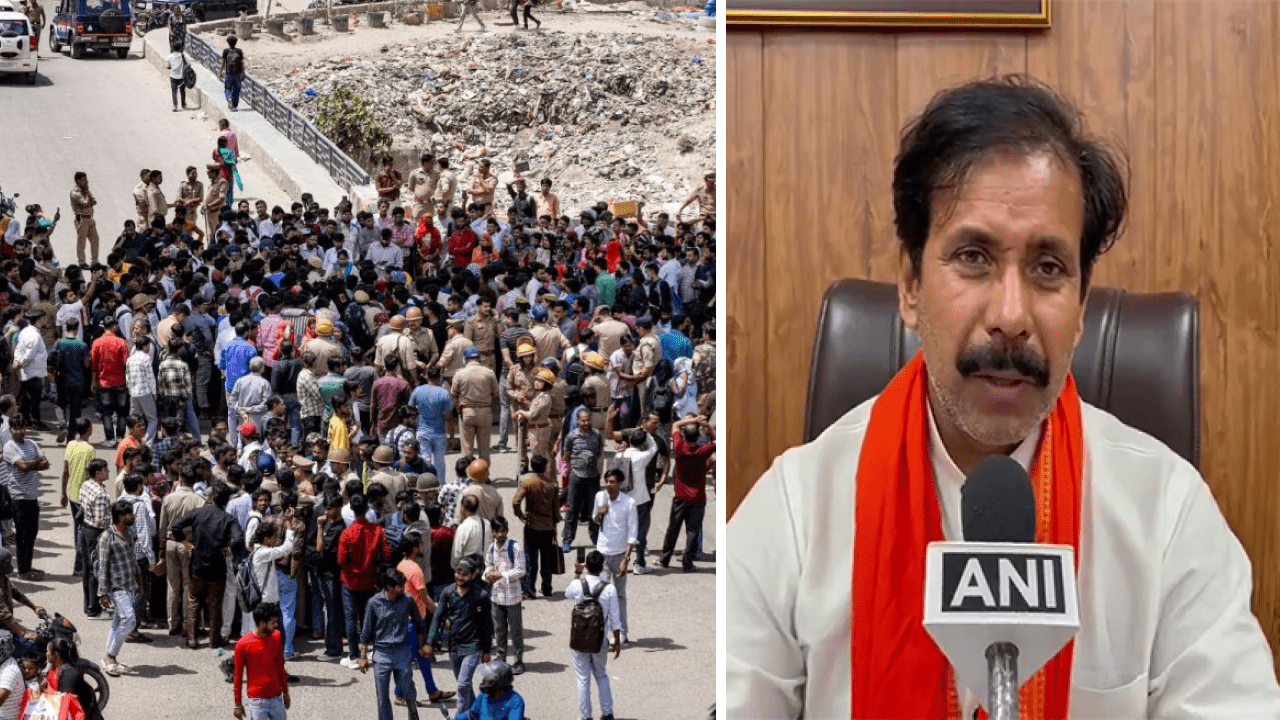
Violence erupted across multiple industrial zones in Noida on Monday as protests by factory workers demanding wage hikes spiraled into clashes, arson, and widespread disruption, prompting the Uttar Pradesh government to launch a high-level investigation into what it describes as a possible “planned conspiracy.” Authorities are also examining claims of external involvement, including a potential Pakistan link, amid heightened security concerns following recent terror-related arrests in the region.
The unrest broke out in key industrial pockets such as Phase-2, Sector 60, Sector 62, and Sector 84, where large groups of workers gathered to press for higher wages. What began as organised demonstrations escalated into incidents of stone-pelting, vandalism, and vehicles being set ablaze. Traffic movement was severely affected across major routes, while law enforcement agencies rushed to contain the situation.
Uttar Pradesh Labour Minister Anil Rajbhar alleged that the violence may not have been spontaneous. He stated that preliminary assessments suggest an attempt to disrupt law and order and derail the state’s development trajectory. His remarks come in the context of recent arrests of four suspected terrorists in Meerut and Noida, who are believed to have links with handlers based in Pakistan. While investigations are ongoing, officials have not independently confirmed any direct connection between those arrests and the violence.
Authorities also indicated that the timing of the unrest could be significant, suggesting it may have been intended to interfere with Chief Minister Yogi Adityanath’s scheduled programme in Muzaffarnagar on the same day.
Also read: Noida Workers’ Protest Turns Violent Over Wage Demands, Vehicles Torched in Industrial Belt
Law Enforcement Response and Ground Situation
Heavy deployment of police and paramilitary forces helped bring the situation under control by late evening, officials said. Senior administrative and police officers were dispatched to the affected areas on the Chief Minister’s instructions, and they have been engaging directly with worker representatives to de-escalate tensions.
Noida Police Commissioner Laxmi Singh attributed part of the escalation to misinformation spread through social media. According to her statement, two accounts were identified as key sources of misleading content that contributed to inflaming the protests. Legal action has been initiated against those responsible.
Singh further noted that individuals from neighbouring districts may have entered protest zones, exacerbating the situation. Several people have been detained in connection with the violence. Despite the unrest in some areas, police reported that out of 83 protest locations involving approximately 42,000 workers, demonstrations remained peaceful in the majority of cases, with only a handful turning violent.
Why This Matters
The Noida violence underscores growing tensions in industrial hubs where labour demands intersect with economic pressures. Noida, part of the National Capital Region (NCR), is a major manufacturing and services centre, making stability in the region critical for both state and national economic output.
Any prolonged unrest could disrupt supply chains, deter investment, and impact industrial productivity. The suggestion of a larger conspiracy, particularly involving external elements, raises the stakes further by linking labour unrest with national security concerns an intersection that demands careful and evidence-based investigation.
At the same time, the episode highlights the increasing role of digital misinformation in amplifying on-ground tensions. Authorities’ identification of social media as a trigger point reflects a broader pattern seen in recent incidents across India, where online narratives can rapidly translate into real-world consequences.
Background Context
The protests were primarily driven by demands for wage increases, reflecting ongoing concerns among industrial workers over rising living costs and compensation disparities. Uttar Pradesh has positioned itself as an investment-friendly state in recent years, with initiatives aimed at boosting manufacturing and infrastructure development.
The state government has repeatedly emphasized labour welfare under its “Shramev Jayate” framework, which seeks to balance industrial growth with worker rights. However, periodic unrest in industrial clusters suggests that gaps remain in addressing worker grievances at scale.
The recent arrests of suspected terrorists in nearby districts have also heightened security vigilance, creating a backdrop in which any large-scale disturbance is likely to be scrutinized through both law-and-order and national security lenses.
What Happens Next
Investigative agencies are now tasked with determining whether the violence was purely a result of labour unrest or part of a more coordinated effort involving misinformation or external actors. Officials have indicated that all angles including digital incitement and cross-district mobilization are under active examination.
On the administrative front, the state government has prioritised dialogue as the primary mechanism for resolution. Senior officials are continuing discussions with worker groups to address their demands and prevent further escalation.
Meanwhile, security remains tight across Noida’s industrial zones, with authorities maintaining a visible presence to deter any resurgence of violence. Further arrests and legal actions are expected as the investigation progresses.