
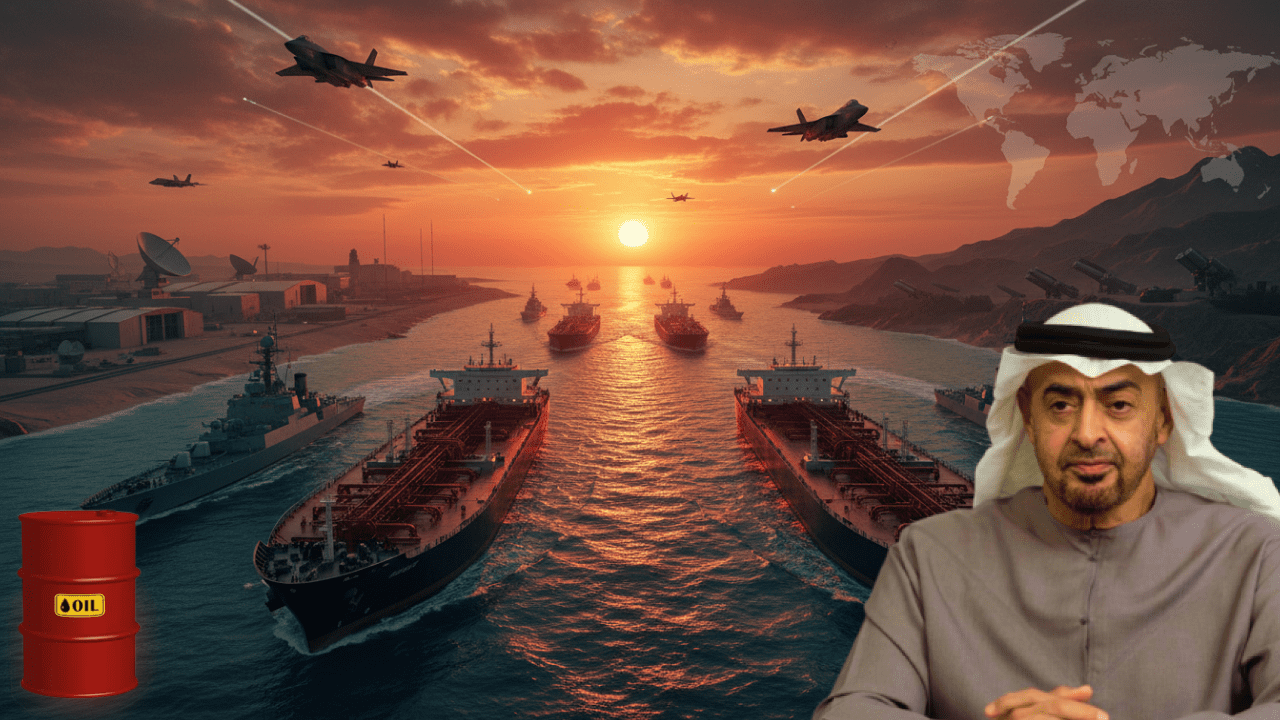
The United Arab Emirates is actively considering a direct military role alongside the United States and its allies to reopen the Strait of Hormuz, marking a potential turning point in the widening Iran conflict. According to multiple reports citing regional and diplomatic officials, Abu Dhabi is exploring participation in a coalition that could use force to secure one of the world’s most critical oil transit routes, as tensions with Iran intensify and global energy security hangs in the balance.
The development comes as Iran continues retaliatory strikes against Gulf states following US and Israeli military actions on its territory. The Strait of Hormuz a narrow maritime chokepoint through which a significant share of global oil supply passes has become a focal point of the conflict after disruptions to shipping raised fears of prolonged economic fallout.
At the same time, US President Donald Trump has reportedly pushed allies to shoulder more responsibility in securing the region, even suggesting that safeguarding oil routes should not fall solely on Washington. While the US appears to be weighing a shorter-term military engagement strategy, Gulf partners, led by the UAE, are signaling readiness to take a more assertive role in ensuring the strait remains open.
Also read: Trump’s 15-Point Iran Ceasefire Plan Sparks Confusion as Tehran Rejects ‘Self-Negotiation’ Claims
A Strategic Shift in UAE Policy
The UAE’s willingness to consider military involvement represents a sharp departure from its earlier diplomatic posture. Prior to the escalation, Emirati officials had positioned themselves as intermediaries between Washington and Tehran, attempting to de-escalate tensions through dialogue.
That approach has now given way to a more hardline stance following repeated Iranian attacks on Gulf infrastructure and urban centers. Officials indicate that Abu Dhabi is aligning more closely with Washington’s call for allied burden-sharing, particularly in safeguarding maritime trade routes.
The UAE is also reportedly pushing for a United Nations Security Council resolution that would authorize collective military action to reopen the Strait of Hormuz. Emirati diplomats have been engaging with counterparts in Europe and Asia to build support for a multinational coalition, arguing that the global economic stakes warrant broader participation.
However, such a resolution faces significant geopolitical hurdles, as permanent Security Council members Russia and China could exercise veto power. Despite this, Gulf officials suggest the UAE is prepared to contribute to military operations even without formal UN authorization.
Potential Military Role and Capabilities
If the UAE proceeds, it would become the first Gulf nation to join the conflict directly with combat or operational support. Analysts note that even limited participation could significantly alter the dynamics of the war by signaling unified Arab backing for the campaign against Iran.
The country’s military assets position it as a valuable partner in any maritime security operation. The UAE maintains strategic infrastructure near the Strait of Hormuz, including a major deep-water port at Jebel Ali and several forward-operating bases that could support logistics, surveillance, and naval missions.
Its air force, equipped with US-made F-16 fighter jets, has prior experience conducting joint operations with American forces, including missions against extremist groups in Iraq. Additionally, the UAE operates surveillance drones and maintains stockpiles of precision-guided munitions, which could help offset resource constraints faced by allied forces.
Officials have also discussed more specialized roles, such as mine-clearing operations, escorting commercial tankers, and potentially supporting efforts to secure contested islands in the strait. One such island, Abu Musa controlled by Iran but claimed by the UAE has been highlighted in strategic discussions as a possible focal point in efforts to regain control of key maritime positions.
Regional Alignment and Coalition Building
The UAE is not alone in reassessing its posture toward Iran. Other Gulf nations, including Saudi Arabia and Bahrain, are reportedly hardening their positions, though they have not yet committed troops to direct combat roles.
Bahrain, which hosts the US Navy’s Fifth Fleet, is said to support the push for a UN resolution authorizing action in the Strait of Hormuz. A vote on such a proposal could emerge in the coming days, though its outcome remains uncertain.
Meanwhile, Emirati officials argue that broader international participation particularly from energy-dependent nations in Asia and Europe could be secured if a UN mandate is obtained. This reflects growing concern that prolonged disruption in the strait could trigger global economic instability.
The UAE foreign ministry has publicly emphasized that there is “broad global consensus” on the need to preserve freedom of navigation in the Strait of Hormuz, referencing international criticism of Iran’s actions and support for maintaining open sea lanes.
Why This Matters
The Strait of Hormuz is one of the most strategically vital waterways in the world, with a substantial portion of global oil exports passing through its narrow corridor. Any sustained disruption not only threatens regional stability but also has immediate implications for global energy prices, supply chains, and economic growth.
The UAE’s potential entry into the conflict signals a shift from proxy and indirect engagements to a more overt, state-led confrontation involving regional powers. This raises the risk of a broader war involving multiple countries, increasing the stakes for both military escalation and diplomatic resolution.
Moreover, the move underscores a changing security architecture in the Gulf, where local powers are increasingly willing to take direct action rather than relying solely on US intervention.
What Happens Next
In the coming days, attention will focus on whether the United Nations Security Council takes up the proposed resolution and how key global players respond. A veto from Russia or China could complicate efforts to legitimize military action, potentially forcing coalition members to act without UN backing.
Simultaneously, the scale and scope of UAE involvement will be closely watched. Even limited operational support could pave the way for deeper engagement, especially if the situation in the Strait of Hormuz deteriorates further.
For now, the UAE’s signaling marks a critical inflection point one that could reshape the trajectory of the Iran conflict and redefine the balance of power in the Gulf region.