
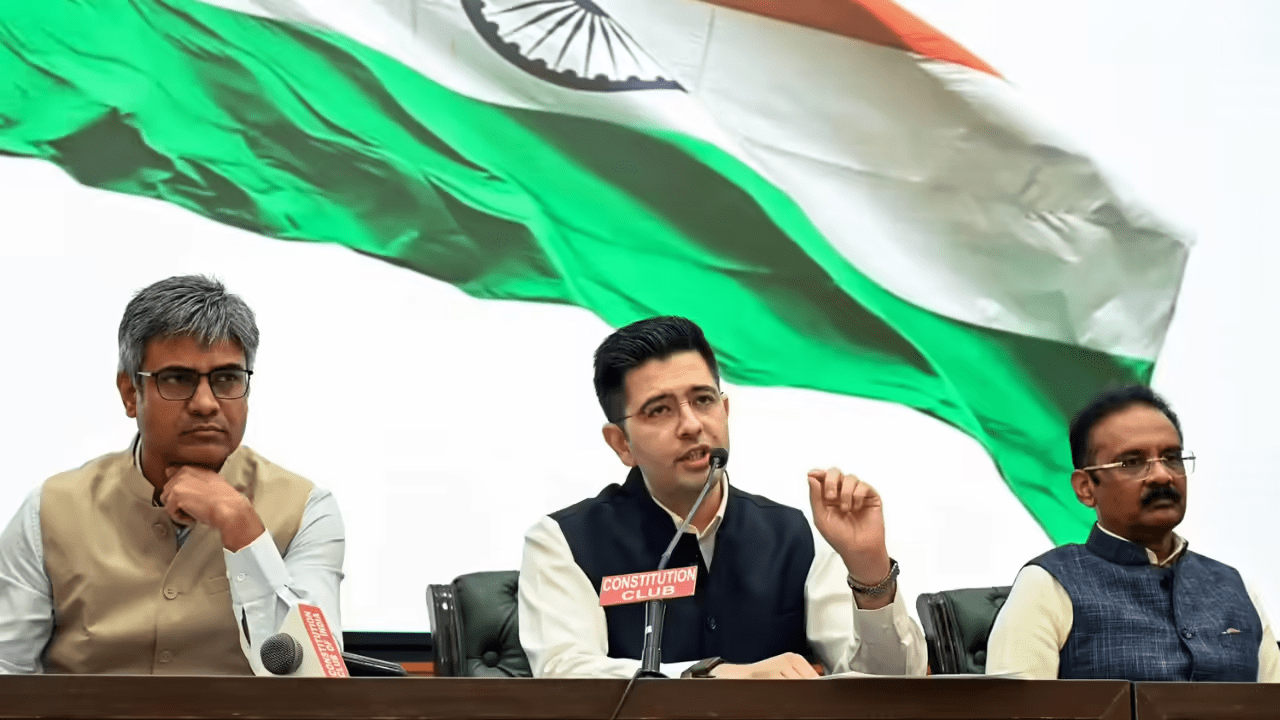
In a significant political development with potential national implications, Aam Aadmi Party (AAP) leader Raghav Chadha on Friday announced that he, along with six other Rajya Sabha MPs, has decided to merge with the Bharatiya Janata Party (BJP). The move, formalized through constitutional provisions allowing group defection, marks one of the largest parliamentary shifts from AAP since its inception and dramatically alters its strength in the Upper House.
Addressing a press conference in New Delhi, Chadha confirmed that more than two-thirds of AAP’s Rajya Sabha members have signed documents to join the BJP, a threshold that enables them to avoid disqualification under the anti-defection law. The group has already submitted the necessary paperwork to the Rajya Sabha Chairman.
Alongside Chadha, MPs Sandeep Pathak and Ashok Mittal publicly announced their exit, while others backing the move include Harbhajan Singh, Rajinder Gupta, Vikram Sahney, and Swati Maliwal. With seven members departing, AAP’s presence in the Rajya Sabha has been reduced from 10 to just three.
The development comes days after Chadha was removed as AAP’s deputy leader in the Rajya Sabha, a decision reportedly linked to internal dissatisfaction over his political positioning and engagement in party-led opposition activities.
Chadha framed the exit as a principled decision, asserting that the party had drifted from its founding ideals. He said he could no longer align himself with what he described as a departure from values and priorities, adding that continuing within the party would have meant compromising his stance.
He also praised the leadership of Prime Minister Narendra Modi, citing decisive governance and global positioning as key factors influencing his move, and expressed readiness to contribute under the BJP’s leadership.
AAP, however, reacted sharply, accusing the BJP of orchestrating a calculated effort to weaken opposition parties through what it termed “Operation Lotus” a phrase often used by opposition leaders to allege political poaching. Senior AAP leader Sanjay Singh criticized the departing MPs, calling the move a betrayal of public trust, particularly in Punjab, where the party holds power.
The BJP, on its part, welcomed the development, describing it as evidence of growing disillusionment within AAP. Party spokespersons claimed the defections reflect deeper structural and credibility issues within the opposition party.
Also read: Raghav Chadha Breaks Silence After AAP Ouster, Raises Questions Over ‘Silencing’ in Rajya Sabha
Why This Matters
This mass defection represents a major inflection point for AAP, especially in the national political arena. The Rajya Sabha has been a crucial platform for the party to influence legislative debates and assert its presence beyond Delhi and Punjab. Losing a majority of its Upper House MPs significantly weakens its ability to shape national discourse.
For the BJP, the development strengthens its parliamentary position while reinforcing a narrative of opposition fragmentation. It also signals the party’s continued ability to attract leaders from rival camps, particularly those with national visibility.
The move could also reshape alliances and strategies ahead of future elections, as opposition unity becomes increasingly critical in countering the BJP’s dominance.
Also read: ED Raids Target AAP MP Ashok Mittal’s Lovely Group Days After Rajya Sabha Role Change
Background Context
The defection follows a period of internal friction within AAP. Chadha’s removal as deputy leader in the Rajya Sabha earlier this month highlighted growing tensions. The party had reportedly expressed concerns over his absence from key opposition initiatives, including protests and parliamentary actions.
Additionally, disagreements emerged over strategic priorities, with Chadha emphasizing public-centric issues while the party leadership pushed for a more coordinated opposition stance.
The anti-defection law played a pivotal role in enabling this shift. Under Indian law, legislators can avoid disqualification if at least two-thirds of a party’s members agree to merge with another party. Chadha’s group met this requirement, ensuring their continuation as Rajya Sabha MPs despite switching allegiance.
What Happens Next
The immediate next step involves formal induction of the MPs into the BJP, expected to take place after meetings with senior party leadership. This will likely be followed by a recalibration of roles and responsibilities within the BJP’s parliamentary structure.
For AAP, the focus will shift to damage control both in terms of parliamentary strategy and public perception. The party may seek to reinforce its remaining leadership while addressing internal dissent to prevent further erosion.
Politically, the episode is likely to intensify debates around party loyalty, ideological consistency, and the use of constitutional mechanisms for political realignment. It may also prompt renewed scrutiny of the anti-defection framework and its implications for democratic stability.
Key Figures and Data
- Total AAP Rajya Sabha MPs before defection: 10
- MPs joining BJP: 7
- Remaining AAP Rajya Sabha MPs: 3
- Constitutional threshold for merger: Two-thirds of party members
- AAP Lok Sabha MPs: 3
The scale and timing of this shift make it one of the most consequential parliamentary realignments in recent years, with ripple effects expected across India’s political landscape.