
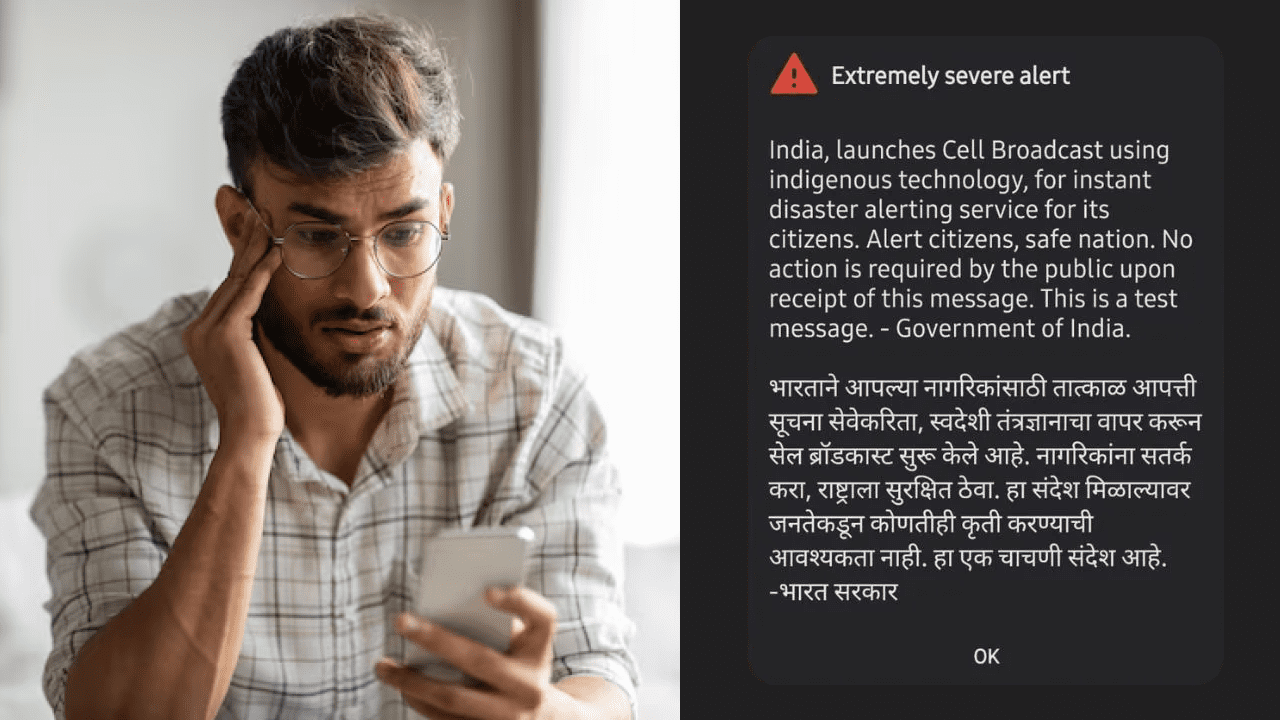
The India Cell Broadcast System test triggered widespread alarm across cities on Saturday as millions of smartphones simultaneously emitted loud sirens and flashed urgent warnings. What initially appeared to many as a real emergency from global conflict fears to cyberattacks was later confirmed to be a planned nationwide drill by the Government of India to test its new real-time disaster alert infrastructure.
The alert, sent around late morning, displayed a clear message: no action was required and the notification was only a test. Despite this, the sudden and coordinated nature of the warning complete with an unfamiliar, high-decibel alert tone sparked confusion in public spaces including trains, hospitals, theatres, and homes.
Authorities clarified that the exercise is part of India’s rollout of an indigenous Cell Broadcast-based emergency communication system developed by the Department of Telecommunications (DoT) in collaboration with the National Disaster Management Authority (NDMA). The system is designed to instantly warn citizens during disasters such as earthquakes, floods, cyclones, and industrial hazards.
How the Alert Unfolded Across India
The test message reached users across multiple states and Union territories, appearing as a full-screen pop-up accompanied by a piercing siren that overrode silent and do-not-disturb modes.
In Mumbai, theatre audiences and commuters were startled as dozens of phones rang in unison. In Delhi, families reported simultaneous alerts across all devices, while in cities like Bengaluru and Lucknow, people initially feared natural disasters or security threats. Some individuals even mistook the alert for a hacking attempt or software malfunction before reading the message in full.
The alert was delivered in multiple languages including English, Hindi, Marathi, Telugu, and Gujarati reflecting the system’s capability to communicate regionally relevant information. However, not all devices received the notification, highlighting early-stage limitations in reach and compatibility.
What Is the Cell Broadcast System?
Unlike traditional SMS alerts, the Cell Broadcast System uses a network-based technology that sends messages to all compatible mobile devices within a specific geographic area simultaneously. It does not require internet connectivity, mobile apps, or user subscriptions.
The system is built on an indigenous platform aligned with global emergency alert standards and is capable of geo-targeting specific districts or neighborhoods. Messages appear instantly and are designed to grab attention through loud alerts and screen interruptions critical during life-threatening situations.
Officials noted that India has already used related systems to send billions of SMS alerts for weather warnings, but this new approach significantly enhances speed and reach.
Background Context
India’s move toward a robust public alert system comes amid increasing climate-related disasters and urban vulnerabilities. Floods, cyclones, lightning strikes, and earthquakes have repeatedly exposed gaps in last-mile communication.
The newly tested system is part of a broader strategy to build a resilient, technology-driven disaster response framework. Authorities have indicated that future alerts will be more localized and tailored, improving both accuracy and response time.
In some states, including Bihar, follow-up preparedness exercises such as blackout drills and civil defence simulations are already being planned to familiarize citizens with emergency protocols.
Industry / Market Impact
The rollout of the Cell Broadcast System is expected to have significant implications for India’s telecom and technology sectors. Telecom operators will need to ensure infrastructure compatibility and reliability for seamless alert delivery, while smartphone manufacturers may be required to optimize device-level support for such notifications.
The system could also drive innovation in public safety technologies, opening opportunities for startups and technology providers working in disaster management, geolocation services, and communication infrastructure.
Additionally, the initiative strengthens India’s push for indigenous technological solutions, reducing reliance on foreign systems while aligning with global standards.
What Happens Next
Authorities have made it clear that Saturday’s alert was only an initial test. More drills are expected in the coming months to refine the system’s performance, improve device compatibility, and enhance public awareness.
Future alerts are likely to include more precise geo-targeting, ensuring that only affected areas receive warnings. Officials are also expected to focus on clearer labeling of test messages to avoid confusion and panic.
Public education campaigns may follow to help citizens distinguish between real emergencies and test notifications, ensuring appropriate responses when the system is deployed during actual crises.
Expert Analysis / What This Means
The India Cell Broadcast System test marks a pivotal shift in how the country approaches disaster communication, but the public reaction underscores a critical gap between technological capability and user awareness. While the system successfully demonstrated its ability to reach millions instantly, the confusion it caused highlights the need for clearer messaging and better public preparedness.
For users, the experience was a reminder of how disruptive but necessary such alerts can be in real emergencies. The ability to override silent modes ensures visibility but also raises concerns about panic if messages are not clearly understood.
From an industry standpoint, the rollout positions India alongside countries with advanced emergency alert systems, signaling maturity in digital infrastructure. However, inconsistencies in device reception suggest that further calibration is needed before full-scale deployment.
Comparatively, similar systems in countries like the United States and Japan have undergone years of public familiarization, indicating that India may need sustained awareness campaigns to achieve the same level of effectiveness.
Ultimately, while the system has the potential to save lives, its success will depend not just on technology, but on public trust, clarity, and repeated exposure to ensure citizens respond appropriately when real danger strikes.