
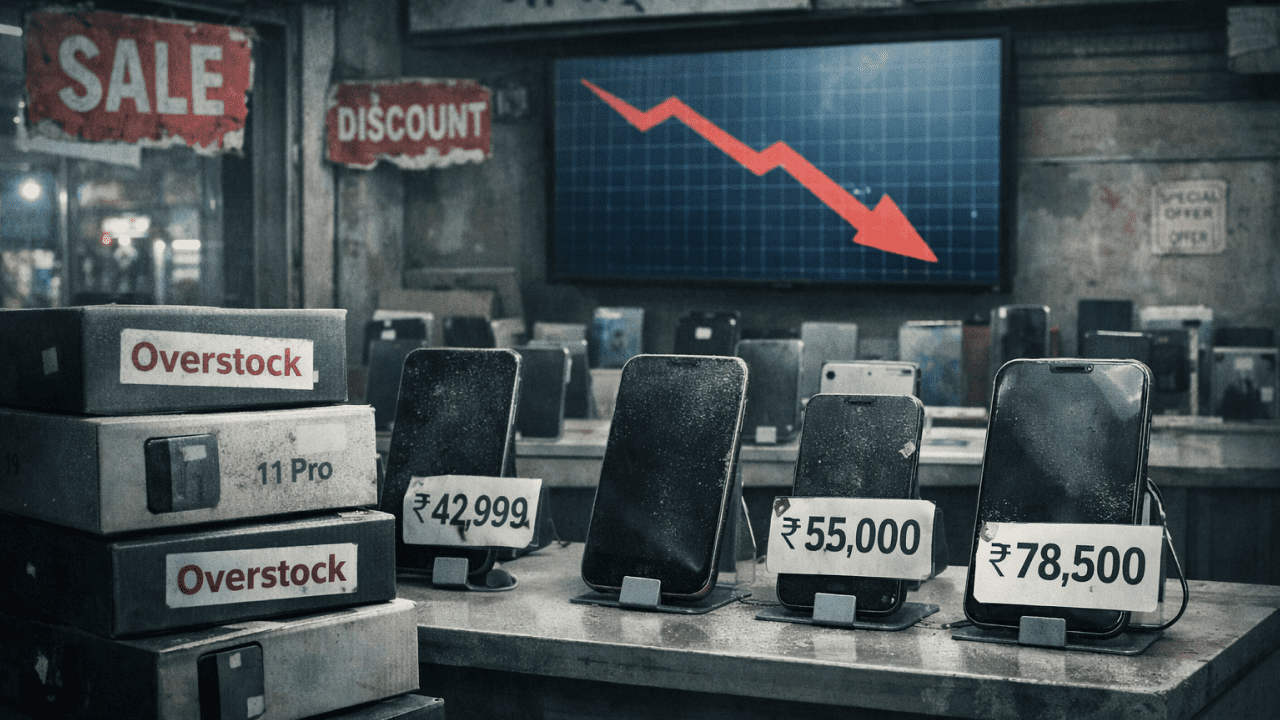
India’s smartphone market has recorded its weakest quarterly performance in six years, with shipments declining 3% year-on-year in the January–March 2026 period, according to Counterpoint Research. The downturn reflects a deeper structural slowdown driven by rising handset prices, stretched household budgets, and lengthening upgrade cycles factors that are reshaping one of the world’s largest smartphone markets.
While the headline decline appears modest, analysts warn that the underlying pressures particularly surging component costs and weakening demand in the budget segment signal a more prolonged and uneven slowdown. The situation is especially significant for India, where entry-level and mid-range devices have traditionally powered volume growth.
At the core of the decline is an affordability squeeze. Smartphone prices have risen by more than ₹1,500 on average, largely due to escalating costs of memory components such as NAND and DRAM, alongside currency fluctuations. The impact has been most severe in the sub-₹15,000 category, a segment that accounts for a substantial share of overall shipments. As a result, consumers are holding onto their devices longer, delaying upgrades amid broader financial pressures.
Rising household expenses, including energy costs linked to ongoing geopolitical tensions, have further reduced discretionary spending. Smartphones, once considered essential purchases, are increasingly being deferred in favor of basic needs.
Despite the demand slowdown, manufacturers accelerated product launches in early 2026, with nearly one-third of new models introduced in the first quarter. This strategy was aimed at offsetting rising input costs and protecting margins, but it has not been sufficient to revive consumer demand.
Also read: Global Airlines Raise Fares as Jet Fuel Crisis Deepens Amid West Asia Conflict
Market Leaders and Competitive Landscape
Vivo emerged as the market leader in Q1 2026, capturing a 21% share, supported by an expanded product lineup and strong offline distribution. Samsung followed with a 17% share, benefiting from demand for its A-series models and early traction for its latest flagship lineup.
Oppo secured third place with roughly 14% market share, registering steady growth among the top players. Xiaomi (including Poco) and Realme completed the top five rankings, leveraging their presence in the ₹10,000–₹20,000 price band to sustain volumes.
Collectively, brands under the BBK Electronics umbrella Vivo, Oppo, and Realme now account for nearly half of India’s smartphone market, underscoring their dominance across price segments.
Apple, meanwhile, expanded its presence to 9% market share during the quarter, driven by continued demand for its premium devices, particularly the iPhone 17 series. Aggressive financing options, including long-term EMI plans and exchange offers, have helped the company maintain momentum despite broader market weakness.
In contrast to the struggling mass market, the premium segment devices priced above ₹45,000 remains resilient. Google recorded strong growth in this category, driven by demand for AI-enabled features, while brands like Nothing continued to grow rapidly by targeting niche, design-focused consumers.
Why This Matters
The current slowdown marks a significant shift in India’s smartphone growth story. For years, the market has been driven by first-time buyers and frequent upgrades in the budget segment. However, rising costs and economic pressures are now disrupting this model.
The widening gap between premium and entry-level demand is particularly noteworthy. While high-end buyers remain relatively insulated from price increases, budget-conscious consumers are becoming increasingly sensitive to even modest price hikes. This divergence could fundamentally alter how brands approach product strategy, pricing, and distribution.
Additionally, the slowdown has broader implications for the electronics supply chain, retail networks, and digital adoption trends in India. A prolonged weakness in smartphone sales could impact app ecosystems, mobile services growth, and overall digital consumption patterns.
What Happens Next
The near-term outlook for India’s smartphone market remains challenging. Analysts expect shipments to decline further in the April–June quarter, potentially falling by double digits. For the full year 2026, overall volumes are projected to drop by around 10%.
A key concern is the continued rise in component costs. Memory prices alone have surged nearly fourfold in recent quarters, with additional increases of 15–20% anticipated in the near term. These cost pressures are likely to keep retail prices elevated, further dampening demand.
In response, smartphone manufacturers are expected to adopt a more cautious approach. This includes tightening product portfolios, focusing on high-margin premium devices, and improving operational efficiency across supply chains and distribution channels.
However, this strategy may come at the cost of volume growth, particularly in the mass-market segment. As a result, the recovery in India’s smartphone market is expected to be gradual and uneven, with growth concentrated in higher price tiers.
Background Context
India has long been one of the fastest-growing smartphone markets globally, driven by a large population, rising internet penetration, and affordable device availability. The sub-₹15,000 segment has historically accounted for a significant portion of shipments, making it highly sensitive to price fluctuations.
The current downturn highlights the vulnerability of this model in the face of global supply chain disruptions and inflationary pressures. With memory components forming a critical part of smartphone manufacturing costs, sustained price increases in this area have had a cascading effect on retail pricing.
At the same time, evolving consumer behavior marked by longer replacement cycles and increased value-consciousness is reshaping demand patterns. This shift is forcing brands to rethink their growth strategies in a market where volume expansion can no longer be taken for granted.