
A fragile US-Iran ceasefire entered a critical phase on Thursday after President Donald Trump warned of overwhelming military escalation if Tehran fails to comply with a forthcoming agreement, underscoring deep uncertainty around a truce reached after weeks of intensifying conflict in the Middle East.
In a strongly worded statement, Trump said American military forces would remain fully deployed “in and around Iran” until what he described as a “real agreement” is finalised and honoured. He cautioned that any violation could trigger a dramatic escalation, declaring that renewed conflict would be “bigger, better, and stronger than anyone has ever seen before.”
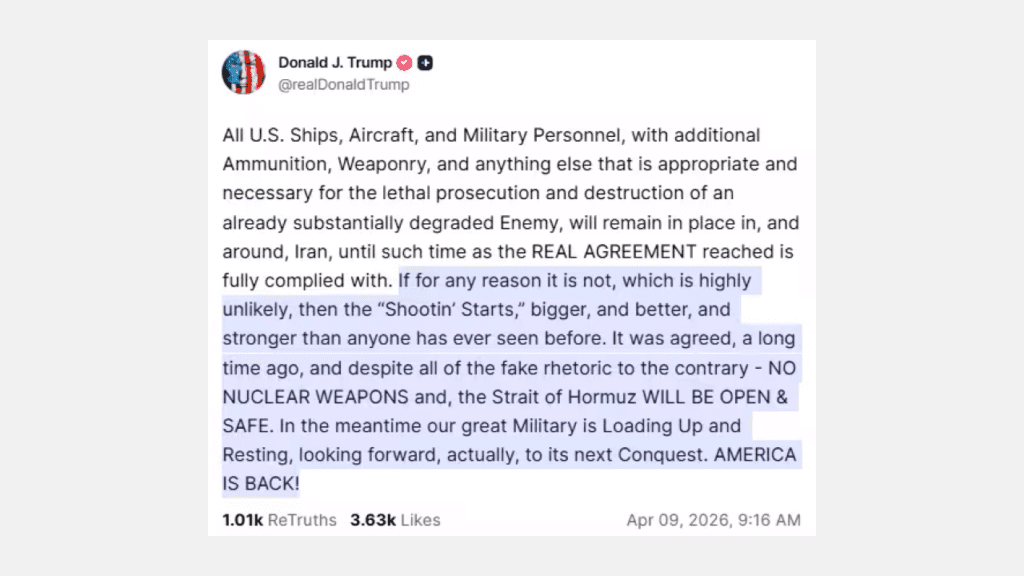
The warning comes just days after Washington and Tehran agreed to a two-week ceasefire aimed at halting hostilities that had intensified over Iran’s nuclear programme and tensions surrounding the strategic Strait of Hormuz, a critical artery for global oil shipments.
Despite the pause in direct confrontation, both sides have issued conflicting claims about the terms and outcome of the agreement, raising doubts about its durability.
Also read: US-Iran Ceasefire Announced After Kharg Island Strikes and Escalating Gulf Conflict
Conflicting Narratives Undermine Trust
While the United States has framed the ceasefire as a strategic success, Iranian authorities have presented a starkly different account.
Tehran’s Supreme National Security Council described the truce as a “historic victory,” claiming that Washington had effectively accepted key Iranian demands, including recognition of its nuclear enrichment rights, easing of sanctions, and control over the Strait of Hormuz.
In contrast, US officials rejected that narrative. Defence Secretary Pete Hegseth asserted that Iran had been forced into the ceasefire under pressure, describing the outcome as a decisive American military success that degraded Iran’s missile capabilities and military infrastructure.
The sharply divergent interpretations highlight the deep mistrust shaping upcoming negotiations, which are expected to begin under tight timelines and intense scrutiny.
Regional Conflict Threatens Ceasefire Stability
Even as Washington and Tehran step back from direct confrontation, violence continues to ripple across the region, threatening to derail diplomatic efforts.
Israel has intensified strikes against Hezbollah positions in Lebanon, targeting infrastructure linked to the Iran-backed militant group. The escalation follows rocket attacks launched by Hezbollah into Israeli territory, further widening the conflict’s scope.
According to Lebanese authorities, the latest wave of Israeli strikes has resulted in significant casualties, with hundreds reported killed or injured. The bombardment marks one of the most severe episodes of violence in Lebanon since the broader conflict began.
The United Nations, led by Secretary-General António Guterres, has warned that continued military activity in Lebanon poses a “grave risk” to the already fragile ceasefire between the US and Iran, urging all parties to halt hostilities immediately.
Meanwhile, tensions over the Strait of Hormuz remain unresolved. While Washington insists the waterway must remain open and secure, Iran has at times signaled control over the chokepoint, even moving to restrict access amid escalating hostilities.
Why This Matters
The stakes surrounding the ceasefire extend far beyond bilateral tensions between the US and Iran.
The Strait of Hormuz handles a significant share of the world’s oil shipments, making its stability essential for global energy markets. Any disruption could trigger sharp increases in oil prices, disrupt supply chains, and heighten economic uncertainty worldwide.
Additionally, the dispute over Iran’s nuclear programme remains a central flashpoint. The US continues to insist that Tehran must not acquire nuclear weapons, while Iran maintains its right to nuclear development under certain conditions.
The current standoff reflects a broader geopolitical struggle involving regional allies, proxy groups, and global powers, with the potential to escalate into a wider conflict if diplomacy fails.
What Happens Next
The coming two weeks are expected to be decisive.
Negotiations between US and Iranian representatives are set to begin soon, with both sides working toward a more comprehensive agreement. However, the process is already burdened by mutual distrust and conflicting expectations.
Trump has made clear that military readiness will remain high during the negotiation period, signaling that diplomacy is being pursued alongside a credible threat of force.
At the same time, ongoing regional violence particularly involving Israel and Hezbollah adds a volatile dimension that could undermine talks or provoke renewed confrontation.
Whether the ceasefire holds will depend on several factors, the ability of both sides to align on core demands, the containment of proxy conflicts, and the management of strategic flashpoints like the Strait of Hormuz.
Timeline of Events
- Weeks prior: Escalating conflict between the US and Iran over nuclear tensions and maritime security
- Tuesday: Announcement of a two-week ceasefire agreement
- Wednesday: Intensified Israeli strikes in Lebanon, rising regional tensions
- Thursday: Trump issues escalation warning, conflicting claims emerge over ceasefire terms
- Next phase: Planned negotiations to determine long-term agreement