
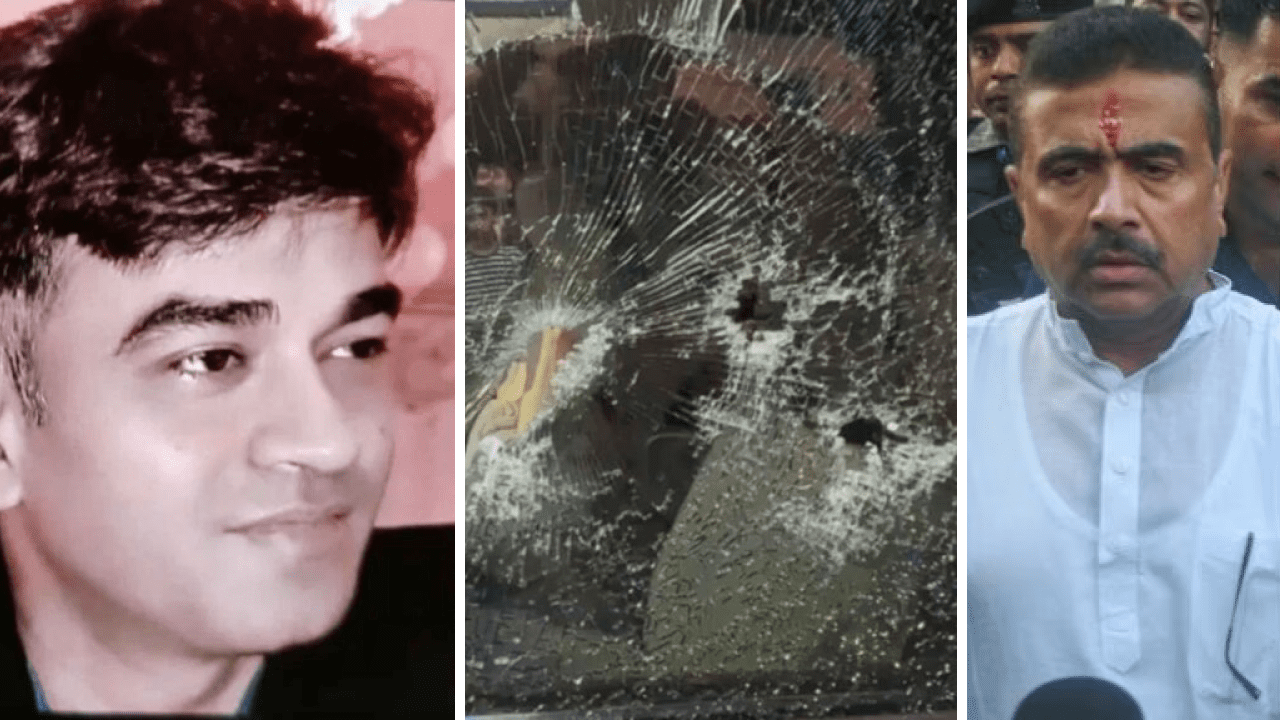
The killing of Chandranath Rath, a close aide and executive assistant to BJP leader Suvendu Adhikari, has intensified political tensions in West Bengal just days after the state’s high-stakes assembly election results. Rath, a former Indian Air Force employee who later emerged as one of Adhikari’s most trusted organisational figures, was shot dead by unidentified assailants in North 24 Parganas district on Wednesday night in what BJP leaders have described as a “cold-blooded murder.”
The attack took place near Madhyamgram’s Doharia-Doltala area, where motorcycle-borne assailants allegedly intercepted Rath’s vehicle around 10:30 pm, forced it to stop, and opened fire at close range before fleeing. Police have launched an investigation, while political leaders across the state condemned the killing amid an already volatile post-election atmosphere.
The murder comes within 48 hours of the assembly poll verdict and amid continuing political friction between the BJP and the ruling Trinamool Congress (TMC). BJP leaders have alleged ongoing violence against party workers in several districts following the results.
Rath, 41, was widely known within BJP circles as a discreet but highly influential backroom strategist who handled sensitive campaign operations, logistical planning, and organisational coordination for Suvendu Adhikari.
From Air Force Service to Bengal Politics
Born in Chandipur in Purba Medinipur district, Chandranath Rath had a markedly different path into politics than most political operatives. He studied at the Rahara Ramakrishna Mission, where acquaintances say he was deeply influenced by the institution’s spiritual discipline and values during his formative years.
Before entering politics, Rath served in the Indian Air Force for nearly two decades. Sources close to the family said he had even considered pursuing a spiritual life before eventually joining the armed forces. After taking voluntary retirement from the Air Force, he briefly worked in the corporate sector before transitioning into political and administrative work.
His family had longstanding political connections in Purba Medinipur. Rath’s mother, Hasi Rath, had earlier held a position in a local panchayat body during the Trinamool Congress regime. The family later shifted allegiance to the BJP alongside Suvendu Adhikari in 2020 after the senior leader’s dramatic exit from the TMC.
Rath officially became part of Adhikari’s inner team around 2019, when Adhikari was still serving as a minister in the Mamata Banerjee government. Initially tasked with office coordination and administrative duties, Rath gradually evolved into a key political organiser trusted with sensitive assignments and campaign management.
Also read: Mamata Banerjee’s Midnight Strongroom Vigil Triggers EVM Row Ahead of Bengal Results
Trusted Operator in High-Stakes Campaigns
Although he maintained a low public profile, Rath played a significant role in several politically sensitive electoral battles in Bengal. BJP insiders say he was deeply involved in campaign logistics during the Nandigram and Bhabanipur elections, both among the most closely watched contests in the state.
He reportedly coordinated communication between party workers, managed operational details during rallies and protests, and supervised multiple organisational activities behind the scenes.
Rath also drew attention shortly before the election counting process. On April 30, during Mamata Banerjee’s visit to the Bhabanipur strongroom at Shakhawat Memorial High School, Rath reportedly led BJP workers protesting outside the counting centre in the absence of Adhikari. He allegedly confronted police officials over the presence of a TMC campaign vehicle near the strongroom, prompting intervention by police and CRPF personnel.
Within BJP circles, Rath was increasingly viewed as an emerging organisational figure who enjoyed Adhikari’s complete trust. Some party insiders had even speculated that he could receive a larger administrative role if the BJP expanded its influence in the state.
Political Reactions Intensify
Reacting to the killing, Suvendu Adhikari described the incident as “heart-wrenching” and appealed for calm while the investigation continues.
“The way the attack was executed clearly suggests that the assailants had conducted a recce beforehand,” Adhikari told reporters outside the hospital where Rath was taken after the shooting.
The BJP leader said West Bengal Director General of Police Siddhnath Gupta had assured him of a thorough investigation. However, Adhikari refrained from directly accusing any political organisation and urged party workers not to “take the law into their own hands.”
Adhikari also alleged that attacks on BJP workers were continuing in several parts of the state after the election results. He claimed that one BJP worker had been shot in Basirhat while another was stabbed in the Baranagar area on the same night.
Senior BJP leaders mourned Rath’s death and described him as dependable, disciplined, and non-political in temperament. BJP MLA Agnimitra Paul referred to him as “Mr Dependable,” while Sreerupa Mitra Chaudhury said Rath handled everything from legislative coordination to campaign logistics over the past several years.
Expert Analysis / What This Means
The killing of Chandranath Rath is significant not only because of his proximity to Suvendu Adhikari, but also because it underscores the increasingly hostile political climate in West Bengal following fiercely contested elections. Rath was not merely a personal assistant; he was a trusted operational figure embedded in BJP’s Bengal strategy.
For the BJP, the incident is likely to reinforce claims that political workers and organisers remain vulnerable to targeted violence in the state. The party may use the episode to intensify pressure on both the state administration and central agencies for stricter security oversight.
The murder could also deepen political polarisation at a time when tensions between the BJP and TMC are already elevated. Any perception of politically motivated violence risks escalating grassroots confrontations across sensitive districts.
From an organisational perspective, Rath’s death creates a vacuum within Adhikari’s close operational network. Individuals handling campaign logistics and political coordination often play critical but invisible roles in sustaining electoral machinery.
The incident also highlights how backroom political operatives once largely outside public attention are increasingly becoming central figures in India’s high-intensity state politics.
If investigators establish political motives or premeditation, the case could become a major flashpoint in Bengal’s broader debate over law and order during election cycles.
Timeline of Events
2019
Chandranath Rath formally joins Suvendu Adhikari’s political team while Adhikari serves in the Mamata Banerjee government.
2020
Rath’s family shifts allegiance from the Trinamool Congress to the BJP alongside Adhikari.
April 30, 2026
Rath leads BJP workers protesting outside the Bhabanipur counting centre over alleged violations involving a TMC vehicle.
May 2026 Assembly Elections
Rath plays a role in election coordination and campaign logistics for BJP operations.
Wednesday Night
Motorcycle-borne assailants allegedly intercept Rath’s vehicle in Madhyamgram and shoot him at close range.
Why This Matters
The murder of a senior political aide so soon after a major state election is likely to sharpen scrutiny on Bengal’s political environment and security conditions. Political violence has long remained a contentious issue in the state, particularly during and after elections.
Rath’s killing may also influence future campaign strategies, with political parties expected to increase security measures for organisational staff and local coordinators who operate outside the public spotlight but remain deeply involved in electoral operations.
The investigation’s findings could have broader political implications, especially if evidence points toward organised targeting or politically motivated planning.