
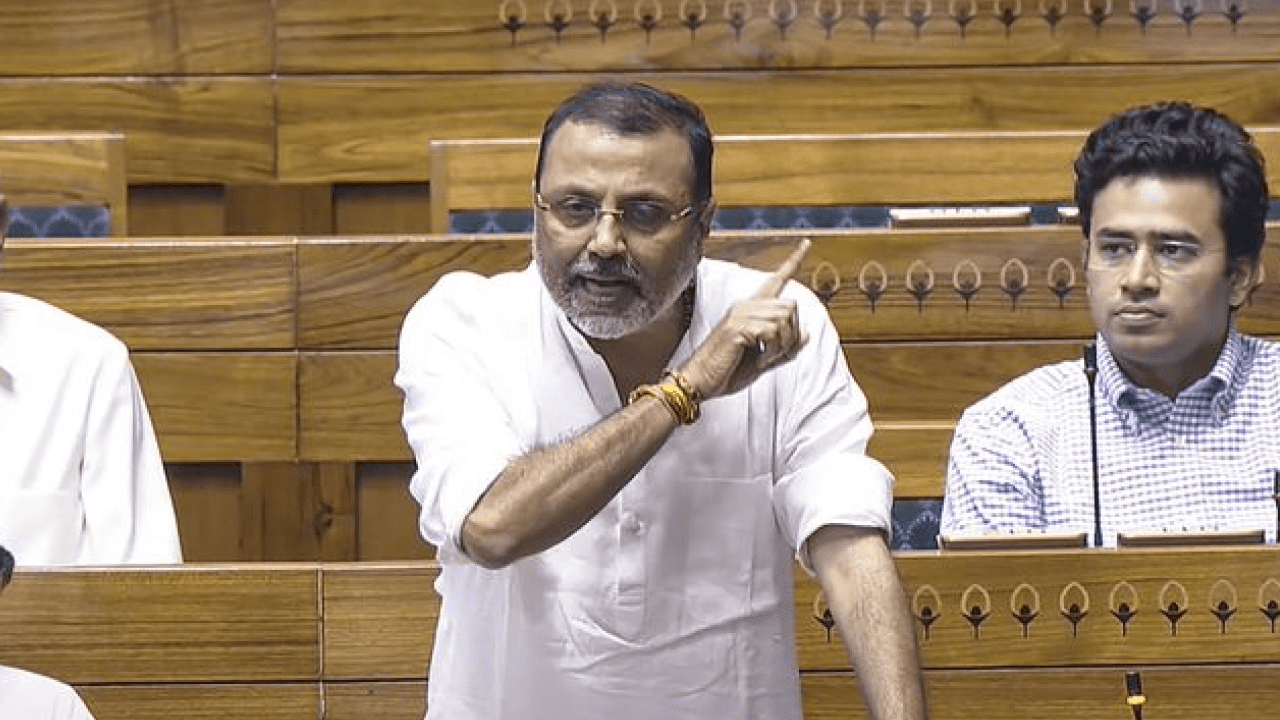
A sharp political controversy erupted on the anniversary of the June 3, 1947 Partition Plan after Bharatiya Janata Party (BJP) MP Nishikant Dubey launched a scathing attack on the Nehru-Gandhi family, linking the roots of the Jammu and Kashmir dispute to decisions taken during the final months of British rule in India.
In a series of remarks posted on social media, Dubey described the historic partition framework as the “Mountbatten-Nehru-Jinnah agreement,” arguing that the arrangement laid the groundwork for challenges that continue to affect India decades later. His comments came on the anniversary of the announcement by Lord Louis Mountbatten that British India would be divided into two independent nations India and Pakistan.
The BJP parliamentarian claimed that discussions held in Shimla between May 10 and May 12, 1947, were instrumental in shaping the eventual partition plan. According to Dubey, Jammu and Kashmir was treated separately within the political framework of the time, a decision he believes contributed to the long-standing dispute over the region.
Dubey also accused the Congress leadership of proceeding with the partition process without the full consent or involvement of Mahatma Gandhi. In his remarks, he alleged that Gandhi was sidelined during crucial decisions leading up to Partition and argued that the political choices made during that period had far-reaching consequences for the nation.
The comments marked one of Dubey’s strongest criticisms yet of the Nehru-Gandhi family, whom he accused of bearing responsibility for decisions that shaped the course of post-independence India. His remarks quickly drew attention across political circles, reigniting debates around the historical legacy of Partition and the role played by key leaders during the final phase of British rule.
Background Context
The June 3 Plan, announced by the last Viceroy of India, Lord Mountbatten, outlined the framework for the partition of British India into two sovereign states. The plan was subsequently accepted by major political stakeholders of the time, including representatives of the Indian National Congress and the Muslim League.
Partition led to one of the largest mass migrations in modern history, accompanied by widespread communal violence and displacement. The status of princely states, including Jammu and Kashmir, emerged as a major issue in the months that followed, eventually becoming one of the most sensitive geopolitical disputes in South Asia.
For decades, historians, political commentators and policymakers have debated the decisions made by leaders involved in the independence process. Questions surrounding the negotiations, timelines and political compromises of 1947 continue to generate discussion across ideological lines.
Reactions and Political Context
Dubey’s latest remarks fit into a broader pattern of criticism directed by BJP leaders toward Congress over historical decisions made during the tenure of India’s first generation of post-independence leadership.
The BJP MP has repeatedly questioned policies associated with former Congress governments. Just days before his latest comments on Partition, Dubey criticized past water-sharing agreements with Bangladesh, arguing that decisions taken during the administrations of former Prime Ministers Indira Gandhi and Rajiv Gandhi adversely affected Indian farmers and border states.
While Congress has frequently defended the historical decisions of its leaders as necessary responses to complex political realities, BJP leaders have increasingly revisited key moments in Indian history to challenge that narrative.
The renewed focus on Partition-era decisions is likely to intensify political debate, particularly as historical interpretation continues to play a significant role in contemporary political discourse.
Expert Analysis / What This Means
Dubey’s remarks underscore how the legacy of Partition remains deeply intertwined with present-day political narratives. Nearly eight decades after independence, historical events continue to influence electoral messaging, ideological positioning and public debate.
For political parties, revisiting Partition serves as a way to frame competing visions of national history and leadership. The controversy also highlights the enduring sensitivity surrounding Jammu and Kashmir, a subject that remains central to India’s political and security discussions.
From a broader perspective, such statements may further polarize debates over historical accountability. Supporters may view them as a reassessment of decisions made in 1947, while critics could see them as an attempt to reinterpret history through a contemporary political lens.
The episode demonstrates how historical milestones continue to shape political discourse in India, particularly when linked to national identity, territorial integrity and the legacy of prominent political families. As public interest in historical narratives grows, similar debates are likely to remain a recurring feature of India’s political landscape.
Why This Matters
The significance of Dubey’s remarks extends beyond a single political statement. They touch on foundational questions about India’s independence, Partition and the leadership decisions that shaped the country’s future.
Historical interpretations often influence contemporary policymaking and political messaging. By revisiting the events surrounding June 1947, political leaders can shape public perceptions of both the past and present.
The debate also reflects a broader trend in Indian politics where historical events are increasingly becoming subjects of active political contestation. As a result, discussions surrounding Partition, Kashmir and the role of national leaders are likely to remain politically relevant for years to come.
What Happens Next
Political reactions to Dubey’s comments are expected to continue, particularly if opposition leaders respond directly to his allegations. The controversy may also fuel renewed discussion among historians, commentators and political analysts regarding the circumstances surrounding the Partition Plan and its long-term consequences.
As India approaches future anniversaries tied to independence and Partition, historical narratives are likely to remain a powerful element of public discourse, with competing political interpretations continuing to shape national conversations.