
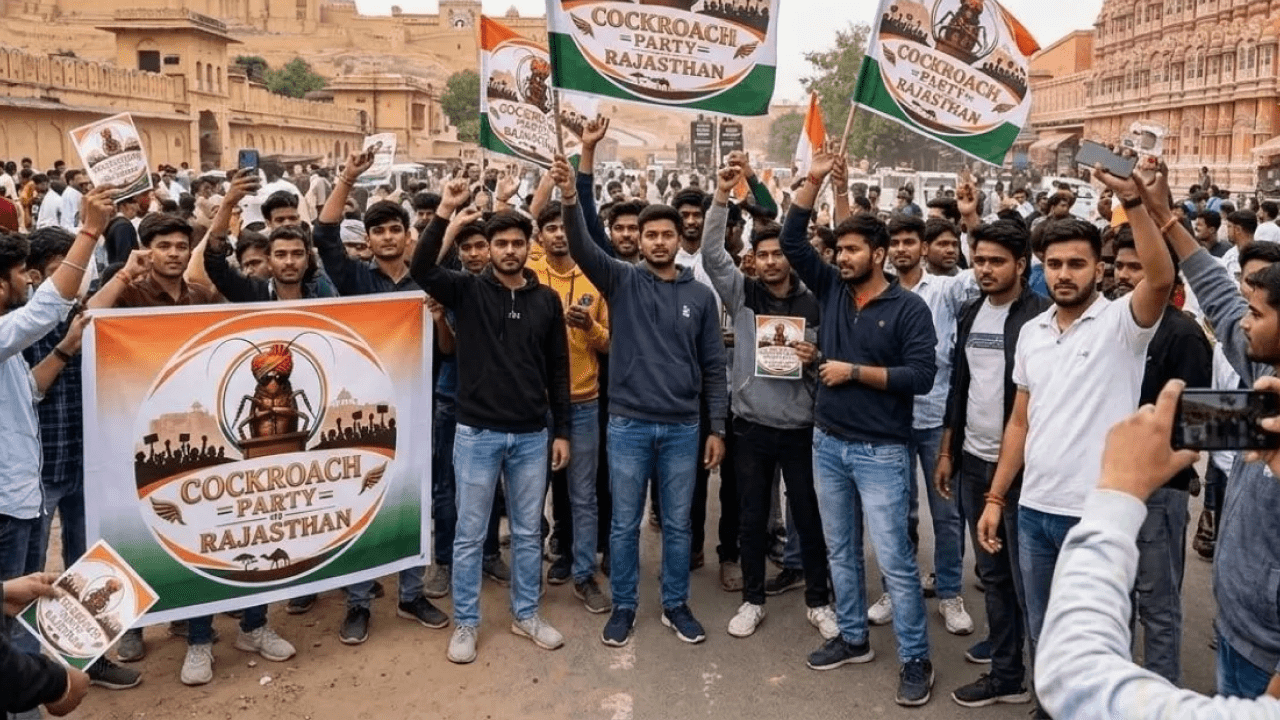
A satirical online campaign that began as a reaction to controversial remarks by a Supreme Court judge has rapidly evolved into one of India’s most talked-about political phenomena. The “Cockroach Janta Party” (CJP), a parody political platform built around memes, humour and youth frustration, has amassed millions of followers across social media within days, triggering debate about unemployment, free speech, political dissent and the growing disconnect between India’s young population and mainstream politics.
The movement gained momentum after Supreme Court judge Surya Kant drew criticism for remarks comparing some unemployed youth and activists to “cockroaches” during a court hearing. Although the judge later clarified that his comments were aimed at individuals obtaining fraudulent degrees and not India’s youth as a whole, the statement sparked widespread backlash online.
Seizing on the controversy, political communications strategist and Boston University student Abhijeet Dipke launched the Cockroach Janta Party as a satirical digital movement. Within less than a week, the platform’s Instagram following surged beyond 15 million and later crossed 19 million followers, overtaking the Instagram presence of several established political parties.
The movement brands itself as “a political front of the youth, by the youth, for the youth” and humorously describes itself as the “voice of the lazy and unemployed.” Through parody manifestos, mock campaign slogans and viral memes, the CJP has become an outlet for growing frustration among India’s younger generation over unemployment, rising living costs, competitive exam controversies and political disillusionment.
Its manifesto mixes satire with pointed political criticism, including proposals such as banning post-retirement Rajya Sabha seats for former chief justices, imposing long-term restrictions on political defections and introducing stronger women’s representation in Parliament.
The movement’s sudden rise has also drawn political attention. Congress MP Shashi Tharoor described the phenomenon as evidence of deeper dissatisfaction among young Indians and warned against attempts to suppress it online. After the CJP’s X account, which had accumulated more than 200,000 followers, was withheld in India following a legal demand, Tharoor publicly criticised the move.
Calling the blocking “disastrous and deeply unwise,” Tharoor argued that democratic societies require space for satire, humour and dissent. He also suggested that opposition parties should recognise the movement as a sign of political opportunity.
According to Tharoor, the rapid popularity of the Cockroach Janta Party reflects a generation searching for channels to express frustration with governance and economic pressures. He said the challenge for opposition parties would be converting online dissatisfaction into meaningful political participation and electoral engagement.
Also read: Vijay Expands Tamil Nadu Cabinet as Congress Returns to Power Structure After Nearly 60 Years
Why This Matters
India is home to one of the world’s youngest populations, with millions entering the workforce every year. Yet concerns over job scarcity, delayed recruitment processes and repeated government examination paper leaks have intensified anxiety among students and young professionals.
The Cockroach Janta Party’s popularity demonstrates how political expression among young Indians is increasingly shifting toward digital-first movements driven by humour, irony and viral culture. Unlike conventional political campaigns, the CJP relies on meme language, self-deprecating jokes and internet-native communication styles that resonate strongly with Gen Z audiences.
Its rapid spread also highlights a broader trend visible across South Asia, where youth-led online movements have increasingly influenced political narratives. From protests in Sri Lanka to unrest in Bangladesh and Nepal, younger populations in the region have used digital platforms as tools for mobilisation and dissent.
While critics dismiss the CJP as a short-lived internet trend or an opposition-aligned campaign because of founder Abhijeet Dipke’s previous association with the Aam Aadmi Party (AAP), supporters argue that its popularity reflects genuine public frustration rather than coordinated political engineering.
Expert Analysis / What This Means
The rise of the Cockroach Janta Party signals more than a viral meme cycle it reflects a changing political communication landscape in India. Young voters are increasingly disengaged from traditional political messaging and are instead gravitating toward satire-driven platforms that combine humour with social criticism.
For mainstream political parties, particularly the opposition, the movement exposes a vacuum in youth representation. The ability of a parody platform to attract millions within days suggests many young Indians feel unheard in formal political spaces.
The controversy surrounding the withholding of the CJP’s X account may further amplify the movement rather than weaken it. Attempts to restrict satirical or dissent-oriented platforms often generate additional public attention and strengthen narratives around suppression of free expression.
The phenomenon also demonstrates how internet culture is becoming politically influential. Memes and parody, once dismissed as trivial online behaviour, are increasingly shaping public discourse and mobilising communities around social grievances.
For the ruling establishment, the movement serves as a warning sign about rising youth dissatisfaction tied to unemployment, economic insecurity and distrust of institutions. If these concerns remain unaddressed, digital frustration could evolve into more organised forms of political activism.
At the same time, the CJP’s future remains uncertain. Many viral online movements struggle to transition into sustainable offline mobilisation. Whether the platform remains a symbolic protest space or transforms into a broader political force will depend on its ability to maintain momentum beyond social media.
Also read: NEET UG 2026 Leak Fallout: Government Admits Failure, Orders Retest as CBI Probes NTA Link
Timeline of Events
Supreme Court Remarks Spark Backlash
Justice Surya Kant’s comments comparing some unemployed youth and activists to “cockroaches” trigger widespread criticism online.
Satirical Movement Launches
Abhijeet Dipke launches the Cockroach Janta Party as a parody political platform using the cockroach as a symbol of survival and resilience.
Social Media Explosion
Within days, the movement gains millions of followers on Instagram, with memes and satirical content spreading rapidly across platforms.
Political Reactions Emerge
Opposition leaders, including Congress MP Shashi Tharoor, publicly acknowledge the movement and describe it as a reflection of youth frustration.
X Account Withheld in India
The CJP’s X account is restricted in India after a legal demand, sparking fresh debate over censorship and online dissent.
Industry / Market Impact
The success of the Cockroach Janta Party underlines the growing power of digital political branding in India. Social media platforms are increasingly becoming parallel arenas for political influence, especially among younger demographics.
Political consultants and campaign strategists are likely to study the CJP’s rapid growth closely. Its use of meme culture, satire and community-driven participation demonstrates how unconventional digital strategies can outperform traditional political outreach online.
The movement may also influence how political parties communicate with younger voters ahead of future elections. Campaigns built around humour, relatability and internet culture could become more common as parties attempt to connect with digitally native audiences.
At the same time, the controversy surrounding account restrictions raises broader concerns about platform governance, online speech regulation and the balance between legal compliance and political expression in India’s rapidly evolving digital ecosystem.
What Happens Next
The immediate future of the Cockroach Janta Party remains unpredictable. Founder Abhijeet Dipke has insisted the movement is independent and not formally linked to any political organisation, though pressure from both supporters and critics is likely to intensify.
If the movement sustains public engagement, it could evolve into a broader youth-led advocacy platform or influence mainstream political discourse ahead of future elections. However, maintaining momentum beyond viral popularity will require organisational structure, leadership clarity and offline engagement.
For now, the Cockroach Janta Party has already achieved something significant, it has transformed satire into a national political conversation and forced India’s political establishment to confront the frustrations of a digitally empowered generation.