
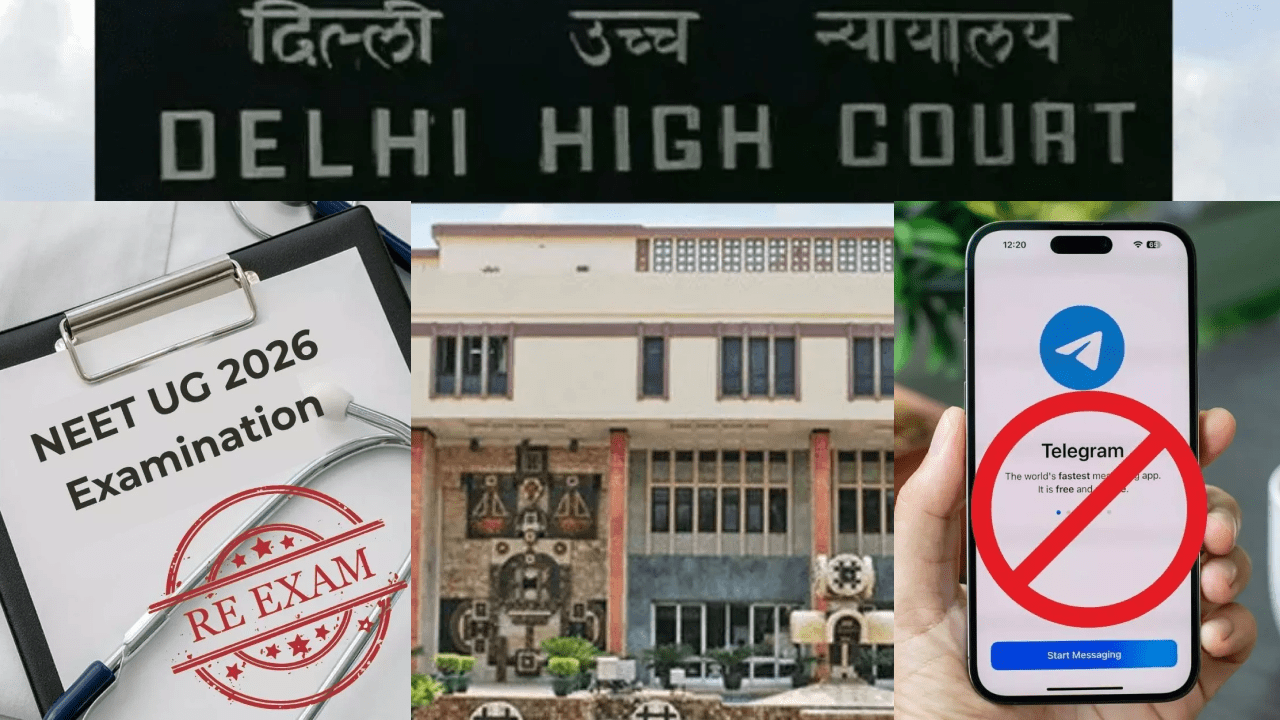
The Delhi High Court has upheld the Centre’s temporary restriction on Telegram imposed ahead of the NEET-UG 2026 re-examination, backing the government’s argument that extraordinary measures were necessary to prevent the platform’s alleged misuse during a high-stakes national examination. The decision comes amid heightened scrutiny of examination security following the cancellation of the original NEET-UG test over paper leak allegations and a continuing investigation by the Central Bureau of Investigation (CBI).
The restriction, which remains in force until June 22, was challenged by Telegram, which argued that the government’s action disproportionately affected millions of legitimate users. However, the court concluded that the Centre had demonstrated sufficient grounds to justify temporary intervention given the urgency and sensitivity surrounding the re-test.
Also read: NEET UG 2026 Leak Fallout: Government Admits Failure, Orders Retest as CBI Probes NTA Link
Court Weighs Exam Integrity Against User Rights
Before delivering its verdict, Justice Tejas Karia raised significant concerns about the proportionality of the government’s action, questioning whether the rights of approximately 150 million Telegram users could be curtailed to safeguard the interests of students appearing for a single examination.
During the proceedings, the court repeatedly examined whether restrictions imposed on a platform used by millions could be justified when the objective was to prevent potential misconduct by a relatively small group of users.
The bench referred to principles laid down by the Supreme Court in the Anuradha Bhasin judgment, which addressed restrictions on communication services and emphasized proportionality in state action. The court sought clarification on whether broad platform-level restrictions were legally justified under existing frameworks.
Telegram’s legal team argued that the ban lacked adequate justification and questioned how concerns surrounding examination malpractice could be linked to issues such as national sovereignty and integrity, grounds often cited under emergency digital restrictions.
Also read: Rahul Gandhi vs CBSE: OSM Evaluation Row Sparks National Debate Over Transparency in Board Exams
Centre Defends Decision, Cites Security Risks
The government strongly defended its decision, arguing that Telegram’s technical architecture presents unique challenges for law enforcement and enables rapid dissemination of information on a scale not easily replicated on other platforms.
Attorney General R. Venkataramani described Telegram as a platform whose design creates significant enforcement difficulties, while Solicitor General Tushar Mehta highlighted features such as large-scale bot creation and automated distribution networks.
According to the Centre, a single Telegram account can create numerous bots capable of spreading information widely and rapidly. Government lawyers argued that such infrastructure could facilitate the circulation of leaked examination material, misinformation, or coordinated campaigns capable of disrupting the conduct of the NEET re-test.
Officials also contended that Telegram’s cloud-based structure makes it difficult for authorities to identify or trace individuals responsible for unlawful activities. The Centre maintained that these characteristics distinguish Telegram from platforms such as WhatsApp and Facebook, where enforcement mechanisms are comparatively more accessible.
The government further claimed that intelligence and investigative assessments had identified Telegram as a platform frequently exploited by criminal and extremist elements, strengthening the case for temporary preventive action.
Background Context
The controversy stems from the cancellation of the original NEET-UG 2026 examination conducted on May 3. The National Testing Agency (NTA) annulled the exam on May 12 following allegations of a widespread paper leak that triggered national outrage among students and parents.
The examination, which serves as the gateway for undergraduate medical admissions across India, was subsequently rescheduled for June 21. With public confidence in the testing process already shaken, authorities sought additional safeguards to prevent any further compromise of examination integrity.
Acting on recommendations from the NTA, the Ministry of Electronics and Information Technology (MeitY) issued directions under Section 69A of the Information Technology Act, 2000, ordering temporary restrictions on Telegram until June 22.
Also read: CBSE Faces Fresh Scrutiny After Schools Receive Messaging Toolkit Amid OSM Backlash
Reactions and Arguments Presented in Court
The hearings highlighted a broader legal and constitutional debate about balancing public interest with digital freedoms.
Government lawyers maintained that the objective was not to permanently restrict access to the platform but to prevent potential misuse during a critical period. They argued that less restrictive measures had been considered and that the temporary nature of the order demonstrated proportionality.
Telegram, meanwhile, challenged the necessity of a blanket restriction, arguing that misuse by some users should not result in consequences for an entire user base. The platform’s counsel also questioned why similar action was not taken against other messaging services where marketing campaigns, mass messaging, and information sharing are commonplace.
The court acknowledged the severe impact of the NEET paper leak controversy while simultaneously probing the limits of executive power in regulating digital platforms during emergencies.
Expert Analysis / What This Means
The ruling could become an important reference point in future disputes involving temporary restrictions on digital platforms in India. By accepting the Centre’s argument that exceptional circumstances justified intervention, the court has signaled that examination integrity and public order concerns may, under certain conditions, outweigh short-term access rights.
For users, the decision raises broader questions about how governments may respond when digital platforms are perceived as enabling large-scale misconduct. The case highlights the growing challenge regulators face in balancing civil liberties with security concerns in an increasingly connected society.
For technology companies, the judgment underscores rising expectations around platform accountability, particularly where automated tools, encrypted communications, and large-scale content distribution systems are involved.
The case also reflects a global trend in which governments are scrutinizing platform architecture rather than merely content moderation practices. Future regulatory frameworks may place greater emphasis on technical design features that authorities believe create enforcement challenges.
In the education sector, the ruling demonstrates the extent to which authorities are willing to deploy extraordinary measures to restore trust in national examinations following major security breaches.
Most significantly, the debate over proportionality is unlikely to end with this case. As digital platforms become central to everyday communication, courts may increasingly be called upon to determine when public interest justifies restrictions affecting millions of users.
What Happens Next
With the restriction set to remain in force until June 22, attention will now shift to the successful conduct of the NEET-UG re-examination and the ongoing CBI investigation into the alleged paper leak.
The broader legal questions raised during the hearings including proportionality, digital rights, and platform accountability could influence future litigation involving government-imposed restrictions on online services.
As authorities continue efforts to strengthen examination security, the case is expected to remain a significant benchmark in India’s evolving digital governance landscape.