
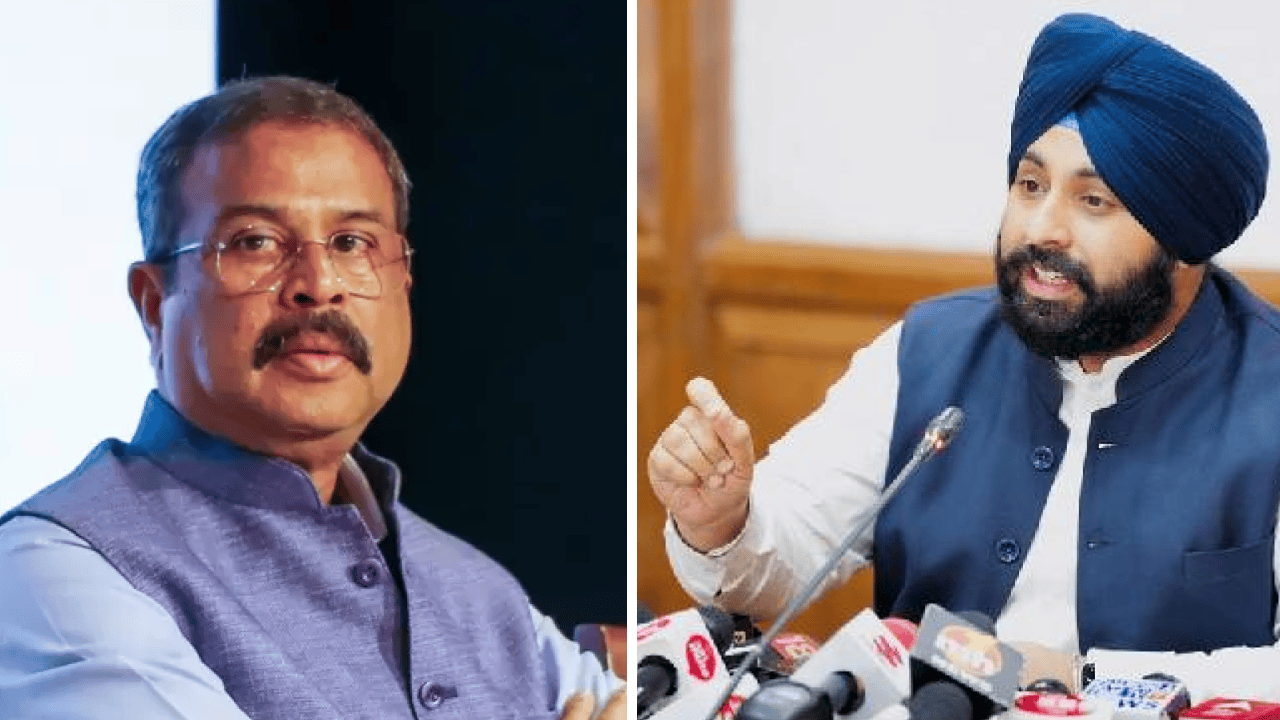
The Punjab paper leak controversy has intensified after the resignation of former Union Education Minister Dharmendra Pradhan over the NEET-UG examination row, with opposition parties using the development to demand accountability from the Aam Aadmi Party (AAP) government in Punjab. The BJP, Congress and Shiromani Akali Dal (SAD) have collectively called for the resignation of Punjab Education Minister Harjot Singh Bains, alleging repeated examination paper leaks and irregularities under the state’s AAP administration.
The political confrontation has gained momentum at a time when education reforms and recruitment transparency remain key public concerns ahead of the next Punjab Assembly elections. While opposition leaders argue that multiple examination controversies warrant ministerial accountability, Chief Minister Bhagwant Mann has firmly rejected allegations of paper leaks, insisting that no competitive examination paper has leaked during the AAP government’s four-and-a-half-year tenure.
Opposition Intensifies Pressure on Punjab Government
The resignation of Dharmendra Pradhan has become the centerpiece of the opposition’s campaign against the Punjab government. BJP leaders argued that if moral responsibility required a Union minister to step down, the same principle should apply in Punjab.
BJP spokespersons questioned why Education Minister Harjot Singh Bains had not resigned despite allegations involving several examinations. Union Minister Ravneet Singh Bittu also demanded Bains’ resignation, accusing the government of failing to safeguard examination integrity and alleging that recruitment papers had been leaked and sold.
The Shiromani Akali Dal echoed similar demands, claiming that at least six examinations, including the Punjab Teacher Eligibility Test (PTET), the Class 12 English examination and the pharmacy officer recruitment test, were affected by alleged paper leaks.
Punjab Congress chief Amarinder Singh Raja Warring also welcomed Pradhan’s resignation, calling it a victory for student protests while urging Chief Minister Bhagwant Mann and Harjot Singh Bains to accept responsibility for alleged examination irregularities in the state. He further accused the government of failing to protect students’ interests and recalled earlier statements by AAP leaders advocating ministerial accountability in similar situations.
Delhi Cabinet Minister Manjinder Singh Sirsa also accused the AAP of adopting different standards on paper leak controversies, alleging that thousands of candidates were impacted by examination irregularities, particularly in the pharmacy officer recruitment process.
Bhagwant Mann Rejects Paper Leak Allegations
Chief Minister Bhagwant Mann has strongly denied the opposition’s allegations, maintaining that no competitive examination paper has leaked since the AAP assumed office in Punjab.
According to Mann, incidents reported during recent examinations involved organized cheating rather than paper leaks. He said authorities acted swiftly after receiving complaints from two examination centres and dismantled an inter-state cheating network.
The chief minister explained that the accused allegedly used Bluetooth-enabled devices to digitally transmit examination content to external operators who supplied answers to candidates during the examination. He stated that law enforcement intervened within minutes, resulting in multiple arrests.
Mann confirmed that 21 people have been arrested in connection with the cheating racket linked to the recently conducted pharmacy officer examination. He argued that the government’s immediate response demonstrated its commitment to protecting the integrity of recruitment examinations.
Political Battle Extends Beyond Education
The controversy has expanded beyond the education department into a broader political debate over accountability.
While the BJP and Congress have focused their criticism on Education Minister Harjot Singh Bains, the Shiromani Akali Dal has also sought the resignation of Health Minister Balbir Singh, citing alleged irregularities connected to recruitment examinations conducted under departments linked to healthcare.
The opposition has repeatedly drawn comparisons between the Centre’s handling of the NEET controversy and Punjab’s response to examination-related allegations, arguing that similar standards of accountability should apply regardless of which party is in power.
AAP, however, maintains that every reported irregularity has been investigated and that action has been taken wherever evidence of wrongdoing has emerged. Party leaders have emphasized that isolated cheating incidents should not automatically be classified as paper leaks.
Expert Analysis / What This Means
The growing Punjab paper leak controversy is likely to become one of the defining political issues ahead of the state’s Assembly elections. Examination integrity directly affects lakhs of students and job aspirants, making the issue highly sensitive for both voters and policymakers.
The opposition is attempting to transform individual examination controversies into a broader narrative about governance and administrative accountability. By linking Punjab’s alleged paper leak cases with Dharmendra Pradhan’s resignation, rival parties are seeking to increase political pressure on the AAP government.
For students and recruitment candidates, the controversy raises concerns about fairness, transparency and confidence in government examinations. Even when governments distinguish between cheating and paper leaks, repeated allegations can erode public trust in recruitment systems.
The issue may also accelerate reforms in examination security, including stronger digital monitoring, tighter surveillance at examination centres and improved coordination between law enforcement agencies and examination authorities.
Compared with previous recruitment controversies across several Indian states, the Punjab debate highlights a growing expectation that governments respond quickly and transparently whenever examination irregularities emerge.
Ultimately, the political and administrative handling of these allegations may influence both public confidence and electoral narratives in the months leading to the state polls.
Why This Matters
Recruitment examinations and board tests determine educational opportunities and government employment for thousands of candidates every year. Allegations of paper leaks or organized cheating can undermine confidence in public institutions and create uncertainty for genuine candidates.
The controversy has also exposed how examination integrity has become a national political issue, with parties increasingly invoking similar incidents across states to question each other’s governance standards.
Industry / Market Impact
The latest controversy is expected to increase pressure on examination authorities to adopt stronger security technologies and stricter monitoring systems.
Experts anticipate greater investment in encrypted digital paper distribution, artificial intelligence-based surveillance, biometric verification and advanced anti-cheating mechanisms. Recruitment agencies may also face tighter compliance requirements and more frequent audits to restore public confidence.
For coaching institutes and aspirants, prolonged uncertainty surrounding recruitment examinations can disrupt preparation cycles and delay hiring across government departments.
What Happens Next
The political confrontation is expected to continue as opposition parties intensify demands for ministerial resignations ahead of the Punjab Assembly elections.
Investigations into the pharmacy officer examination cheating racket are likely to remain under scrutiny, while the Punjab government is expected to defend its record by highlighting arrests and enforcement actions.
Any fresh findings from ongoing investigations could significantly shape the political discourse, particularly if additional examination irregularities or administrative lapses come to light.