
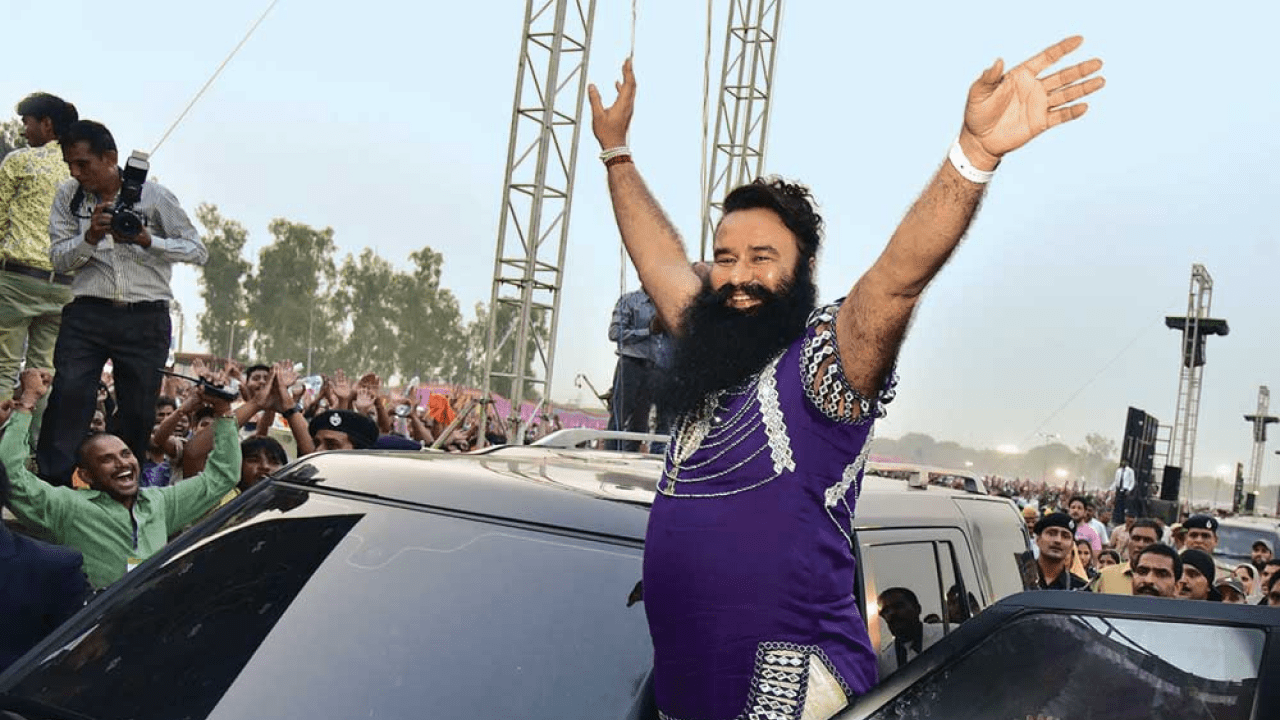
Dera Sacha Sauda chief Gurmeet Ram Rahim Singh walked out of Sunaria Jail in Rohtak on Tuesday after being granted a 30-day parole by Haryana authorities, marking his 16th temporary release since his 2017 conviction in the rape case involving two women disciples. The latest parole has reignited debate over the frequency of temporary releases granted to the controversial religious leader, who is serving a 20-year prison sentence.
The self-styled godman exited the high-security prison early Tuesday morning and is expected to stay at the Dera headquarters in Sirsa during the parole period. His legal team confirmed that the release was approved by the competent state authority under provisions of the Haryana Good Conduct Prisoners (Temporary Release) Act, 2022.
The parole comes at a time when scrutiny around Ram Rahim’s repeated releases has intensified among opposition parties, legal observers, and sections of civil society. Critics argue that the frequency of his paroles and furloughs undermines public confidence in the justice system, while supporters insist he is availing legal rights available to eligible prisoners under state law.
According to prison records, Gurmeet Ram Rahim listed as convict number 8647/C has already spent 406 days outside prison through paroles and furloughs since his conviction nearly nine years ago. With the latest 30-day release, his total time spent outside jail rises to approximately 436 days.
Temporary Releases Since 2017
Since being convicted by a special CBI court in August 2017, Ram Rahim has repeatedly secured temporary release from custody. His first release came in October 2020 for a single day, followed by multiple paroles ranging from 21 to 50 days over subsequent years.
This year alone, the Dera chief has already availed 70 days of parole. Earlier in January 2026, he was granted a 40-day parole during celebrations linked to former Dera chief Shah Satnam Singh’s birth anniversary. The current 30-day parole effectively exhausts the annual parole quota permitted under Haryana law.
Under the Haryana Good Conduct Prisoners (Temporary Release) Act, prisoners may receive up to 10 weeks of parole in a calendar year, generally divided into two spells. Separately, they may also apply for three weeks of furlough, which is legally distinct from parole because furlough counts toward the sentence served, while parole does not.
Legal experts note that despite exhausting his parole limit for the year, Ram Rahim may still remain eligible for furlough under the same law.
Also read: AIADMK Factional Rift Deepens as Rebel Bloc Signals Support for CM Vijay’s TVK
Murder Convictions Overturned by High Court
Although Ram Rahim continues to serve his sentence in the rape case, two major murder convictions against him were overturned in recent years.
In 2019, a special CBI court had sentenced him to life imprisonment for the murder of journalist Ram Chander Chhatrapati, who had published reports critical of the Dera chief. However, the Punjab and Haryana High Court acquitted him in the case earlier this year.
Similarly, in 2021, he was convicted for conspiring to murder former Dera manager Ranjit Singh, whose killing in 2002 had drawn national attention. That conviction was also set aside by the High Court in 2024.
The acquittals significantly altered the legal landscape surrounding the Dera chief, leaving the 2017 rape conviction as the primary sentence currently operative against him.
Why This Matters
The repeated release of Gurmeet Ram Rahim has become politically sensitive in Haryana and Punjab, particularly because of the Dera Sacha Sauda’s sizeable follower base across northern India. The sect has historically been viewed as electorally influential, with political parties often accused by rivals of attempting to court its support.
Every parole granted to the Dera chief tends to trigger renewed criticism from opposition groups and victims’ rights advocates, who question whether influential convicts receive preferential treatment unavailable to ordinary prisoners.
The issue also raises broader questions about the implementation of parole laws in India. While parole is intended to support rehabilitation, family connections, and reintegration into society, critics argue that repeated long-duration releases for high-profile convicts blur the distinction between incarceration and temporary freedom.
For supporters of prison reform, however, the case demonstrates how parole laws are increasingly being interpreted through legal rights rather than exceptional privileges. The debate is likely to continue as more states revise prison rules and temporary release frameworks.
Also read: Chandranath Rath Killing Sparks Political Shockwaves in Bengal After Poll Verdict
Expert Analysis / What This Means
The latest parole granted to Gurmeet Ram Rahim is likely to deepen public scrutiny of Haryana’s prisoner release framework and the discretionary powers exercised by state authorities. While the parole falls within the legal limits prescribed under the 2022 Act, the frequency and duration of his releases have created a perception that influential convicts may benefit disproportionately from procedural flexibility.
The controversy also reflects the growing tension between prisoner rights and public sentiment in high-profile criminal cases. In ordinary circumstances, parole is considered an important correctional mechanism aimed at rehabilitation and maintaining social ties. However, when applied repeatedly to politically or socially influential figures, the process often attracts allegations of preferential treatment.
The case could further influence future judicial review of parole policies, particularly concerning convicts involved in serious crimes such as sexual assault. Legal experts may increasingly push for stricter transparency standards around parole approvals, including public disclosure of evaluation criteria and security assessments.
Politically, Ram Rahim’s recurring releases are likely to remain contentious because of the Dera’s electoral influence in Haryana, Punjab, and parts of Rajasthan. Opposition parties may continue to use the issue to challenge the state government’s neutrality and administrative independence.
The development may also revive discussion about balancing prison reform with accountability in cases involving public figures. As India modernizes correctional policies, governments may face pressure to establish clearer safeguards to prevent parole systems from appearing uneven or selectively applied.
Timeline of Key Events
August 2017
Ram Rahim was convicted by a special CBI court for raping two women disciples and sentenced to 20 years in prison.
October 2020
He received his first temporary release from prison.
2019–2021
Separate life sentences were awarded in the Ram Chander Chhatrapati murder case and the Ranjit Singh murder conspiracy case.
2024
Punjab and Haryana High Court acquitted him in the Ranjit Singh murder case.
March 2026
The High Court acquitted him in the journalist murder case.
May 2026
He secured his 16th temporary release through a 30-day parole.
Industry / Market Impact
The repeated parole controversy has also drawn attention to the broader ecosystem surrounding influential religious organizations in India. Dera Sacha Sauda commands a large social and financial network with significant grassroots influence across northern states.
Periods of Ram Rahim’s release often trigger heightened activity among followers, including gatherings, digital engagement, and renewed visibility for the organization. Security agencies and local administrations typically monitor such periods closely due to concerns over crowd management and law-and-order implications.
The case additionally highlights how high-profile criminal proceedings involving religious leaders can shape public trust in judicial institutions, prison administration, and governance structures.