
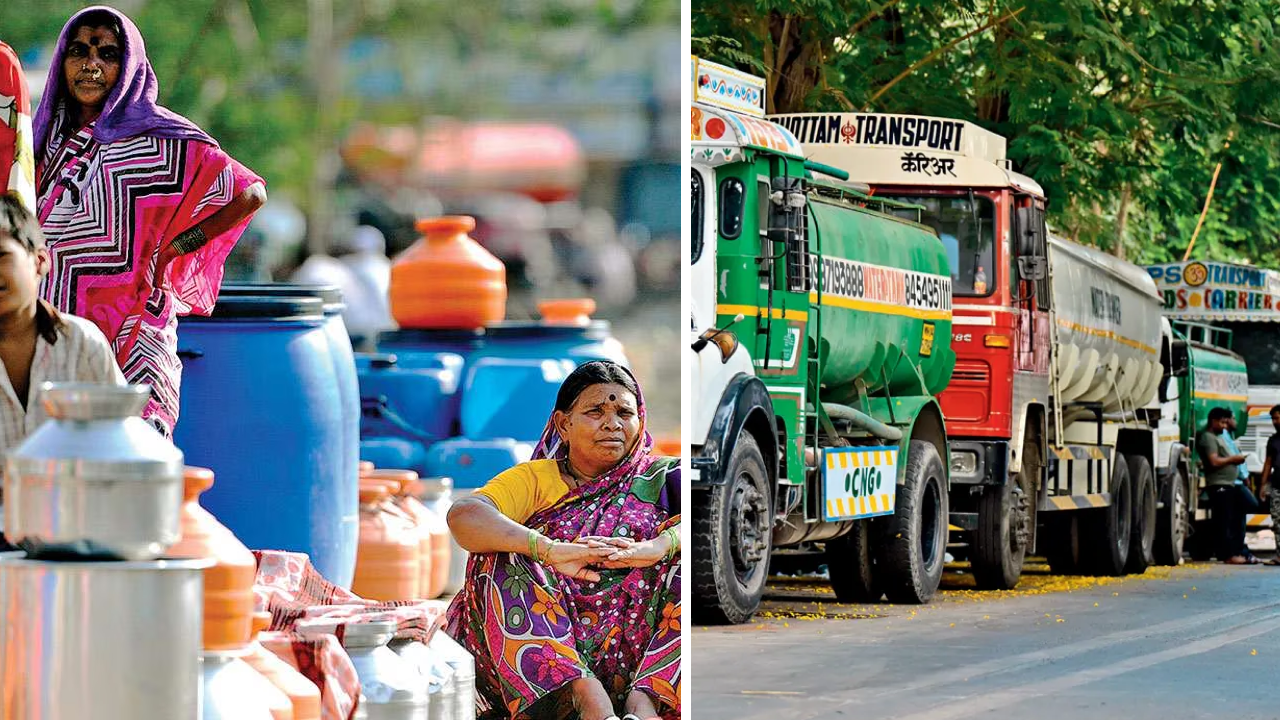
Mumbai is confronting a growing water crisis as reservoir levels supplying the city have fallen below 10% of total capacity, forcing authorities to tighten conservation measures and raising concerns about additional supply cuts in the coming weeks. The Mumbai water crisis has also sparked a sharp increase in tanker prices, placing added financial pressure on residents, housing societies, and businesses already grappling with reduced municipal supply.
According to civic officials, the seven reservoirs that provide drinking water to Mumbai currently hold less than one-tenth of their combined storage capacity. The declining reserves follow a delayed and weaker-than-expected start to the monsoon season, underscoring the city’s heavy dependence on annual rainfall for water security.
The Brihanmumbai Municipal Corporation (BMC) has already implemented a 10% reduction in water supply and has begun drawing on reserve water sources to manage demand. Officials estimate that current water stocks could sustain the city until around August 20 under existing arrangements. However, if rainfall does not improve significantly by the end of June, another round of cuts may be introduced in early July.
The situation has prompted concerns across political and civic circles, with municipal authorities reviewing contingency plans and long-term strategies to address the worsening shortage.
Also read: Shiv Sena (UBT) Faces Fresh Turmoil as Sanjay Raut Alleges ₹50 Crore Defection Offers to MPs
Why Mumbai Is Facing Another Water Crisis
Despite being India’s financial capital and one of the country’s most developed urban centres, Mumbai remains highly dependent on monsoon rainfall for its drinking water supply.
The city relies on seven key reservoirs Bhatsa, Upper Vaitarna, Middle Vaitarna, Modak Sagar, Tansa, Vihar, and Tulsi for nearly all of its potable water needs. Unlike many inland cities, Mumbai has limited groundwater options because excessive extraction risks seawater intrusion from the Arabian Sea, making underground reserves unsuitable for large-scale use.
This dependence leaves the city vulnerable to fluctuations in monsoon performance. When rainfall arrives late or remains below average, reservoir levels can decline rapidly, creating pressure on municipal supplies.
Climate variability has further complicated the challenge. Experts have noted increasingly erratic rainfall patterns, with prolonged dry spells often followed by short bursts of intense rain. While such downpours may lead to urban flooding, they do not always guarantee sustained replenishment of reservoir systems.
Tanker Rates Soar as Demand Outpaces Supply
As municipal water availability shrinks, Mumbai’s dependence on private and civic water tankers has surged, driving prices sharply higher across several neighbourhoods.
Residents in multiple housing societies have reported paying significantly more for both raw groundwater tankers and potable water deliveries. In some areas, tanker rates have increased by several hundred rupees within days, while transport costs for approved potable water tankers have also risen substantially.
The shortage has created a difficult situation for large residential complexes that require multiple tanker deliveries daily to meet the needs of thousands of residents, maintenance staff, and service workers. Even after paying higher prices, some societies report receiving fewer tankers than required.
Industry representatives attribute the price spike to declining groundwater reserves. Most tanker operators rely on borewells and other groundwater sources, many of which are experiencing reduced water levels amid the delayed monsoon.
The impact extends beyond households. Construction projects have also been affected after authorities suspended water supply to building sites. Developers warn that rising tanker costs could increase project expenses and create logistical challenges, particularly if the shortage continues through the monsoon season.
Also read: India’s Fuel Price Shock Deepens as Petrol Crosses ₹100 in Delhi, More Hikes Still Possible
Expert Analysis / What This Means
Mumbai’s current water crisis highlights a structural vulnerability that extends beyond a single weak monsoon season. The city remains heavily reliant on rainfall despite decades of rapid urbanisation, population growth, and increasing water demand.
For residents, the immediate consequence is likely to be stricter conservation measures, higher household expenses, and growing dependence on alternative water sources. Housing societies that rely on tankers may face rising maintenance costs, which could eventually be passed on to residents.
For businesses and developers, higher tanker prices and restricted municipal supply could increase operating costs and slow project timelines. Commercial establishments are already facing tighter restrictions than residential consumers.
The crisis also raises broader questions about urban water management in an era of climate change. Mumbai’s experience reflects a growing trend in major cities worldwide, where extreme weather events coexist with water scarcity. Similar challenges have emerged in previous drought years, including 2009, when prolonged shortages forced authorities to maintain restrictions for extended periods.
The current situation may accelerate investments in rainwater harvesting, wastewater recycling, leak reduction, and more efficient distribution systems. Without significant infrastructure upgrades, Mumbai could face recurring shortages despite receiving substantial annual rainfall.
Industry / Market Impact
The water shortage is beginning to affect multiple sectors of Mumbai’s economy.
Real estate developers face rising operational costs due to increased reliance on tanker water. Construction schedules may also be affected if supply constraints worsen. Commercial establishments, already subject to stricter water reductions, may need to implement additional conservation measures to maintain operations.
The tanker industry, meanwhile, is experiencing a surge in demand. Operators report receiving a significantly higher volume of requests as residential societies and businesses seek alternative water sources. However, declining groundwater availability is limiting supply, contributing to higher prices across the market.
Experts note that prolonged shortages could have wider economic implications if water restrictions become more severe during peak summer and post-monsoon months.
What Happens Next
The trajectory of Mumbai’s water situation will largely depend on monsoon performance over the next several weeks.
If rainfall intensifies and reservoir levels recover, authorities may avoid imposing additional restrictions. However, continued rainfall deficits could trigger another 10% reduction in water supply during early July.
The state government has also directed civic authorities to prepare a comprehensive water management roadmap extending through August 2027. The strategy is expected to focus on water availability, distribution efficiency, conservation measures, emergency planning, and long-term resilience.
In the meantime, officials are encouraging residents to reduce consumption through practical measures such as fixing leaks, limiting unnecessary water use, reusing household water where possible, and adopting water-efficient fixtures.
With reservoir levels at critically low levels and demand continuing to rise, the coming weeks could prove decisive for Mumbai’s water security.