
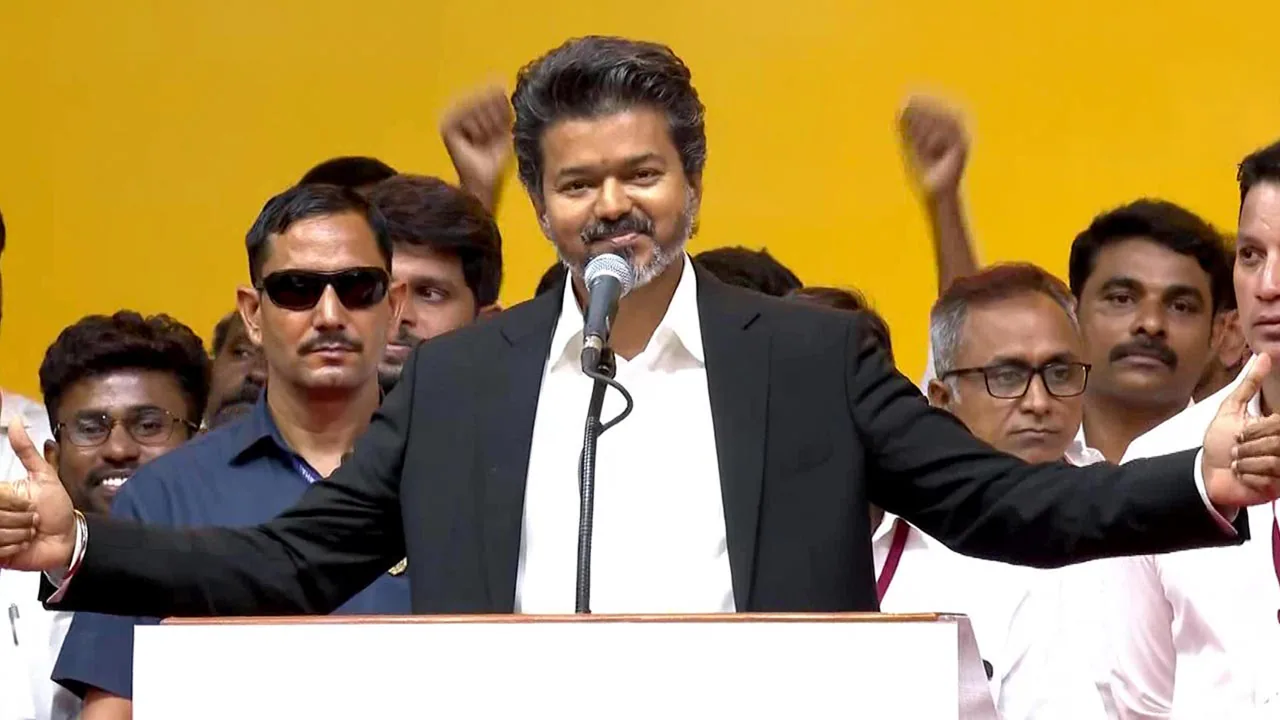
Tamil Nadu Chief Minister C Joseph Vijay on Thursday carried out a major expansion of his newly formed cabinet, inducting 23 legislators into the Council of Ministers and reshaping the political landscape of the state just weeks after taking office. The expansion is particularly significant because it marks the return of the Congress party to the Tamil Nadu government after nearly six decades, while also signaling the consolidation of a fragile but strategically important coalition led by Vijay’s Tamilaga Vettri Kazhagam (TVK).
The swearing-in ceremony, held at Lok Bhavan and administered by Governor Rajendra Vishwanath Arlekar, saw 21 MLAs from TVK and two legislators from the Congress party take oath as ministers. The move comes nearly two weeks after Vijay and nine ministers were sworn in following the assembly election that propelled the actor-turned-politician into power.
The latest expansion increases the strength of the Vijay cabinet to 32 ministers, leaving three vacancies in the 35-member council permitted under constitutional limits. Those remaining berths are widely expected to go to alliance partners including the Viduthalai Chiruthaigal Katchi (VCK) and the Indian Union Muslim League (IUML), both of which currently provide crucial outside support to the government.
Congress legislators Rajesh Kumar and P. Vishwanathan were inducted after receiving approval from the party leadership led by Mallikarjun Kharge. Their inclusion carries historical weight, as Congress has not been part of the Tamil Nadu government since the tenure of former Chief Minister M Bhaktavatsalam ended in 1967 following the DMK’s landmark victory under CN Annadurai.
Among the newly sworn-in ministers were TVK MLAs including Srinath, S Kamali, C Vijayalakshmi, R V Ranjith Kumar, D Sarath Kumar, V Sampath Kumar, Mohamed Farvas, Marie Wilson, and Tamil Parthiban, reflecting Vijay’s attempt to broaden regional and community representation within his administration.
Also read: AIADMK Factional Rift Deepens as Rebel Bloc Signals Support for CM Vijay’s TVK
Why This Cabinet Expansion Matters
The cabinet reshuffle is more than a routine administrative exercise. It reflects the delicate balancing act required for Vijay’s government to maintain stability in a fractured assembly. TVK emerged as the single-largest party in the 234-member Tamil Nadu Assembly but fell short of a majority by 10 seats, forcing Vijay to rely on post-poll support from Congress, VCK, IUML, CPI, and CPM.
The support arrangement was politically sensitive from the outset. Congress reportedly agreed to back Vijay only after assurances that no “communal forces” would be accommodated within the coalition framework. Left parties and VCK also extended support to prevent political instability and avoid the possibility of central intervention through President’s Rule.
The absence of VCK and IUML ministers in the current expansion has therefore drawn significant attention. However, senior leaders from the alliance indicated that both parties are likely to receive one cabinet berth each in the coming days after finalizing their nominees.
TVK leaders have publicly encouraged VCK chief Thol Thirumavalavan to join the ministry, though reports suggest he may instead contest a future by-election rather than enter the cabinet immediately.
Expert Analysis / What This Means
The expansion of Vijay’s cabinet marks the first real test of coalition governance for the TVK administration. While the actor-turned-chief minister secured public momentum through a strong electoral debut, maintaining political cohesion among ideologically diverse allies could prove significantly more challenging than campaigning.
Congress re-entering the Tamil Nadu government after nearly 60 years is symbolically important and could reshape the party’s relevance in the state. For Congress, participation in governance offers visibility and influence at a time when regional alliances have become central to its national strategy.
For Vijay, accommodating alliance partners without alienating his core support base will be critical. The delayed induction of VCK and IUML indicates ongoing negotiations over representation, policy influence, and electoral calculations ahead of future local body and parliamentary contests.
The controversy surrounding rebel AIADMK legislators also highlights the fragile nature of the coalition. Left parties have openly warned they may reconsider support if defectors from AIADMK are rewarded with ministerial positions. This effectively limits Vijay’s room for political maneuvering.
The developments also underscore how Tamil Nadu politics is entering a transition phase after decades dominated by the DMK-AIADMK binary. TVK’s emergence as a governing force suggests the state may be witnessing the beginning of a broader political realignment.
If Vijay successfully manages coalition pressures while maintaining administrative stability, his government could redefine regional politics in Tamil Nadu over the next electoral cycle.
Industry / Political Impact
The cabinet expansion is expected to influence both governance and investor sentiment in Tamil Nadu. Political stability remains a key concern for industries operating in the state, particularly in manufacturing, automobiles, electronics, and IT sectors that depend on predictable policy continuity.
By rapidly expanding the cabinet and signaling inclusiveness toward alliance partners, Vijay appears focused on projecting administrative stability. Political observers say this could help reassure businesses after a highly competitive election that resulted in a fractured mandate.
The return of Congress to government may also strengthen coordination between the state and opposition-led national blocs on policy matters, particularly regarding federal funding, welfare programs, and infrastructure projects.
Meanwhile, the Left parties’ continued support gives the coalition ideological breadth but could also complicate economic reforms if disagreements emerge on privatization, labor policies, or industrial expansion.
Timeline of Events
February 2024
Vijay formally launched Tamilaga Vettri Kazhagam (TVK), marking his entry into active politics.
Tamil Nadu Assembly Elections
TVK emerged as the single-largest party but failed to secure a majority in the 234-member assembly.
Post-Election Negotiations
Congress, VCK, CPI, CPM, and IUML extended support to Vijay, enabling him to form the government.
May 10
Vijay and nine ministers were sworn in as the new Tamil Nadu government took office.
Latest Cabinet Expansion
Twenty-three additional ministers, including two Congress MLAs, joined the council of ministers, taking the cabinet strength to 32.
What Happens Next
Attention will now shift to the remaining cabinet berths and whether VCK and IUML formally join the ministry. IUML has already convened internal meetings to finalize its nominee, while discussions continue within VCK over representation and future electoral strategy.
The Vijay government will also face scrutiny over how it handles coalition expectations, governance delivery, and relations with outside supporters. Any move involving rebel AIADMK legislators could trigger friction within the alliance, particularly with Left parties that have warned against compromising on “clean governance.”
For now, however, the expanded cabinet signals that Vijay is moving quickly to stabilize his administration and institutionalize TVK’s transformation from a new political experiment into a governing force.