
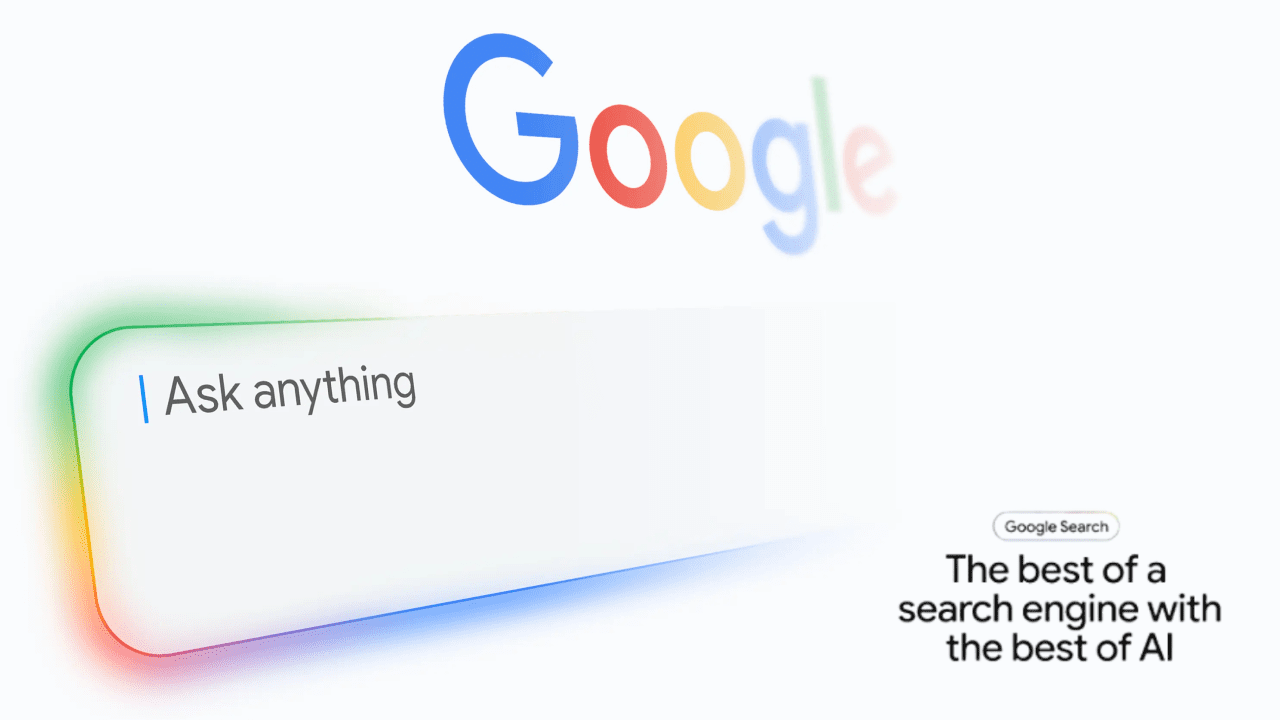
Google has unveiled one of the most significant overhauls of its Search product in over two decades, introducing a new AI-first architecture powered by Gemini 3.5 Flash as the default model in AI Mode, alongside a fully redesigned intelligent search box and a suite of autonomous “Search agents.” Announced at Google I/O, the changes mark a decisive shift from traditional keyword-based search toward conversational, multimodal, and task-executing AI workflows.
The rollout comes as Google reports that AI Mode has surpassed one billion monthly users, with query volume more than doubling each quarter and reaching an all-time high in the most recent quarter. The company says this surge reflects a broader transformation in user behavior, where search is evolving from discrete queries into continuous, context-aware interactions.
At the center of this transformation is a redesigned search experience that allows users to input longer, more complex prompts using text, images, files, videos, and even Chrome tabs while AI-generated suggestions now go beyond traditional autocomplete. Google says the interface represents the most substantial change to the Search box in more than 25 years.
Gemini 3.5 Flash Becomes the Default Brain of AI Search
Google confirmed that Gemini 3.5 Flash is now the default model powering AI Mode globally, extending its most advanced lightweight AI system into everyday search interactions.
The model is designed for high-speed reasoning, multimodal understanding, and agent-like behavior, enabling Search to handle not only factual queries but also complex, multi-step tasks. The upgrade follows a series of earlier integrations, including Gemini-based AI Overviews and prior defaults in Google’s broader Gemini ecosystem.
With this change, AI Mode becomes the primary interface for generative search experiences, reinforcing Google’s strategy of embedding foundation models directly into its core products rather than treating them as standalone tools.
A Fully Redesigned Intelligent Search Box
The centerpiece of the update is what Google calls an intelligent search box, now rolling out globally across all regions where AI Mode is available.
Unlike the traditional static input field, the new search box dynamically expands as users type, accommodating long-form prompts and structured instructions. It is designed to anticipate user intent, offering AI-generated suggestions that help shape and refine queries in real time.
Crucially, the system now supports multimodal input, allowing users to search using:
- Text queries
- Images
- Documents and files
- Videos
- Active Chrome tabs
This positions Search as a unified input layer for nearly any type of digital content.
Google also emphasized continuity between AI Overviews and AI Mode. Users can now transition directly from summary responses into full conversational sessions, with context preserved across interactions on both desktop and mobile.
Search Agents Move Toward Always-On AI Assistance
One of the most transformative additions is the introduction of Search agents, AI systems designed to operate continuously in the background.
The first wave, known as information agents, will monitor the web in real time scanning sources such as news sites, blogs, social platforms, and Google’s live data streams covering finance, shopping, and sports. These agents will deliver synthesized updates based on user-defined goals.
For example, users could configure agents to:
- Track rental listings matching specific requirements
- Monitor product launches or athlete collaborations
- Alert users to price or availability changes
These agents represent a shift from reactive search to proactive information delivery.
Google also previewed agentic booking tools, enabling Search to complete real-world tasks such as scheduling services or contacting businesses directly. In some categories, including home repair and pet care, users may even request that Google place phone calls on their behalf. These features are expected to roll out across the United States in the coming months.
Generative UI and “Mini Apps” Inside Search
Google is also pushing Search beyond answers into interactive software generation.
Using capabilities powered by Gemini 3.5 Flash and the Antigravity platform, Search will be able to generate custom user interfaces in real time. These generative UIs can include visual simulations, dashboards, graphs, and interactive tools tailored to specific queries.
Examples include:
- A physics simulation to explain complex scientific concepts
- A personalized fitness or wellness tracker
- A project dashboard for planning events or relocations
These tools are designed to function as persistent “mini apps,” allowing users to return to them over time and continue their tasks.
Google says these generative experiences will be available broadly in Search, with more advanced customization features rolling out first to AI Pro and Ultra subscribers in the U.S.
Personal Intelligence Expands Globally Without Subscription
Alongside agentic features, Google is expanding Personal Intelligence in AI Mode to nearly 200 countries and 98 languages, removing the previous subscription requirement.
Users will be able to connect personal Google services such as Gmail and Google Photos, with Calendar integration expected in future updates. The system is designed to incorporate personal context when enabled into search results and AI responses.
Google emphasized that users retain full control over what data is connected, highlighting privacy and consent as central design principles.
This expansion signals a broader move toward deeply personalized search experiences, where results are influenced not only by the public web but also by an individual’s digital footprint.
Expert Analysis / What This Means
Google’s redesign marks a structural shift from search as a retrieval engine to search as an execution layer. Users are no longer just asking questions they are delegating tasks to autonomous systems capable of acting on their behalf.
This fundamentally changes how information flows online. If agents increasingly summarize, monitor, and act within Search itself, fewer user journeys may extend outward to independent websites, reshaping referral traffic patterns across the web ecosystem.
It also accelerates the convergence of search, productivity tools, and personal assistants into a single interface. Features like generative UI and mini apps suggest that Search is evolving into a lightweight operating system for everyday digital tasks.
Historically, Google Search has evolved through ranking improvements and interface refinements. This shift is different: it introduces persistent AI agents and dynamic application generation, moving beyond static results entirely.
For users, the benefit is convenience and automation. For publishers and digital businesses, it raises long-term questions about visibility, attribution, and engagement within an AI-mediated discovery layer.
The expansion of Personal Intelligence further intensifies this shift by blending private user context with public information retrieval, potentially redefining relevance itself as a personalized construct rather than a universal ranking.
Industry / Market Impact
This overhaul strengthens Google’s position in the competitive AI search race, particularly against emerging AI-native search tools and conversational assistants. By embedding Gemini 3.5 Flash directly into Search and scaling agents globally, Google is effectively defending its core search monopoly while redefining what “search” means.
The introduction of agentic workflows may also pressure competitors to shift from answer engines to action engines, where systems not only provide information but complete tasks end-to-end.
For advertisers and SEO professionals, the shift suggests a future where traditional keyword optimization may matter less than structured, machine-readable content that AI agents can interpret and act upon.
What Happens Next
Google has staged the rollout across multiple phases:
- Gemini 3.5 Flash is already active globally in AI Mode
- The intelligent search box is rolling out across supported regions
- Information agents and mini apps arrive this summer (subscription-based in early phases)
- Agentic booking expands across the U.S. in coming months
- Personal Intelligence expands globally without subscription access
Further integration with Google Calendar is expected but not yet scheduled.
Key Figures and Data
- AI Mode: 1 billion+ monthly users
- Query growth: more than doubling each quarter
- Peak usage: all-time high recorded last quarter
- Languages supported for Personal Intelligence: 98
- Countries/territories expansion: nearly 200
Background Context
Google’s shift builds on a gradual transition that began with AI Overviews and earlier Gemini integrations across its ecosystem. Over the past year, the company has steadily moved toward embedding generative AI into core Search functions, culminating in this unified AI-first interface.
This evolution aligns with Google CEO Sundar Pichai’s broader vision of Search as an “agent manager,” where users increasingly delegate complex tasks rather than manually browsing results.
Reactions / Official Statements
Google leadership framed the update as part of a long-term redefinition of Search, emphasizing that user expectations have shifted from simple query results to ongoing conversational and task-driven experiences. The company describes the new system as a way to bring “the world’s information to work for you” through intelligent, proactive AI.