

Apple says it prevented more than $2.2 billion in fraudulent App Store transactions in 2025, highlighting the growing scale of digital fraud targeting mobile ecosystems and the company’s increasing reliance on artificial intelligence-driven security systems to combat it. The disclosure underscores how online marketplaces are becoming major battlegrounds for cybercriminals, with fake apps, stolen payment credentials, manipulated reviews, and fraudulent developer accounts evolving in sophistication each year.
The company revealed that its combination of machine learning systems and human moderation teams stopped over 5.4 million stolen credit cards from being used for illicit purchases on the App Store during the year. Apple also blocked more than 1.1 billion attempts to create fraudulent customer accounts and disabled another 40.4 million accounts linked to abuse or suspicious activity.
The figures were released as Apple detailed the broader security infrastructure behind the App Store, which now serves more than 850 million weekly users across 175 storefronts worldwide. The company said its anti-fraud systems have prevented more than $11.2 billion in suspicious transactions over the past six years.
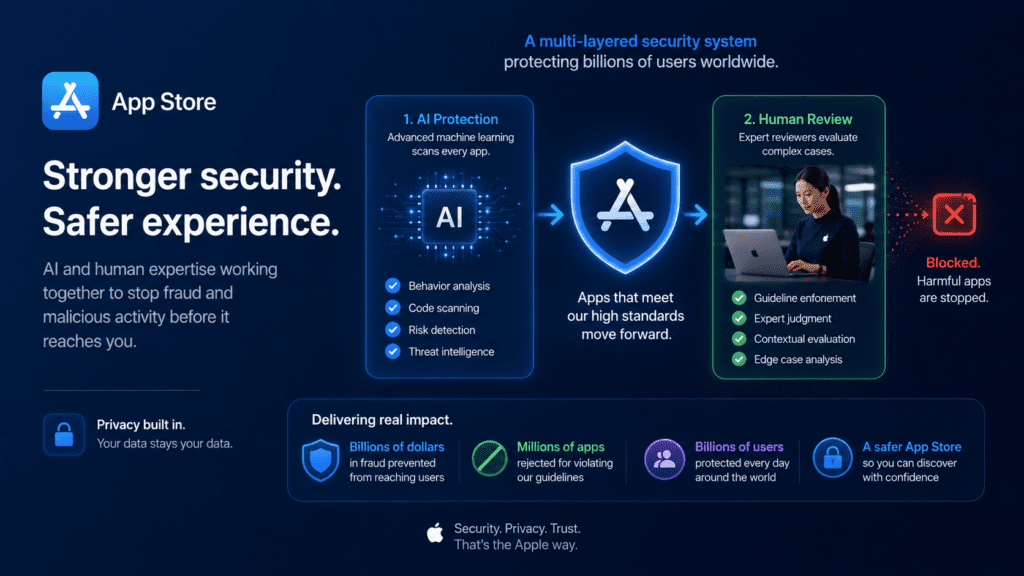
At the center of Apple’s security strategy is a layered review process that combines automated AI analysis with human oversight. The company said this hybrid approach has become increasingly important as app fraud schemes grow more complex and malicious actors use sophisticated methods to bypass platform safeguards.
Massive Crackdown on Fraudulent Apps and Developers
Apple said it rejected more than two million app submissions in 2025 for violating App Store guidelines, including apps linked to spam, deceptive behavior, privacy violations, and hidden features.
Among the rejected submissions were over 371,000 apps accused of copying other apps or misleading users, while another 443,000 were blocked over privacy concerns. Apple also removed nearly 59,000 apps that initially appeared legitimate such as games or utility apps but later changed functionality after approval in attempts to commit financial fraud.
The company further intensified action against suspicious developers by terminating approximately 193,000 developer accounts tied to fraud concerns and rejecting more than 138,000 developer enrollment attempts before they entered the ecosystem.
Apple also reported a surge in fraudulent activity outside its official marketplace. According to the company, it detected and blocked 28,000 illegitimate apps circulating through pirate storefronts and unauthorized distribution channels. These apps reportedly included malware, pirated software, gambling applications, and explicit content disguised as legitimate mobile apps.
In a single recent month, Apple said it stopped 2.9 million attempts to install or launch apps distributed outside the App Store or approved alternative marketplaces.
Also read: Apple and Google Launch End-to-End Encrypted RCS Messaging Across iPhone and Android
AI Becomes Central to App Store Security
Apple’s latest figures illustrate how artificial intelligence has become a critical tool in large-scale digital security operations. The company said AI-powered systems are now deeply integrated into nearly every stage of App Store moderation, from payment fraud detection to review authenticity monitoring.
Machine learning models reportedly analyze app similarities, behavioral anomalies, suspicious account activity, and deceptive update patterns in real time. Apple said these systems help reviewers identify malicious behavior faster while allowing legitimate developers to receive approvals more efficiently.
The App Review team processed more than 9.1 million app submissions in 2025 alone, while more than 306,000 new developers joined the platform during the same period.
Apple also used AI tools to combat manipulation of App Store discovery systems. The company processed over 1.3 billion ratings and reviews during the year and blocked nearly 195 million fraudulent reviews before they became visible to users. Additionally, Apple prevented nearly 7,800 deceptive apps from appearing in search results and stopped another 11,500 apps from manipulating App Store charts.
Expert Analysis / What This Means
Apple’s disclosure reflects a broader shift in the technology industry where AI is no longer just powering consumer products it is becoming essential infrastructure for cybersecurity and digital trust. The scale of attempted fraud highlighted by Apple demonstrates how lucrative app ecosystems have become for cybercriminal networks operating globally.
For users, the report reinforces the importance of curated app marketplaces and payment protections as mobile devices increasingly handle banking, identity verification, and personal data storage. Fraudulent apps today are capable of stealing credentials, monitoring activity, or manipulating payments without obvious warning signs.
For developers, Apple’s aggressive enforcement policies may create stricter compliance requirements, but they also help protect legitimate businesses from counterfeit apps, fake reviews, and cloned software that can undermine revenue and reputation.
The findings also intensify the ongoing debate around sideloading and third-party app marketplaces. Apple has long argued that tighter control over app distribution improves security, while critics contend that it limits competition. The company’s latest fraud statistics are likely to strengthen its position in regulatory discussions surrounding mobile ecosystem openness.
More broadly, the report signals that digital fraud prevention is entering a new era where AI systems must continuously evolve alongside increasingly adaptive cyber threats. As generative AI tools become more accessible, experts expect fraudulent app creation and social engineering tactics to become even harder to detect.
Also read: Microsoft Warns of Explosive Rise in QR Code Phishing as Global AiTM Campaign Hits 35,000 Users
Industry / Market Impact
The revelations come at a time when major technology companies face growing pressure from regulators to balance platform openness with user security. Apple’s fraud-prevention figures could influence policy discussions in the United States, Europe, and Asia regarding app store governance and alternative distribution systems.
The mobile app economy has become one of the largest digital marketplaces globally, with billions of transactions occurring annually across gaming, finance, subscriptions, e-commerce, and productivity services. A major security breach within such ecosystems could have widespread financial and reputational consequences.
Apple’s continued investment in AI-based moderation may also push competitors such as Google and other digital platform operators to increase spending on automated trust and safety systems. Industry analysts increasingly view fraud prevention as a competitive differentiator rather than just a compliance requirement.
What Happens Next
Apple indicated it will continue expanding both its AI-driven security infrastructure and human review operations to counter evolving threats. The company is expected to further refine automated fraud detection systems capable of identifying malicious behavior before apps reach consumers.
Future enforcement efforts will likely focus on increasingly sophisticated scams involving AI-generated content, fake identities, manipulated reviews, and deceptive subscription models. The company is also expected to maintain heightened scrutiny of apps targeting children, financial services, and digital payments.
As regulators continue examining app marketplace rules globally, Apple’s latest fraud-prevention data may become a key part of the company’s defense of its tightly controlled ecosystem model.
Key Figures and Data
- $2.2 billion in fraudulent transactions prevented in 2025
- $11.2 billion in fraud blocked over six years
- 5.4 million stolen credit cards stopped
- 1.1 billion fake account creation attempts blocked
- 40.4 million fraudulent customer accounts deactivated
- 2 million problematic app submissions rejected
- 193,000 developer accounts terminated
- 138,000 developer enrollments rejected
- 195 million fake ratings and reviews blocked
- 28,000 illegitimate apps detected on pirate storefronts
- 850 million weekly App Store visitors globally