
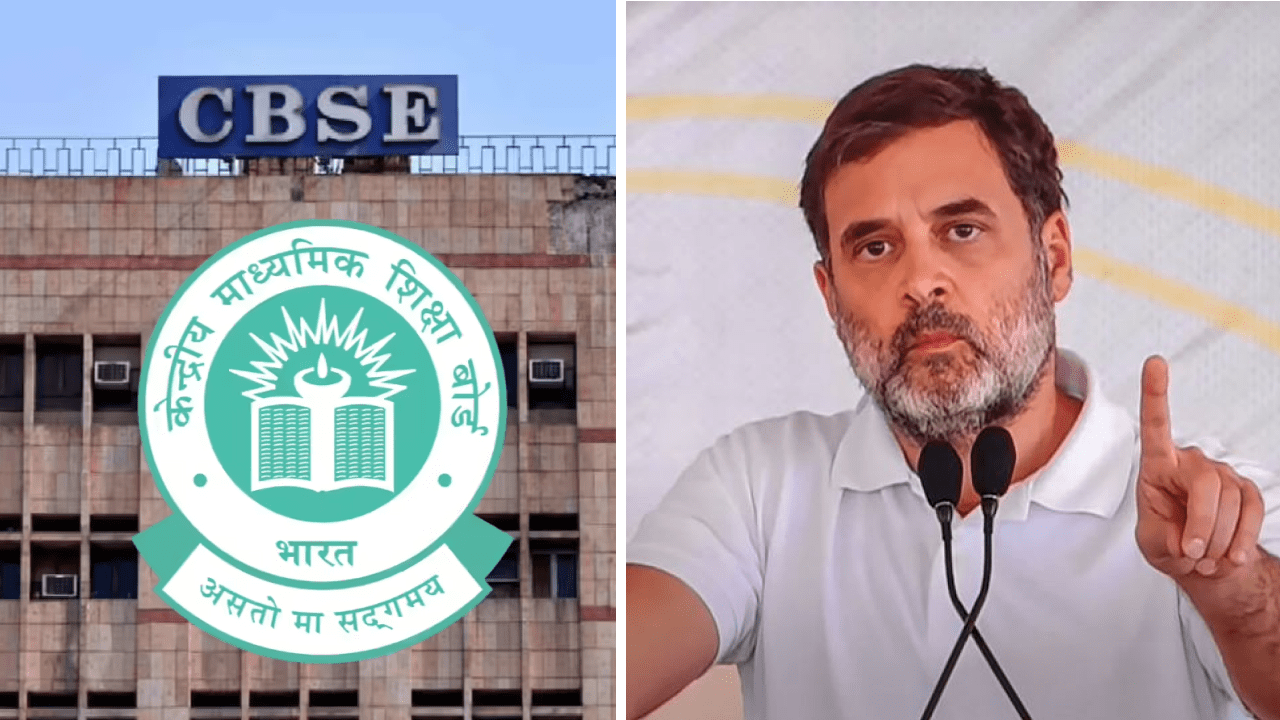
A political storm has erupted over the Central Board of Secondary Education’s new On-Screen Marking (OSM) system after Congress leader Rahul Gandhi accused the board of “massive tampering” in Class 12 examination results, intensifying scrutiny over the digital evaluation process used for nearly 1.85 million students across India.
The controversy has rapidly escalated beyond a routine examination dispute, drawing attention to allegations of mismatched answer sheets, poor-quality scanned copies, technical glitches, and questions over the private contractor hired to manage the digital evaluation infrastructure. The issue has also reignited broader concerns about the reliability of high-stakes examination systems in India following recent controversies surrounding competitive exams.
Rahul Gandhi launched a direct attack on the Modi government and the CBSE, alleging that the agency awarded the OSM contract had a controversial history under a previous corporate identity. He claimed the company, now operating as Coempt Edutech, was earlier linked to disputes in Telangana under the name Globarena.
Calling the situation a “deliberate conspiracy,” Gandhi demanded an independent judicial inquiry and the formation of a Special Investigation Team (SIT) to investigate the evaluation process and the awarding of the contract.
The Congress MP also raised four key questions directed at the government and the education authorities, including why the contract was awarded to the company, whether procurement norms were bypassed, whether background checks were conducted, and whether any connection existed between the company’s management and the central government.
CBSE, however, strongly rejected the allegations, describing them as “misleading” and “not based on facts.” In an official statement, the board said the contract was awarded through a transparent procurement process in accordance with the government’s General Financial Rules.
According to the board, the Request for Proposal (RFP) for digital evaluation of Board Exams 2026 was floated on the Central Public Procurement portal in August 2025 and the contract was awarded only after due evaluation of qualified bidders.
Also read: NEET UG 2026 Leak Fallout: Government Admits Failure, Orders Retest as CBI Probes NTA Link
How the OSM Controversy Began
The controversy gained momentum after several students began posting complaints on social media alleging discrepancies in their reevaluation documents.
One of the most widely discussed cases involved Class 12 student Vedant Shrivastava, who claimed that the Physics answer sheet uploaded under his roll number during the reevaluation process did not belong to him. The student shared screenshots comparing handwriting from different subject papers, alleging that the evaluated Physics script appeared to be written by someone else.
The issue quickly went viral, triggering outrage among students and parents already anxious over board exam results.
Social media platforms were soon flooded with complaints about blurry answer sheet scans, portal crashes, payment failures during reevaluation applications, and delays in grievance resolution. Several users alleged that scanned copies of answer sheets were unreadable or incorrectly mapped to candidates.
The controversy deepened further after reports emerged that some students who publicly raised concerns online faced trolling and political targeting. Rahul Gandhi accused online political groups of harassing students instead of addressing their grievances.
Meanwhile, a petition challenging the rollout of the OSM system has reportedly reached the Allahabad High Court, alleging that the implementation was rushed and lacked adequate safeguards.
CBSE Defends Digital Evaluation System
CBSE has maintained that there has been no compromise of its actual evaluation platform and clarified that URLs circulating online were linked only to a testing environment containing sample data.
The board stated that the operational evaluation portal remained secure and that no breach had been detected.
To defend the integrity of the process, CBSE released detailed figures regarding the digital evaluation exercise. According to the board, nearly 98.66 lakh answer books were scanned for evaluation. Evaluators were authorized to reject low-quality scans, after which answer sheets were rescanned and reassigned wherever necessary.
CBSE said more than 68,000 answer books were rescanned due to quality concerns. In over 13,000 cases where scan quality remained inadequate, the board claimed manual evaluation was conducted and marks were uploaded after verification.
The board argued that the OSM system was introduced to increase transparency, reduce human bias, and improve efficiency in the evaluation process.
Expert Analysis / What This Means
The CBSE OSM controversy highlights the growing tension between rapid digitisation and institutional preparedness in India’s education system. While digital evaluation systems are designed to improve transparency and speed, their credibility depends heavily on technical reliability and public trust.
For students, even isolated discrepancies can have life-changing consequences because board exam marks directly influence university admissions, scholarships, and competitive exam opportunities. In a system where academic pressure is already intense, allegations of mismatched answer sheets or unreadable scans can trigger widespread panic.
The controversy also exposes how quickly social media amplifies educational grievances into national political issues. What began as student complaints evolved into a broader debate involving procurement transparency, data security, and accountability in public examinations.
For the education sector, the episode could force authorities to reconsider how new technologies are implemented in high-stakes testing environments. Experts may now push for phased rollouts, independent audits, and stronger grievance redressal systems before nationwide deployment.
The dispute also comes at a sensitive time for India’s examination ecosystem following recent controversies around competitive exams and paper leak allegations. As a result, public confidence in examination authorities is under sharper scrutiny than ever before.
If unresolved, the issue could lead to greater judicial intervention, parliamentary scrutiny, and demands for regulatory reforms in digital assessment systems across India.
Industry / Market Impact
The controversy may have wider implications for India’s rapidly expanding education technology and digital assessment industry. Government boards and universities have increasingly adopted digital evaluation platforms to handle large-scale examinations more efficiently.
However, allegations surrounding the CBSE system could slow future adoption unless stronger accountability mechanisms are introduced. Companies involved in examination technologies may now face more rigorous audits, cybersecurity reviews, and procurement scrutiny before securing government contracts.
The situation may also encourage policymakers to establish national standards for digital evaluation infrastructure, including mandatory third-party verification and data integrity testing.
What Happens Next
Pressure is mounting on both CBSE and the Education Ministry to provide greater transparency regarding the evaluation process and vendor selection.
Possible next steps could include judicial review, parliamentary debate, or the constitution of an independent technical audit panel to assess the functioning of the OSM system.
Student groups and parents are also expected to continue demanding clearer grievance mechanisms, easier access to answer sheets, and more accountability in reevaluation procedures.
For now, the controversy remains politically charged, with opposition parties framing it as a governance failure while CBSE insists that the integrity of the evaluation process remains intact.