
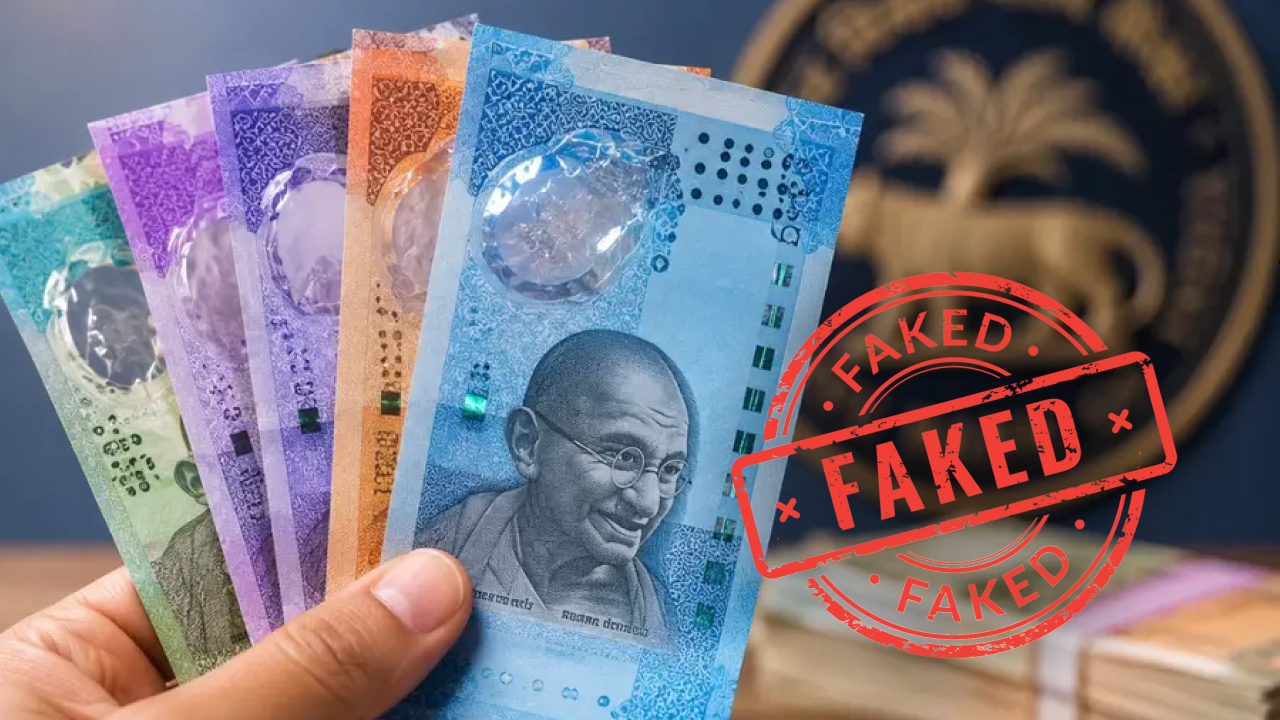
Confusion surrounding India’s future currency design has intensified after viral social media posts falsely claimed that the Reserve Bank of India (RBI) would replace all paper currency notes with plastic banknotes by June 30, 2026. The claims, amplified through manipulated videos and AI-generated images, prompted an official clarification from authorities, even as the central bank confirmed that polymer-based currency remains under preliminary consideration.
The issue gained traction online after posts suggested that existing paper notes would soon be withdrawn and replaced with plastic currency. Some viral content also claimed that a newly designed ₹500 plastic note without Mahatma Gandhi’s photograph had already been launched. However, government fact-checkers and RBI officials have categorically rejected these assertions, stating that no such decision has been taken and that current paper currency notes remain valid legal tender.
According to official clarification issued through the government’s fact-checking mechanism, there are no plans to withdraw paper currency notes or replace them with plastic notes by any fixed deadline. Authorities also identified some of the circulating videos as digitally altered content designed to mislead users.
The clarification comes at a time when discussions about modernizing India’s currency infrastructure have resurfaced following remarks from RBI Governor Sanjay Malhotra, who recently acknowledged that polymer banknotes are being evaluated. However, he emphasized that the proposal remains at a preliminary stage, with no final policy decision announced.
Viral ₹500 Plastic Note Claim Found to Be False
A separate wave of misinformation centered on images purportedly showing a newly launched ₹500 plastic currency note that lacked Mahatma Gandhi’s portrait. The images quickly spread across multiple social media platforms, triggering speculation about a major redesign of Indian banknotes.
Verification efforts found no official announcement from either the RBI or the Central Government regarding such a currency note. The absence of any notification, press release, or regulatory communication further undermined the claim.
Digital analysis of the viral image indicated a high probability that it was generated using artificial intelligence. The image displayed several visual inconsistencies compared with officially issued Indian currency and failed to match any approved banknote design currently in circulation.
Under the RBI Act, the central bank has the authority to issue banknotes, while the Central Government approves their design, form, and material. Any significant change in India’s currency system would require formal government notification and extensive public communication.
Why RBI Is Exploring Polymer Currency
While the viral claims are false, discussions around polymer banknotes are not entirely unfounded. RBI officials have confirmed that the central bank is examining the feasibility of introducing polymer-based currency in India.
Polymer notes are manufactured using a specialized plastic substrate rather than the cotton-based paper currently used for Indian banknotes. First introduced in Australia, polymer currency has since been adopted in several countries, including the United Kingdom, Canada, New Zealand, and Singapore.
Supporters of polymer notes argue that they offer several advantages over traditional paper currency. They are more resistant to moisture, dirt, and physical damage, allowing them to remain in circulation for significantly longer periods. International studies suggest that polymer notes can last two to five times longer than conventional paper notes.
The RBI has historically faced challenges related to currency deterioration, particularly in a country with diverse climatic conditions and high cash usage. Damaged notes require frequent replacement, creating additional printing and distribution costs.
Expert Analysis / What This Means
The latest controversy highlights the growing challenge of distinguishing between legitimate policy discussions and misinformation in the digital era. While the RBI is evaluating polymer banknotes, that process is fundamentally different from an approved nationwide currency replacement programme.
For consumers, the immediate takeaway is clear, existing paper currency notes remain fully valid and there is no deadline for exchanging them. Any future transition, if approved, would likely occur gradually over several years rather than through a sudden withdrawal.
For the banking sector, polymer notes could represent a long-term modernization initiative aimed at reducing replacement costs and improving note durability. Enhanced security features may also strengthen efforts to combat counterfeiting, particularly in high-denomination notes.
The episode also demonstrates how AI-generated images and altered videos can rapidly influence public perception, especially when they involve sensitive topics such as currency and financial policy. Similar misinformation campaigns have emerged in the past around demonetisation, currency redesigns, and digital payments, underscoring the need for official verification before sharing financial claims.
Ultimately, the RBI’s current position remains cautious, polymer notes are being studied, but no rollout plan, replacement schedule, or new currency design has been approved.
Also read: India’s Fuel Price Shock Deepens as Petrol Crosses ₹100 in Delhi, More Hikes Still Possible
Industry / Market Impact
A future shift toward polymer currency could have significant implications for India’s currency production ecosystem. Printing facilities, raw material suppliers, and security technology providers would need to adapt to new manufacturing requirements.
Polymer notes typically involve higher initial production costs but lower lifetime expenses due to their durability. Countries that have adopted polymer currency often report reduced replacement frequency and improved circulation efficiency.
Financial institutions may also benefit from lower handling costs as polymer notes are generally more resistant to wear and tear. However, any transition would require substantial infrastructure planning and public awareness campaigns.
Timeline of Events
- 2007: RBI first proposed exploring polymer banknotes.
- Subsequent Years: Pilot projects involving polymer ₹10 notes were considered in selected Indian cities.
- 2016: Government informed Parliament that procurement processes related to polymer notes had been initiated.
- Recent Years: RBI experimented with varnished notes to improve durability of conventional paper currency.
- 2026: Viral social media posts falsely claimed nationwide replacement of paper notes with plastic currency.
- Current Status: RBI confirms polymer notes remain under preliminary examination with no final decision announced.
Background Context
India’s currency system currently relies primarily on cotton-based banknotes designed to balance durability, security, and production costs. Over the years, the RBI has periodically upgraded security features to combat counterfeiting and improve note longevity.
Globally, polymer banknotes have become increasingly popular due to their resilience and advanced anti-counterfeit capabilities. Countries that adopted the technology generally introduced it in phases, often beginning with lower denominations before expanding usage.
India’s exploration of polymer currency reflects broader international trends toward more durable and secure banknote technologies, though the transition remains under evaluation rather than implementation.