
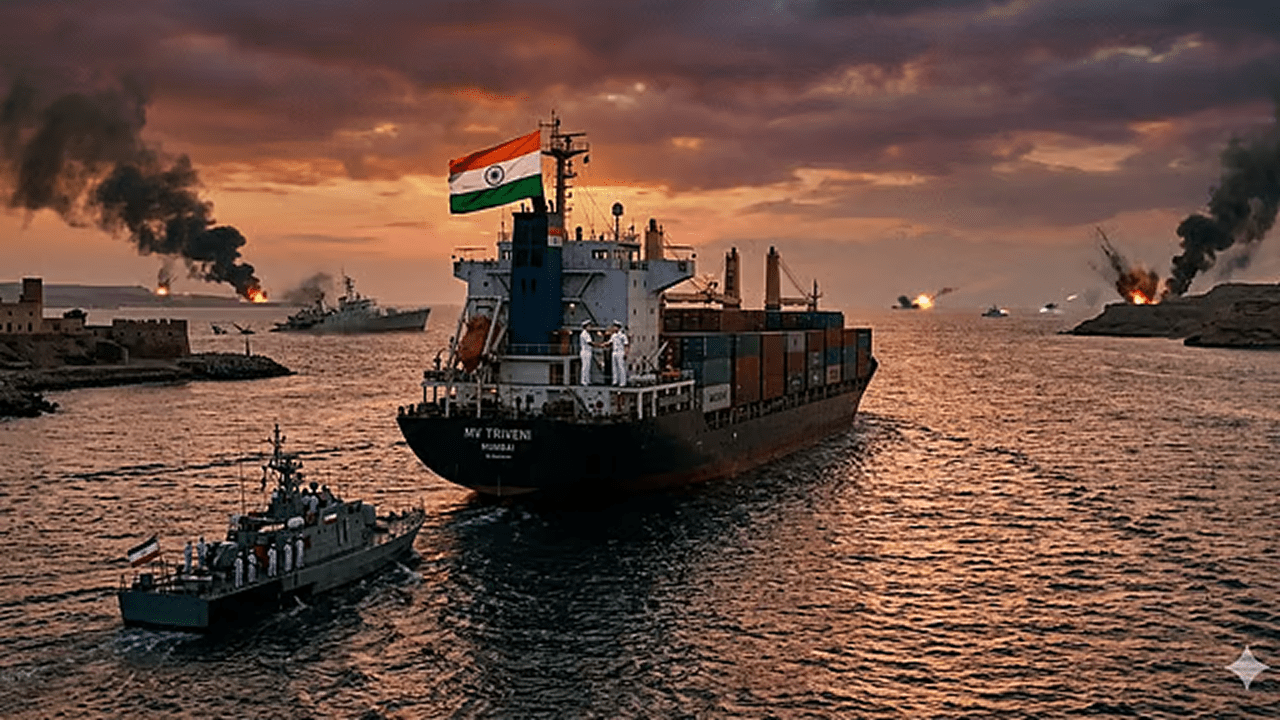
India on Saturday dismissed reports that another Indian-crewed tanker had come under attack in the Gulf of Oman, even as concerns continue to grow over the safety of commercial shipping following a series of US military strikes on vessels operating in the region. The clarification came after unverified claims circulated online suggesting that MT Liaki Freedom, a tanker carrying Indian crew members, had been targeted near Oman and had stopped responding to communications.
The Ministry of External Affairs (MEA) said it had directly contacted the vessel’s master, who confirmed that all crew members were safe and that reports of an attack were false. The government’s intervention helped quell fears of another maritime incident in a region already on edge after three separate strikes on Indian-crewed vessels in as many days.
The episode highlights the rapidly deteriorating security environment in the Gulf, where escalating tensions surrounding US enforcement actions against vessels allegedly linked to Iranian oil trade have raised alarms across the global shipping industry. India, which has one of the world’s largest seafaring workforces, has increasingly found itself at the center of the unfolding crisis.
Also read: Delhi B&B Fire Tragedy Exposes Deep Regulatory Failures as Death Toll Reaches 21
False Alarm Over MT Liaki Freedom
Speculation regarding MT Liaki Freedom emerged after reports claimed the vessel had stopped responding on Very High Frequency (VHF) communication channels while operating near Oman. Initial concerns were amplified by maritime groups and social media posts suggesting casualties were possible.
However, Indian authorities swiftly moved to verify the situation. According to the MEA, direct communication with the ship confirmed that the crew remained unharmed and the vessel had not been attacked.
The Forward Seamen’s Union of India (FSUI), which had initially expressed concern after difficulties contacting the tanker, later withdrew earlier claims and confirmed that the vessel had not been targeted.
The incident underscores the growing atmosphere of uncertainty in Gulf waters, where shipping companies, sailors and governments are struggling to separate verified information from speculation amid an escalating security crisis.
Three Tanker Strikes Trigger Diplomatic Tensions
The false reports emerged against the backdrop of three confirmed attacks involving Indian-crewed vessels since the beginning of the week.
The most serious incident involved MT Settebello, a Palau-flagged tanker carrying 24 Indian crew members. A strike on the vessel resulted in the deaths of three Indian sailors, marking one of the deadliest incidents involving Indian seafarers in the region in recent years.
According to US Central Command, the vessel was targeted for allegedly violating a blockade aimed at restricting maritime trade linked to Iran. The tanker’s management company, however, has denied those allegations and disputed claims that the vessel ignored instructions from US forces.
A day later, MT Jalveer, a Guinea-Bissau-flagged tanker with 20 Indian sailors onboard, suffered an engine-room fire following a strike. All crew members were safely evacuated with assistance from Omani authorities.
Earlier in the week, MT Marivex was also struck, forcing its 24-member Indian crew to abandon ship after distress calls reported fire and flooding. The crew was subsequently rescued.
The attacks have intensified scrutiny over military operations in one of the world’s most strategically important maritime corridors.
India Lodges Strong Protest
New Delhi has responded forcefully to the incidents, describing attacks on commercial shipping as unacceptable.
External Affairs Minister S. Jaishankar raised the issue directly with US Secretary of State Marco Rubio, reiterating India’s objection to military actions that have resulted in civilian casualties.
Indian officials have also summoned senior US diplomatic representatives in New Delhi to formally convey the country’s concerns.
The government has emphasized that international shipping lanes must remain open and secure, while stressing that civilian mariners should not become casualties of geopolitical conflicts.
The deaths aboard MT Settebello have added urgency to India’s diplomatic efforts, with authorities working to repatriate both surviving crew members and the bodies of the deceased sailors.
Expert Analysis / What This Means
The Gulf shipping crisis represents a significant challenge for India because of its extensive maritime workforce and heavy reliance on regional energy trade routes. With nearly 300,000 Indian seafarers working globally and thousands operating in Gulf waters, any escalation directly affects Indian citizens and commercial interests.
The recent strikes also raise difficult questions about the risks faced by civilian crews navigating politically sensitive maritime zones. Unlike military personnel, commercial sailors have little control over cargo ownership, sanctions disputes or geopolitical rivalries, yet they often bear the greatest personal risk.
For the shipping industry, insurance costs, operational risks and route planning are likely to become increasingly complex if tensions continue. Vessel operators may face stricter compliance requirements and higher security expenditures.
Diplomatically, the incidents have introduced friction into India-US relations, although analysts believe they are unlikely to fundamentally alter the broader strategic partnership between the two countries.
The situation also highlights the vulnerability of global energy supply chains. The Gulf and the Strait of Hormuz remain critical arteries for international oil and gas trade, meaning prolonged instability could have consequences far beyond the region.
Most importantly, the crisis is renewing calls for stronger international protections for civilian mariners operating in conflict-prone waters.
Timeline of Events
June 8
MT Marivex, carrying 24 Indian crew members, is struck near Oman. The crew issues distress calls before being rescued.
June 10
MT Settebello is hit during a separate incident. Three Indian sailors are killed while 21 others are rescued.
June 11
MT Jalveer suffers damage after a strike and reports a fire in its engine room. All 20 Indian sailors are evacuated safely.
June 13
Reports emerge claiming MT Liaki Freedom has been attacked. India verifies the vessel’s status and confirms that all crew members are safe, dismissing the reports as false.
Industry / Market Impact
The attacks have intensified concerns throughout the maritime sector, particularly among shipping firms operating in the Gulf of Oman and near the Strait of Hormuz.
Industry experts warn that repeated disruptions could increase freight costs, insurance premiums and voyage delays. Shipping companies may also be forced to reassess risk exposure in the region, potentially affecting trade flows and energy transportation.
India’s shipping sector faces particular challenges given the large number of Indian nationals employed aboard international vessels. Maritime unions have already called for enhanced safety protocols and stronger international coordination to protect civilian crews.
Meanwhile, uncertainty surrounding enforcement actions against vessels suspected of transporting Iranian oil is creating additional legal and operational complications for ship owners, charterers and insurers.
What Happens Next
Attention is now focused on whether military operations in the Gulf will continue and whether additional commercial vessels could become targets.
India is expected to maintain diplomatic engagement with Washington while monitoring the safety of Indian seafarers operating in the region. Maritime authorities are also likely to increase coordination with Gulf states regarding crew safety and emergency response measures.
As investigations into the recent incidents continue, the broader challenge remains preventing further loss of life while ensuring one of the world’s most important shipping corridors remains operational and secure.