
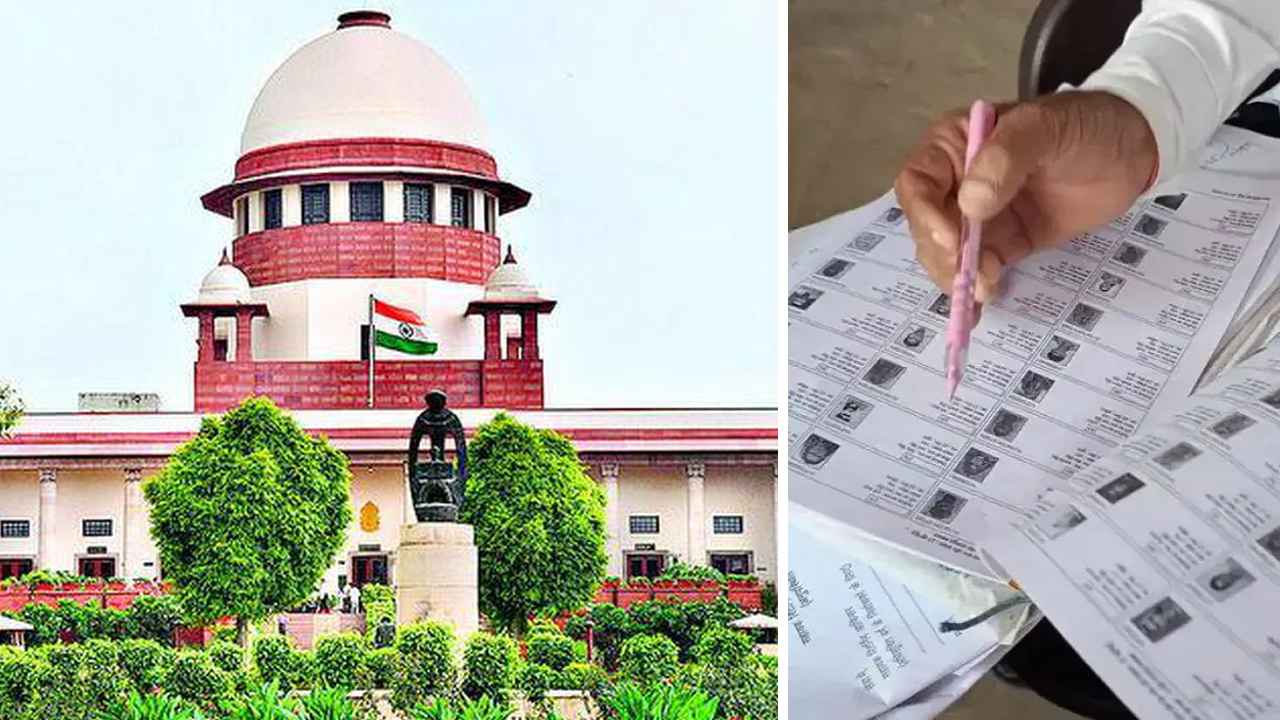
The Supreme Court on Wednesday delivered a landmark ruling backing the Election Commission of India’s (ECI) authority to conduct the Special Intensive Revision (SIR) of electoral rolls, a contentious exercise that has triggered political and constitutional debate across multiple states. In a significant endorsement of the poll body’s powers, the apex court held that the SIR process is legally valid, constitutionally permissible, and directly linked to safeguarding free and fair elections.
The judgment, delivered by a bench led by Chief Justice of India Surya Kant along with Justice Joymalya Bagchi, concluded that maintaining the integrity and accuracy of voter rolls is central to India’s democratic framework. The court ruled that the Election Commission has the statutory authority under the Representation of the People Act, 1950, to undertake special revisions of electoral rolls in exceptional circumstances.
The ruling comes after months of legal challenges against the SIR exercise first initiated in Bihar and later expanded to several states and Union Territories, including West Bengal, Kerala, Tamil Nadu, Delhi, Maharashtra, Telangana, Karnataka, and others.
At the core of the dispute was whether the Election Commission could conduct extensive verification of voters and examine questions related to citizenship while updating electoral rolls. Petitioners argued that the process risked arbitrary exclusion of legitimate voters and violated constitutional protections under Articles 14, 19, 21, 325, and 326.
Rejecting those arguments, the Supreme Court said the SIR exercise does not violate statutory provisions and instead reinforces the constitutional mandate of credible elections.
Court Says Electoral Integrity Is Essential for Democracy
The bench observed that elections are not limited to the mechanics of voting but depend fundamentally on the credibility of electoral rolls. According to the judgment, inaccuracies caused by migration, duplication, urbanisation, and decades without intensive revision justified the Election Commission’s decision to initiate the exercise.
The court accepted the ECI’s reasoning that more than four decades had passed since the last intensive nationwide revision, during which large-scale additions and deletions had altered the voter database substantially.
Importantly, the Supreme Court clarified that the Election Commission can examine citizenship status only for the limited purpose of deciding whether a person qualifies for inclusion in electoral rolls. The judges emphasized that such scrutiny does not amount to a final declaration on citizenship under Indian law.
The court stated that if the Commission finds insufficient evidence supporting a person’s eligibility, it may deny enrolment or initiate deletion proceedings in accordance with legal procedures. However, any such decision remains confined to electoral purposes and cannot extinguish broader citizenship claims under the Citizenship Act.
In cases where names were deleted due to doubts over citizenship, the court directed the Election Commission to refer those cases to competent authorities under the Citizenship Act within four weeks. Authorities must complete adjudication before the next Assembly or local body elections after providing affected individuals an opportunity to be heard.
Also read: India’s Fuel Price Shock Deepens as Petrol Crosses ₹100 in Delhi, More Hikes Still Possible
Expert Analysis / What This Means
The Supreme Court’s endorsement of the SIR process marks one of the most consequential electoral rulings in recent years because it significantly strengthens the institutional authority of the Election Commission ahead of multiple state elections.
For voters, the ruling means electoral verification exercises are likely to become more frequent and more data-intensive in the future. Citizens may increasingly be required to furnish supporting documents to retain or confirm voter registration, especially in states witnessing high migration or demographic shifts.
Politically, the verdict is expected to intensify debates over voter disenfranchisement and administrative neutrality. Opposition parties and civil rights groups have repeatedly argued that large-scale verification drives disproportionately affect economically weaker populations, migrant workers, and marginalised communities who may struggle to produce documentation.
At the same time, the judgment provides constitutional backing for the ECI’s push toward “electoral roll purity,” a concept the Commission has framed as essential to preventing duplicate or fraudulent entries. The court’s repeated emphasis on procedural safeguards suggests future legal scrutiny will focus less on the existence of SIR itself and more on how fairly it is implemented.
The ruling may also shape future electoral reforms, especially around digital verification, Aadhaar-linked identification systems, and citizenship-linked voter scrutiny. Comparisons are already being drawn with earlier controversies involving the National Register of Citizens (NRC), though the court carefully limited the ECI’s authority strictly to electoral purposes.
Also read: NEET UG 2026 Leak Fallout: Government Admits Failure, Orders Retest as CBI Probes NTA Link
Why This Matters
The case carried implications far beyond Bihar, where the controversy initially began in 2025. After launching the first phase there, the Election Commission expanded the SIR exercise to multiple states and Union Territories covering hundreds of millions of voters.
The court’s decision effectively removes the biggest constitutional obstacle to that nationwide rollout.
Petitioners including the Association for Democratic Reforms (ADR), People’s Union for Civil Liberties (PUCL), political activist Yogendra Yadav, and several opposition MPs had argued that the process lacked adequate safeguards and reversed the democratic presumption that every enrolled voter is presumed eligible unless proven otherwise.
Critics warned that the process could allow governments or election authorities to indirectly influence electoral outcomes by determining who remains on voter rolls. During the hearings, concerns were repeatedly raised about mass deletions and procedural confusion during earlier phases of the exercise.
In West Bengal, controversy erupted after millions of voters reportedly faced uncertainty over verification status shortly before polling. Similar anxieties surfaced in Bihar after initial draft rolls reportedly excluded large numbers of voters before subsequent revisions reduced deletions.
Timeline of Events
June 24, 2025
The Election Commission launched the Special Intensive Revision of electoral rolls in Bihar.
July 2025
Multiple petitions challenging the constitutional validity of the exercise were filed before the Supreme Court.
August 1, 2025
The ECI published Bihar’s draft electoral rolls after the court declined to stay the process.
September 30, 2025
The Bihar SIR process concluded. The number of retained electors stood at 7.42 crore compared to 7.89 crore before revision.
October 27, 2025
The Election Commission expanded the SIR exercise to additional states including West Bengal, Kerala, and Tamil Nadu.
May 2026
The Supreme Court upheld the legality of the SIR process and affirmed the ECI’s authority to conduct the exercise nationwide.
Industry / Market Impact
The ruling is expected to accelerate investment in election technology, digital identity verification systems, and large-scale voter data management infrastructure. Technology firms involved in electoral databases, biometric systems, and document authentication could see increased government demand as the Election Commission scales up future revisions.
Legal experts also expect the judgment to influence administrative law and data governance debates, especially concerning how government agencies balance verification requirements with constitutional protections.
The decision could additionally trigger fresh political mobilisation around voter rights, particularly in states approaching elections where electoral rolls may become central campaign issues.
What Happens Next
With the Supreme Court clearing the constitutional challenge, the Election Commission is now likely to continue the phased rollout of SIR exercises across additional states before upcoming Assembly and local elections.
However, the court’s insistence on procedural safeguards, notices, appeals, and hearings means implementation will remain under intense judicial and public scrutiny. Future litigation may focus on individual exclusions, transparency standards, and whether vulnerable communities are disproportionately affected.
The judgment also leaves open the possibility of further legal battles if large-scale deletions emerge during future revisions.
For now, the verdict represents a decisive institutional victory for the Election Commission and reshapes the framework governing voter verification in the world’s largest democracy.