
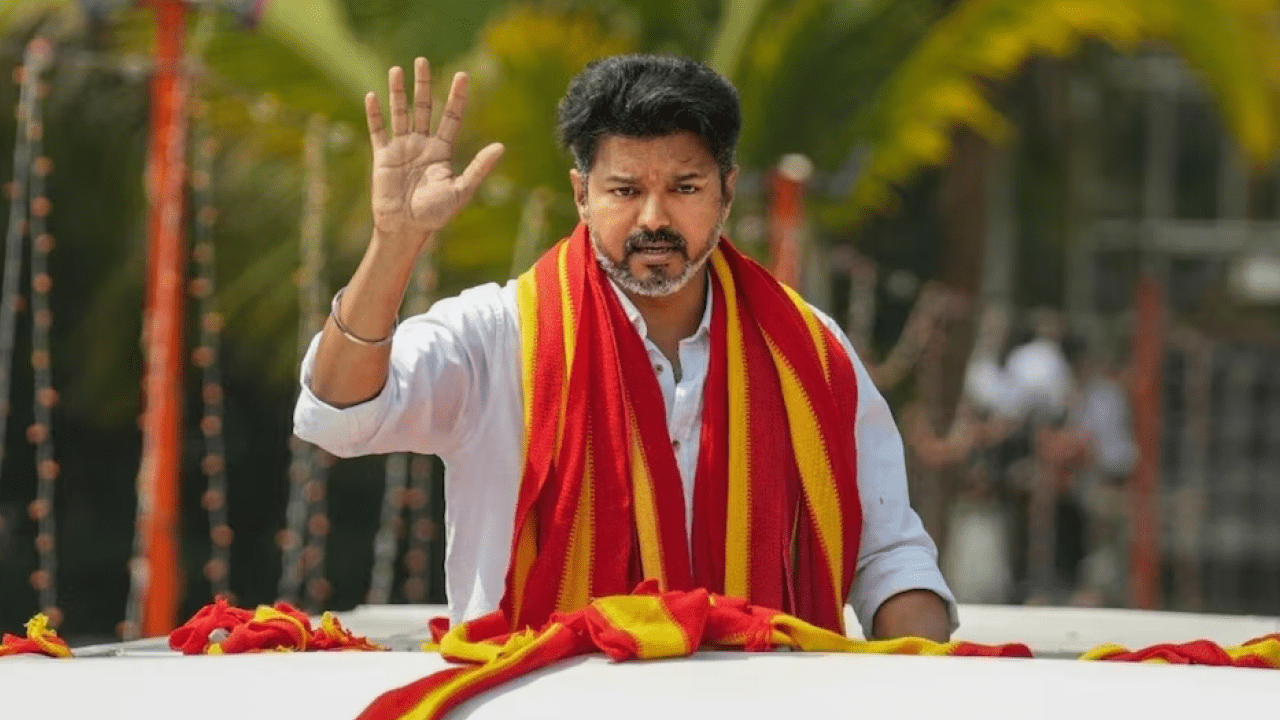
In a dramatic political upheaval, actor-turned-politician Vijay’s Tamilaga Vettri Kazhagam (TVK) has emerged as the single-largest party in the 2026 Tamil Nadu Assembly elections, fundamentally disrupting the state’s long-standing two-party dominance. However, despite its breakthrough performance, the TVK majority shortfall has left the party just below the critical 118-seat mark in the 234-member assembly, triggering intense negotiations and uncertainty over government formation.
TVK secured around 107–108 seats, outpacing both the ruling DMK alliance, which managed 73, and the NDA bloc, which trailed with 53. The fragmented verdict has produced a hung assembly an outcome rare in Tamil Nadu’s traditionally bipolar political landscape dominated by DMK and AIADMK.
As the largest party, TVK is expected to be invited by the governor to attempt forming the government, potentially as a minority administration. Yet the real challenge lies ahead: converting electoral momentum into a stable governance structure.
A Numbers Game: Pathways to Power
With a shortfall of roughly 10-11 seats, TVK’s immediate focus has shifted to post-poll arithmetic. The most viable route appears to be securing support from smaller parties currently aligned with the DMK-led alliance. These include the Congress (5 seats), CPI and CPI(M) (2 seats each), and the Viduthalai Chiruthaigal Katchi (VCK), which could collectively bridge the gap.
There are indications that sections within Congress had previously explored aligning with TVK before the elections, suggesting potential openness to post-poll support. If these parties extend backing either formally or from outside Vijay could comfortably cross the majority threshold.
Another option involves the Pattali Makkal Katchi (PMK), which holds a handful of seats and could play a decisive role in a tight numbers game.
However, a broader realignment involving the entire DMK alliance supporting TVK remains a theoretical possibility. Such a move could preserve national opposition unity while facilitating government formation in Tamil Nadu, though political rivalry between Vijay and DMK leadership complicates this scenario.
The AIADMK and BJP Factor
Any possibility of an alliance with the AIADMK appears unlikely at this stage. Public statements from AIADMK leaders have ruled out cooperation, while TVK has consistently positioned itself against the BJP, calling it an ideological adversary.
This stance effectively blocks any arrangement involving the AIADMK-BJP axis unless significant political compromises are made an outcome that currently seems improbable.
Also read: Mamata Banerjee’s Midnight Strongroom Vigil Triggers EVM Row Ahead of Bengal Results
Historic Debut Reshapes Political Landscape
Vijay’s electoral debut has not only delivered impressive numbers but also redefined Tamil Nadu’s political narrative. Contesting independently without pre-poll alliances, TVK made deep inroads into urban strongholds, including Chennai, traditionally considered a DMK bastion.
The scale of the victory has drawn comparisons to past political disruptions in the state, though analysts remain divided on whether this marks a lasting structural shift or a one-time wave driven by Vijay’s popularity.
The party’s leadership has expressed confidence in forming the government, with internal discussions already underway. Sources suggest that a swearing-in ceremony could take place soon, depending on how quickly support is consolidated.
Background Context
Tamil Nadu politics has historically been shaped by towering figures and strong party identities, from K. Kamaraj to M. Karunanidhi, M.G. Ramachandran, and J. Jayalalithaa. For decades, governance alternated between the DMK and AIADMK, leaving little room for third-party emergence.
TVK’s rise represents the most significant disruption to this pattern in over half a century. Formed in 2024, the party was conceived as a solo political venture, with Vijay repeatedly emphasizing independence from established alliances.
This strategy appears to have resonated with voters seeking an alternative, though it now presents a strategic dilemma in the post-election phase.
What Happens Next
The immediate next step is likely an invitation from the governor to Vijay to form the government. Whether TVK chooses to proceed as a minority government or secures formal coalition support will determine the stability of the administration.
Backchannel negotiations are expected to intensify in the coming days, particularly with smaller parties holding the balance of power. The role of Congress will be especially critical, given its dual positioning within state and national political frameworks.
If talks fail, Tamil Nadu could face prolonged political uncertainty or even the possibility of fresh elections though such outcomes remain unlikely at this stage.
Industry / Market Impact
The election outcome has implications beyond politics, particularly for Tamil Nadu’s investment climate and governance continuity. A stable government led by a first-time political party could introduce policy unpredictability in the short term, especially as TVK transitions from campaign promises to administrative execution.
However, Vijay’s strong mandate also signals public appetite for change, which could translate into reform-driven governance if effectively managed. Sectors reliant on state policy such as infrastructure, manufacturing, and entertainment will closely watch early decisions by a potential TVK-led government.
Expert Analysis / What This Means
The TVK majority shortfall places Vijay at a critical crossroads between maintaining political purity and embracing coalition pragmatism. His campaign was built on rejecting traditional alliances, but governance now demands negotiation and compromise.
For voters, the outcome reflects both endorsement and caution support for change, but not an absolute mandate. For the DMK and AIADMK, the results signal erosion of entrenched voter bases and the urgent need for recalibration.
At a national level, the situation could influence opposition unity, particularly if Congress and Left parties shift their alignment in Tamil Nadu. The coming days will test Vijay’s political acumen beyond charisma his ability to manage alliances, ensure stability, and deliver governance will define whether TVK’s rise is transformative or transitional.