
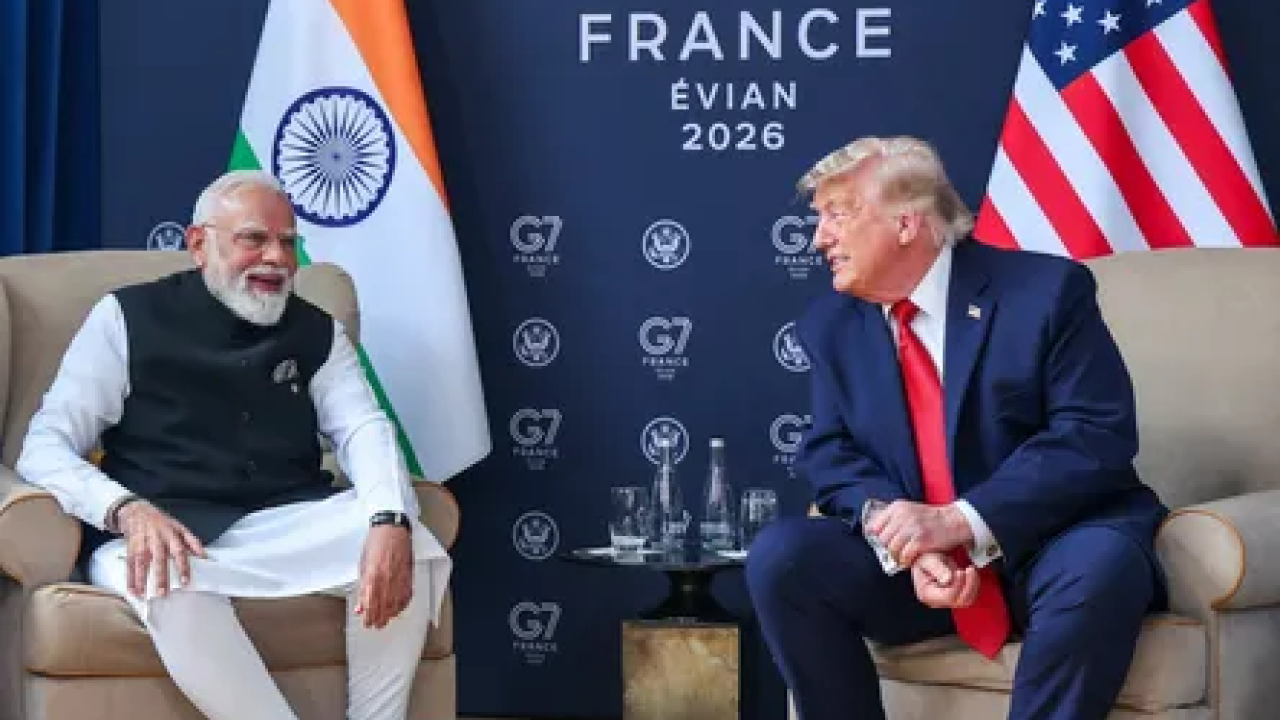
India-US trade deal negotiations gained fresh momentum after Prime Minister Narendra Modi and US President Donald Trump agreed to accelerate efforts toward a commercially meaningful bilateral agreement during their meeting on the sidelines of the G7 Summit in Evian, France. The high-profile talks marked the first face-to-face engagement between the two leaders in 16 months and signaled a renewed attempt to strengthen a relationship that has faced multiple challenges over the past year, including tariff disputes, geopolitical disagreements, and concerns over maritime security.
The meeting comes ahead of a planned visit by US Trade Representative Jamieson Greer to India, where negotiations on the proposed trade pact are expected to advance further. Both leaders instructed officials to work toward an agreement that is balanced, mutually beneficial, and capable of expanding economic cooperation between the world’s largest and fifth-largest economies.
Beyond trade, the discussions covered defense cooperation, technology partnerships, regional security, energy collaboration, and developments in West Asia. The meeting underscored a broader effort by both governments to move past recent tensions and reinforce the strategic partnership that has become a cornerstone of their foreign policy priorities.
Trade Talks Move Into Critical Phase
A central outcome of the Modi-Trump meeting was the shared commitment to conclude ongoing trade negotiations at the earliest opportunity.
Officials from both countries highlighted significant progress made in discussions toward an interim bilateral trade agreement. The leaders reviewed developments under the India-US COMPACT initiative, a framework designed to deepen collaboration in military cooperation, commerce, advanced technologies, and energy.
Trade relations between New Delhi and Washington have experienced turbulence in recent months. The United States imposed punitive tariffs on Indian exports, while India faced pressure over its continued purchases of Russian oil. These issues created friction that slowed progress on broader economic cooperation.
However, the latest discussions suggest both governments now view a trade agreement as a key mechanism for restoring momentum and providing greater certainty for businesses operating across both markets.
President Trump described Modi as a “tough negotiator” and indicated that both sides were actively working on trade arrangements. He also revealed plans to visit India at a future date, a move that could further strengthen diplomatic and commercial engagement.
Maritime Security and Indian Sailors Raise New Concerns
Another significant issue discussed during the meeting was the safety of Indian seafarers operating in the Gulf region, particularly around the Strait of Hormuz, one of the world’s most critical maritime trade routes.
The issue has gained urgency following the deaths of three Indian crew members during military operations involving commercial shipping in the Gulf region. Modi emphasized that the welfare and security of Indian sailors remain a top priority for New Delhi.
The Prime Minister also welcomed recent diplomatic efforts aimed at reducing tensions in West Asia and expressed hope that maritime safety would remain a key component of any future regional stability initiatives.
Freedom of navigation through the Strait of Hormuz remains strategically important not only for India but also for global energy markets and international trade flows.
Strategic Partnership Back in Focus
The talks reflected a broader effort to revitalize the India-US Comprehensive Global Strategic Partnership after a period of strain.
Relations between the two countries faced several challenges over the past year. Apart from trade disagreements, New Delhi strongly rejected repeated claims from President Trump that Washington played a decisive role in ending the India-Pakistan military confrontation following Operation Sindoor in May 2025.
India maintained that the cessation of hostilities resulted from direct engagement between New Delhi and Islamabad, without external mediation.
Additional tensions emerged over changes in US immigration policies and increased H-1B visa costs, which affected Indian professionals and businesses.
Despite these disagreements, both sides have continued to view each other as indispensable strategic partners in an increasingly complex geopolitical environment.
Trump’s public remarks following the meeting were notably supportive of India. He emphasized the strength of bilateral ties and stated that the United States would assist India if it faced external aggression, reflecting the close personal rapport that has developed between the two leaders over multiple years of engagement.
Expert Analysis / What This Means
The renewed push for an India-US trade deal represents more than just an economic negotiation. It reflects a strategic recalibration by both governments at a time when global supply chains, geopolitical alliances, and regional security architectures are undergoing significant change.
For businesses, a successful India-US trade deal could reduce uncertainty, improve market access, and unlock new opportunities in manufacturing, technology, energy, and digital services. Investors are also likely to view progress positively, particularly if it leads to greater policy predictability.
From a geopolitical perspective, the meeting signals that both countries are determined to prevent recent disputes from undermining long-term strategic cooperation. The emphasis on defense, technology, and maritime security suggests the partnership is expanding beyond traditional trade concerns.
The discussion on seafarer safety highlights India’s growing focus on protecting its global workforce and securing maritime trade routes that are essential for its economy.
Compared with previous periods of friction, the current engagement indicates a more pragmatic approach in which both nations seek to manage disagreements while continuing to deepen cooperation in areas of shared interest.
If negotiations progress successfully in the coming months, the outcome could strengthen India’s position in global trade networks while reinforcing Washington’s broader Indo-Pacific strategy.
Industry / Market Impact
A finalized trade agreement could have significant implications across multiple sectors:
- Technology firms may benefit from easier cross-border investment and regulatory cooperation.
- Energy partnerships could expand, particularly in LNG, renewables, and strategic supply chains.
- Defense manufacturers may gain access to new procurement and co-development opportunities.
- Export-oriented industries in both countries could benefit from lower trade barriers and improved market access.
Markets typically view stronger India-US economic ties as supportive of long-term growth, particularly given the scale of bilateral trade and investment flows.
What Happens Next
Attention will now shift to the upcoming visit of US Trade Representative Jamieson Greer to India.
Negotiators are expected to focus on unresolved issues involving tariffs, market access, investment protections, and sector-specific trade concerns. Officials from both countries have indicated that substantial progress has already been achieved, raising expectations that an interim agreement could emerge in the near future.
A potential future visit by President Trump to India could provide additional political momentum and create an opportunity for both sides to announce major economic and strategic initiatives.
Background Context
India and the United States have steadily expanded their partnership over the past two decades, transforming relations from limited engagement into one of the world’s most significant strategic relationships.
The launch of the India-US COMPACT framework earlier in 2025 aimed to accelerate cooperation across defense, advanced technology, trade, and energy. However, disagreements over tariffs, Russia-related policies, regional security issues, and immigration measures complicated the relationship.
The Evian meeting therefore carries significance beyond its immediate outcomes. It represents a visible effort by both governments to stabilize ties, rebuild trust, and advance a shared agenda at a time of heightened global uncertainty.