
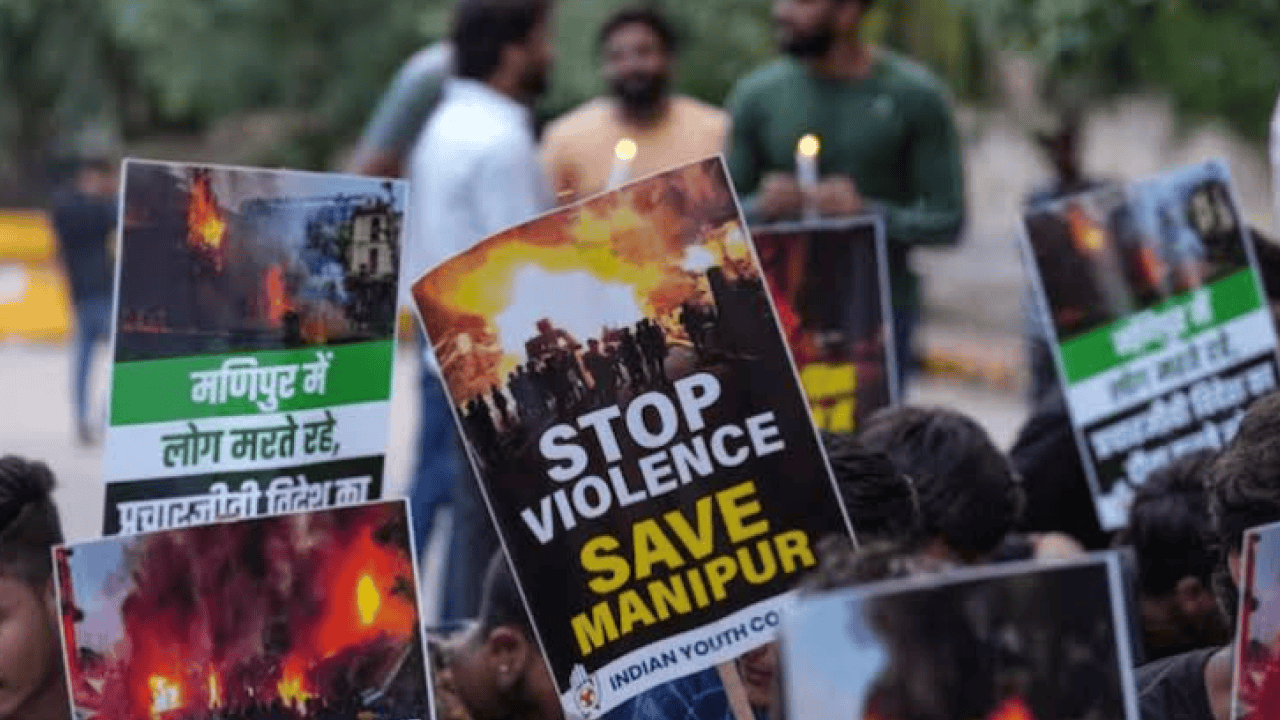
Violence has flared once again in Manipur’s sensitive hill region, with multiple villages in Kamjong district near the India–Myanmar border coming under coordinated arson attacks on July 1, 2026, according to multiple reports and official statements. The incidents involved the burning of homes in both Kuki-dominated and Tangkhul Naga villages, reigniting long-standing ethnic tensions between the two communities and triggering competing allegations of responsibility.
The latest escalation unfolded across villages including Phaimol, Shangkhalok, Huimin Thana, and Kherongram, located close to border pillars 101–113 in the Kamjong sector. While no casualties have been reported so far, dozens of homes and refugee shelters were destroyed, forcing civilians to flee and prompting urgent security deployments in the area.
Coordinated Attacks Across Border Villages
According to police and local accounts, the violence began around midday when unidentified armed individuals entered the largely deserted Kuki village of Phaimol and set fire to residential structures. Authorities say residents had already evacuated earlier amid rising tensions and were taking shelter in nearby safer locations.
Shortly after, retaliatory attacks were reported in nearby Tangkhul Naga villages, including Shangkhalok and adjacent settlements. Security forces intervened in some locations, preventing further spread of fire, though several houses were still damaged or destroyed before control was restored.
Eyewitness accounts cited in local statements suggest that armed groups crossed riverine border points and used surrounding forest routes to launch targeted attacks. Both communities claim the violence was premeditated and executed in quick succession.
Competing Claims of Responsibility
The incident has triggered an immediate and sharply divided blame game between Kuki and Naga civil and village organisations.
Kuki groups, including the Kuki Inpi Manipur and allied civil bodies, have alleged that armed cadres linked to the NSCN-IM and the Myanmar-based Shanni Nationalist Army were responsible for the burning of Phaimol village. They argue the attack reflects a broader pattern of repeated targeting of Kuki settlements across Kamjong and adjoining hill districts over the past year.
They also raised concerns about what they described as a security vacuum following the withdrawal of central forces from certain local posts shortly before the incident, claiming this left border villages vulnerable to armed incursions.
On the other hand, Naga village bodies have accused Kuki armed groups, including the Kuki National Army-B, of orchestrating coordinated attacks on Tangkhul villages such as Kongkan Thana, Shangkhalok, Huimin Thana, and Kherongram. They allege that multiple houses, including those sheltering displaced Burmese refugees, were deliberately set on fire in what they describe as a pre-planned offensive.
Neither set of allegations has been independently verified, and authorities have not officially identified the perpetrators.
Refugees and Civilian Infrastructure Also Hit
Beyond residential damage, reports indicate that camps housing hundreds of displaced persons from Myanmar were also destroyed in the violence at Kherongram. These shelters had been in place since 2023 and were reportedly accommodating over 300 refugees affected by ongoing instability in Myanmar’s border regions.
In some villages, thatched structures belonging to refugees and smaller community dwellings were among the first to be engulfed in flames, compounding the humanitarian impact of the clashes.
Rising Tensions After Earlier Killings
The latest unrest comes against the backdrop of already heightened tensions following earlier incidents in May 2026, when multiple killings, including those of church leaders and civilians, deepened mistrust between communities.
Subsequent protests, road blockades, and retaliatory incidents have kept the region on edge for weeks, with both Naga and Kuki organisations accusing each other of abductions, killings, and cross-border coordination with armed groups operating from Myanmar.
Security analysts note that the Kamjong–Ukhrul belt, which shares a porous border with Myanmar, has remained one of the most volatile zones in the state due to overlapping ethnic claims, insurgent presence, and difficult terrain.
Expert Analysis / What This Means
The renewed violence signals a dangerous re-escalation of ethnic hostilities in a region that has repeatedly seen cycles of retaliation.
The involvement of multiple armed groups across porous border zones complicates attribution and makes containment significantly harder for security forces.
Civilian populations, already displaced in earlier waves of unrest, are increasingly being drawn into the conflict through repeated village burnings.
The targeting of refugee shelters adds a new humanitarian dimension, raising concerns about secondary displacement into already fragile border corridors.
The pattern of “attack–counterattack” allegations suggests a breakdown of trust that is preventing any local-level de-escalation mechanisms from functioning.
If unchecked, the situation risks expanding beyond Kamjong into adjoining hill districts, potentially destabilizing wider parts of Manipur’s border belt.
What This Means for Security in the Border Belt
The Kamjong violence highlights the strategic vulnerability of villages along the India–Myanmar frontier, where terrain, limited infrastructure, and cross-border movement allow armed groups to operate with relative ease. Security forces are increasingly being tasked not just with responding to incidents, but also preventing retaliatory cycles that often unfold within hours of the initial attack.
Authorities are expected to review deployment patterns in vulnerable zones, particularly near abandoned or lightly guarded settlements. However, sustained stability will likely depend on whether political and civil actors from both communities can be brought into structured dialogue.
What Happens Next
Security forces are continuing patrols and damage assessments across affected villages, while police have registered cases and begun preliminary investigations.
Both Kuki and Naga organisations have appealed to the central and state governments for intervention, including stronger border management and accountability for armed groups allegedly operating from across the Myanmar frontier.
Further arrests or official attribution of responsibility could significantly influence whether tensions escalate or temporarily subside in the coming days.