
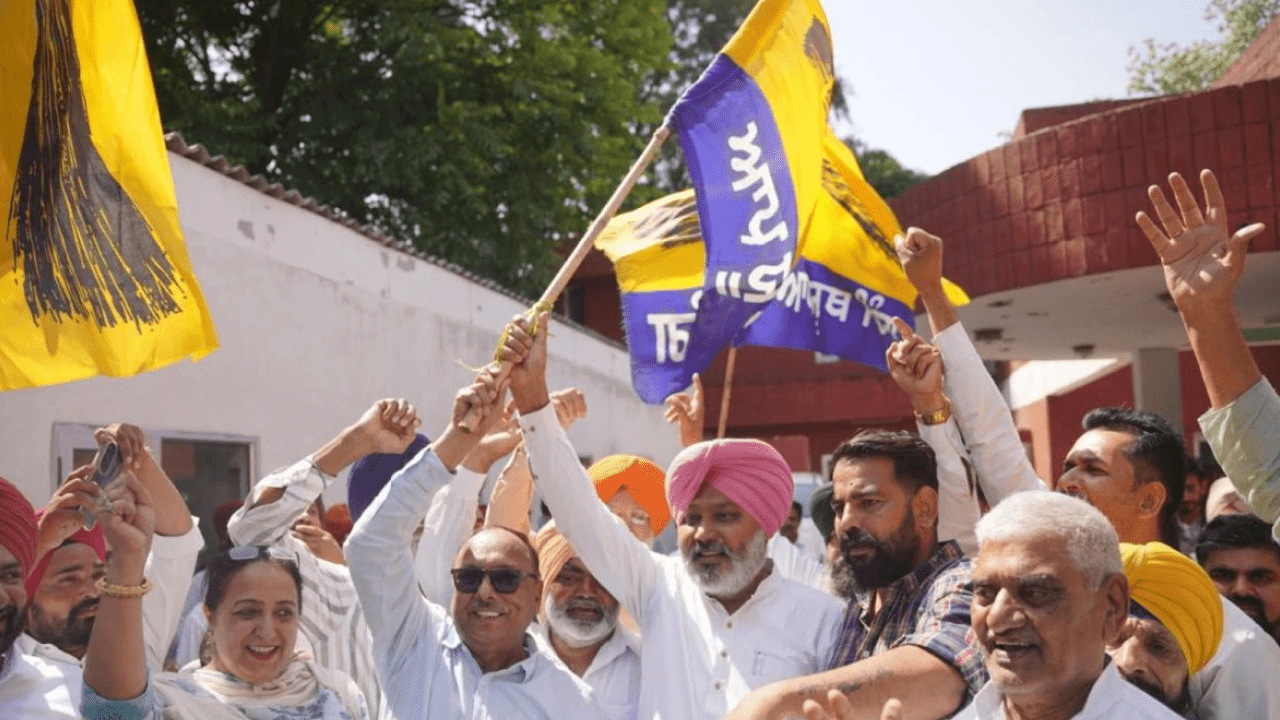
The Punjab civic poll results have delivered a major political boost to the ruling Aam Aadmi Party (AAP), which emerged as the clear winner across urban local bodies in the state, securing nearly half of all municipal wards and consolidating its position ahead of the crucial 2027 Assembly elections. The outcome is being widely viewed as an important political barometer, offering insight into voter sentiment midway through the Bhagwant Mann government’s tenure.
According to data released by the Punjab State Election Commission, AAP won 957 out of 1,977 wards contested across municipal corporations, municipal councils and nagar panchayats. The Congress finished a distant second with 397 wards, while Independent candidates secured 251 seats. The Shiromani Akali Dal (SAD) won 191 wards, and the Bharatiya Janata Party (BJP) managed 167 seats. The Bahujan Samaj Party (BSP) secured seven wards.
The elections were conducted on May 26 across 102 urban local bodies, including eight municipal corporations, 75 municipal councils and 19 nagar panchayats. More than 7,500 candidates contested the elections, which recorded a voter turnout of nearly 64 percent.
AAP leaders described the results as a strong endorsement of the state government’s development agenda and welfare initiatives. Party national convenor Arvind Kejriwal thanked voters for delivering what he called a historic mandate, while Chief Minister Bhagwant Mann said the electorate had rejected divisive politics and reaffirmed support for governance-focused policies.
The opposition, however, challenged the narrative surrounding the victory. Congress leaders alleged misuse of administrative machinery during the campaign, while opposition parties argued that the ruling party enjoyed an uneven electoral playing field.
Key Results Across Major Municipal Corporations
AAP recorded particularly strong performances in several major municipal corporations, securing decisive victories in Moga, Barnala, Bathinda and Batala. The party also emerged as the dominant force in Mohali, winning enough wards to establish a commanding presence in the civic body.
In Mohali, AAP crossed the majority threshold in the 50-member municipal corporation, reinforcing its growing influence in one of Punjab’s most strategically important urban centres.
Pathankot delivered one of the most closely watched contests of the election. Traditionally considered a BJP stronghold, the city witnessed a fragmented mandate with multiple parties competing closely for influence. The results highlighted shifting political dynamics in urban Punjab, where traditional voting patterns are increasingly being challenged.
AAP also posted a strong showing in Sangrur district, including Chief Minister Bhagwant Mann’s home constituency of Dhuri, where the party dominated local civic contests.
Expert Analysis / What This Means
The scale of AAP’s victory extends beyond municipal governance and carries significant implications for Punjab’s political landscape. These elections were widely viewed as a semi-final before the 2027 Assembly elections, making the results politically consequential for all major parties.
For AAP, the outcome strengthens the perception that the party continues to enjoy substantial grassroots support despite facing criticism and anti-incumbency pressures. The victory provides organizational momentum and a stronger local governance network that could prove valuable during future electoral campaigns.
For Congress, the results reveal that while it remains the principal opposition force, it still faces a considerable gap in converting voter dissatisfaction into electoral gains. The party’s second-place finish ensures relevance but raises questions about its ability to mount a serious statewide challenge.
The BJP’s performance is likely to trigger internal assessments, particularly in urban pockets where it had hoped to expand its footprint. Finishing behind Independents and the Akali Dal underscores the challenges the party faces in Punjab’s unique political environment.
The results also indicate that local governance issues, welfare delivery and organizational strength continue to play a decisive role in urban elections, often outweighing national political narratives.
Also read: Vijay Expands Tamil Nadu Cabinet as Congress Returns to Power Structure After Nearly 60 Years
Why This Matters
Municipal elections may not attract the same attention as Assembly or parliamentary contests, but they often serve as an important indicator of political trends at the grassroots level.
Control of municipal bodies enables parties to build local leadership networks, strengthen voter engagement and influence urban development priorities. Strong performances in civic elections can also help parties shape public perception ahead of larger electoral battles.
For AAP, retaining dominance in urban local bodies strengthens its governance credentials and provides a platform to showcase development initiatives before voters return to the polls in 2027.
The results also suggest that Punjab’s electorate remains open to rewarding performance at the local level, rather than strictly adhering to traditional party loyalties.
Key Figures and Data
- Total wards contested: 1,977
- AAP: 957 wards
- Congress: 397 wards
- Independents: 251 wards
- Shiromani Akali Dal (SAD): 191 wards
- BJP: 167 wards
- BSP: 7 wards
- Total urban local bodies: 102
- Municipal corporations: 8
- Municipal councils: 75
- Nagar panchayats: 19
- Voter turnout: 63.94%
- Candidates in fray: Over 7,500
What Happens Next
The immediate focus will shift to the formation of municipal administrations, including the election of mayors and civic leadership teams in key urban centres. These local bodies will play a central role in implementing development projects, managing urban infrastructure and delivering municipal services.
Politically, all major parties are expected to treat the results as a roadmap for future strategy. AAP will seek to capitalize on its momentum, while Congress, BJP and the Akali Dal are likely to reassess their organizational structures and voter outreach efforts.
With less than two years before Punjab heads toward another Assembly election cycle, the civic poll verdict has already begun shaping the political narrative. Whether this momentum translates into statewide electoral success in 2027 remains one of the most important questions in Punjab politics.